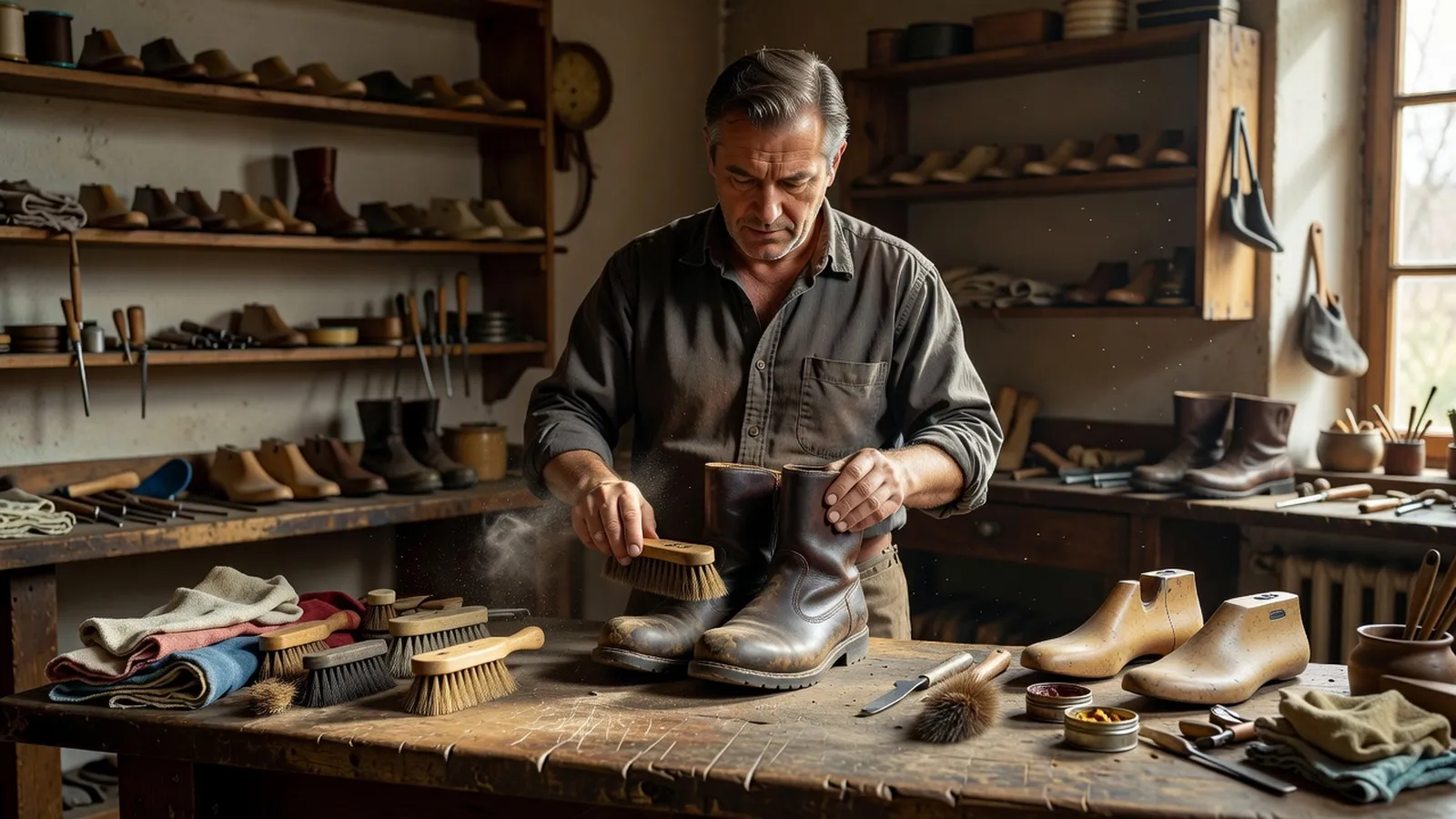
Clean salt off with a damp cloth or a mild rinse, brush suede when it is dry, spot-clean sheepskin gently with cold water and a wool wash, and let every wet boot dry slowly in moving air, never on a radiator. That is the common ground among the makers whose care pages we read for this guide. Where they differ, mostly on protector sprays, this page says so and names who recommends what.
Why winter is hard on boots
A boot that spends November to March on Canadian sidewalks faces three things at once: wet, cold and road salt. Wet and cold are obvious. Salt is the one people underestimate, and it is worth a short look at what it is before turning to cleaning.
According to Environment and Climate Change Canada, road salts serve across Canada as de-icers and anti-icers for winter road maintenance, and some are also spread in summer to keep dust down. The department's Code of Practice describes the salts it assessed as chloride salts (sodium, calcium, magnesium and potassium chloride), along with brines and other additives, and states that roughly 5 million tonnes are used on Canadian roads in an average year. The federal government also says it is not banning road salts and proposes nothing that would reduce road safety. Its concern is the effect of chlorides on the environment.
That last point matters for honesty. The federal pages we read say nothing about what salt does to leather, suede or sheepskin. The warnings about footwear come from boot makers, not from the government. Manitobah warns that salt is corrosive and can damage its footwear even when the boots have been sprayed with a protector. Pajar says salt can leave stains, corrode materials and compromise waterproofing. Those are manufacturers speaking about their own products, and this page attributes them that way throughout.
What follows is built on care pages from Manitobah, EMU Australia, Bearpaw, Pajar, Sorel, Kamik, Steger Mukluks and Baffin, plus general safety advice from Health Canada. For how we use sources, see our method. For the bigger picture on warmth and materials, the companion guide to sheepskin boots covers what the material is and why it behaves as it does.
Start by identifying the material
Care advice only makes sense once you know what the boot is made of, because the same treatment that rescues one material ruins another. A single pair can combine three or four: a rubber or synthetic outsole, a leather or suede upper, a wool or shearling lining, and felt or foam in between.
The Leather Working Group's glossary gives the vocabulary. It defines shearling as a sheep's tanned and dressed skin that keeps its original wool, trimmed to a fairly even length. It defines nubuck as leather buffed to a velvety finish while the grain pattern stays visible, and suede velours as a surface mechanically finished to raise a velvet-like nap. In practice, if your boot feels velvety on the outside, treat it as suede or nubuck. If it is smooth, it is leather. If the wool shows on the inside, the lining is shearling.
The table below pulls together what the makers in our sources say. It is a map, not a rulebook: your own boot's care page overrides it.
| Material | Cleaning, as the maker says | Drying | Watch out |
|---|---|---|---|
| Suede and nubuck | Pajar: suede brush, suede eraser or a vinegar-and-water mix on stains, blot rather than rub | Pajar: air-dry, then brush again to lift the nap | Manitobah: untreated suede is not waterproof; Pajar: test any solution on a hidden area first |
| Smooth leather | Manitobah: gentle soap and a soft brush; wipe salt with a damp cloth | Manitobah: let wet footwear dry naturally | Manitobah: salt stays corrosive even after a protector spray |
| Sheepskin and shearling | EMU: spot-clean with a little cold water and a wool wash, dabbed with a clean cloth | EMU: no heat drying; heat shrinks and reshapes the material | EMU: vigorous scrubbing can remove lanolin and natural oils; no washing machine |
| Rubber and synthetic boots | Kamik: rinse with lukewarm water; Sorel: wipe with a clean, damp cloth | Both: air-dry, away from heaters and fireplaces | Kamik: no washing machine, and no sprays or coatings on its boots |
| Mukluk leather parts | Steger Mukluks: brush off dried dirt, treat salt marks with a de-salting product | Steger: avoid excess heat | Steger: never store in a plastic bag |
Removing salt, step by step
Salt is the most common reason a winter boot looks tired by February: pale, uneven rings along the welt and toe, stiff leather, a rough crust on the lining at the ankle. The makers in our sources agree on the principle (remove it soon and gently) but suggest different tools.
The gentle methods
Manitobah's approach for its leather is the simplest: wipe the salt off with a damp cloth, and use gentle soap with a soft brush for general cleaning. Sorel describes its routine cleaning the same way, a light wipe with a clean, damp cloth, then air drying.
Kamik, whose boots are built differently, says they should be rinsed with lukewarm water to remove dirt and salt after the winter or after heavy use, then air-dried at room temperature. Steger Mukluks suggests brushing dried dirt off leather parts first and treating salt stains with a de-salting product, rather than rubbing mud and salt into the surface.
The vinegar option
Pajar goes a step further. For salt deposits on its winter boots, it suggests spot-cleaning with a solution of white vinegar and water, applied after testing on a hidden area. Notice the order in that advice: test first, treat second. A solution that is harmless on one leather finish can mark another, and the maker is the only party in our sources that has tested its own materials.
This is also where a warning belongs. The internet is full of home recipes for salt stains, from dish soap to baking soda to mixtures nobody can trace. We do not include any that a maker has not published. If your boot's maker does not mention a method, the safe route is the mildest one (a damp cloth), a conversation with the maker or a cobbler, and patience.
Timing
None of our sources gives a number of days or wears after which salt must be removed, so we will not invent one. The logic across all of them is the same: salt is corrosive, so shorter contact is better. A quick wipe at the door after a salted day is easier on the boot than a deep clean in March.
Suede and nubuck
Suede and nubuck are the materials that make people nervous, and with reason. Manitobah says most of its suede and leather is untreated and should not be considered waterproof; only the styles it labels waterproof are sealed. Its suede and leather are porous and need to breathe, which is part of how they perform in extreme cold.
Pajar's routine for suede has four beats. Brush with a suede brush. For stains, use a suede eraser, or a vinegar-and-water mixture, blotting instead of rubbing. Let the boot air-dry. Then brush again to restore the nap. The two things worth taking from this are the verb (blot, do not rub) and the final brushing, which brings the velvety surface back after it has been flattened by moisture.
Manitobah's protection advice for non-waterproof suede and leather is a silicone-based leather or suede protector. Bearpaw advises applying a stain and water repellent made for suede to every one of its sheepskin and suede products before they are first worn, except styles that already come with BearCoat. These two recommendations point the same way: protect suede before the season, not after the first soaking.
What to avoid on suede
- Heat to speed up drying. Pajar says direct heat can warp or crack materials, and Manitobah says wet footwear should dry naturally.
- Rubbing a wet stain. Pajar says to blot.
- Anything you have not tested on a hidden area. Both Pajar and EMU make this point for their own products.
- Salt left to dry in place, since Manitobah and Pajar both describe salt as corrosive to their footwear.
Smooth leather
Smooth leather is the most forgiving of the three, but it is not indestructible. For Manitobah's leather, the maker suggests gentle soap, a soft brush and a damp cloth for salt. Pajar's drying advice applies equally here: a well-ventilated spot, out of direct sun, away from radiators, with the boot stuffed with crumpled newspaper or a boot shaper so it keeps its form while it dries.
Steger Mukluks offers a useful reminder for boots that mix leather with other parts: brush off dried dirt before doing anything wet. Dried mud dissolves into a slurry when you add water, and the slurry is what stains. A dry brush first is cheap and reduces what the damp cloth has to deal with.
Baffin, in a maintenance guide aimed at its industrial boots, adds an inspection habit that suits any boot: look for worn soles and loose stitching, and deal with damage promptly. Cleaning a boot with a failing seam is a short-term fix. Which brings us to repairs, discussed below.
Sheepskin and shearling
Sheepskin is where care advice is most distinctive, because the material is a skin and a fleece at once. The Woolmark Company, speaking about wool generally, says that wool that gets wet should be dried at room temperature, away from direct sun or heat. Its advice on garments (brush with a soft brush after wearing, air them to dispel odours, rest them between wears) is garment advice, not boot advice, so treat it as an idea, not a procedure.
For boots specifically, EMU Australia is the clearest in our sources. Its guidance has four parts:
- Spot-clean rather than wash. Use a small amount of cold water blended with wool wash, and apply it by dabbing with a clean cloth.
- Never put sheepskin boots or slippers in a washing machine.
- Test any cleaner on a small hidden area first, and clean gently, because vigorous scrubbing can remove the lanolin and natural oils in the sheepskin.
- Do not dry with heat. Warm water or heat will shrink the material and change its shape.
Manitobah adds two cautions for its fur and sheepskin: do not pull on the fur, and do not expose it to abrasive chemicals or salts. It also asks owners to keep sprays off the fur and sheepskin, because the maker says they hold natural oils that protect them. Manitobah describes shearling footbeds in most of its mukluks, and says the sheepskin moulds to the shape of the foot. That moulding is one reason to avoid soaking the interior or wringing it out.
Steger Mukluks says its mukluks should not be machine-washed, machine-dried or dry-cleaned. It also names a temperature ceiling of 90 °F (about 32 °C) above which excessive heat will damage them. That figure belongs to Steger's own mukluks; it is not a universal rule for sheepskin, and we do not know of a published threshold from the other makers. The principle, though, is shared: heat is a bigger risk than patience.
For more on how the material compares with leather and felt, the same guide goes into detail.
Drying: the one rule everyone shares
If a single instruction appears in nearly every care page we read, it is this one: dry slowly, in air, away from heat.
- EMU says warm water or heat will shrink sheepskin and change its shape.
- Pajar says to dry boots in a well-ventilated area, out of direct sunlight and away from radiators or heaters, with crumpled newspaper or a boot shaper inside, since direct heat can warp or crack materials.
- Sorel says boots soaked by rain or snow should be left where air moves freely until fully dry.
- Kamik says to air-dry at room temperature, away from heaters and fireplaces.
- Manitobah says wet footwear should dry naturally.
- Woolmark, on wool, says room temperature and no direct sun or heat.
None of these sources gives a number of hours, and boots vary too much for us to supply one. A practical reading: if a boot still feels cool and damp inside, it is not dry. Pulling a wet boot onto a cold foot the next morning is a good way to start a bad day.
A practical reading of Pajar's tip is also worth keeping: the newspaper or shaper is not just there for moisture. It keeps the shaft upright so the boot does not fold and crease as it dries.
Protector sprays: where the makers disagree
This is the part of boot care where a single "right answer" does not exist, and the sources are blunt about it.
| Maker | Position on protector sprays |
|---|---|
| Manitobah | Recommends a silicone-based leather or suede protector for its non-waterproof suede and leather. Does not want fur or sheepskin sprayed. Warns salt can still damage boots that have been protected. |
| Bearpaw | Recommends a suede stain and water repellent on all its sheepskin and suede products before first wear, unless the style has its BearCoat treatment. |
| Kamik | Does not recommend waterproofing sprays, chemical treatments or coatings on its boots, saying they can damage the materials and affect performance. |
Read together, the disagreement makes sense: Kamik's boots are a different construction from a suede or sheepskin boot, and what protects one material can harm another. The lesson is not to pick a side. It is to read the instructions for your own boot and, when they are silent, to treat a spray as a decision, not a default.
Bearpaw's published steps for its water-resistant spray are a reasonable template for anyone who does decide to use one: work in a well-ventilated area, begin with clean, dry shoes, apply an even coat that stops short of soaking the material, then leave them a full 24 hours to dry. Note again the order. Cleaning comes first, because a protector sealed over salt locks the problem in.
Aerosol safety
Spray protectors are usually aerosols, and aerosols have their own rules. Health Canada's chemical safety guide for art-class teachers describes aerosol products as using compressed gas to spray a coating. It notes that their small particles can enter and remain in the airways if inhaled, and that they are highly flammable. It advises short bursts, a well-ventilated area, distance from flames and children, reading and following the label, and choosing non-aerosol products where possible.
Two caveats are worth making plain. That guide is written for art-class products, so its advice is general, not specific to boot sprays. And we did not find a Health Canada page dedicated to footwear waterproofers, so we cannot tell you what the agency says about any particular product. What we can say is what its general household-chemical advice says: read the label and follow every instruction, open windows or use exhaust fans during and after use, take fresh-air breaks, wear the recommended protective equipment, wash your hands afterwards, and keep products tightly closed in their original containers, out of sight and reach of children and pets.
For a sheepskin-lined boot, the practical result is a short list: spray outdoors or by an open window, never near a flame, never on the fur, and not at all if your maker's instructions say no.
Repairs and the cobbler
A well-cleaned boot with a split seam is still a failing boot. Two makers in our sources point to the same professional.
Kamik recommends seeing a cobbler for any repair, saying do-it-yourself fixes or glue can damage the materials and may void the warranty. Pajar suggests visiting a local shoemaker before putting boots away for the season, so that any damage needing repair is identified while there is time to deal with it.
Baffin's inspection list supplies the things to look for: worn soles and loose stitching, handled promptly. Combine the two, and the end-of-season routine writes itself: clean the boots, dry them, inspect them, and take them to a cobbler if anything needs more than cleaning.
We did not find a Canadian cobbler association with an authoritative page on resoling or repair, so we cannot give a list of repairable defects, an expected lifespan, or a price. The makers' warranty terms are the place to start. If you are unsure whether a repair would affect a warranty, ask the maker before you or anyone else glues a thing.
Storing boots for the off-season
Off-season storage is where careful owners lose boots they have looked after all winter. Three makers give guidance that fits together:
- Clean and dry first. Manitobah suggests cleaning the boots and letting them dry completely.
- Closed container, away from heat, moisture and pets. Manitobah suggests a sealed container with something in the shaft to keep it upright.
- Cool, dark, steady. Pajar suggests a dark room at a consistent, cool temperature. Baffin recommends a cool, dry place away from direct sun.
- No plastic bags. Steger Mukluks warns against them, because residual moisture can cause problems.
One nuance: Manitobah recommends a sealed container, Steger warns against a plastic bag. They are not in contradiction, since a bag traps whatever moisture is left in a boot and a rigid container with fully dry boots is a different situation. But it is another reason the "fully dry" step has to be real, not hopeful.
Seasonal routines for Canadian conditions
The climate pages of Environment and Climate Change Canada are the right place to understand how winter varies between regions, and our companion guide to winter boots for the Canadian climate sets out how that shapes choices. For care, the practical difference between regions is how much salt and slush a boot meets, and none of our sources quantifies that. So here are three typical situations, built on the makers' advice, with no measurements invented.
A salted weekday commute. The boots meet slush at the curb and salt on the pavement. The Manitobah, Sorel and Pajar instructions suggest the same low-effort habit at the door: brush off dry dirt, wipe off salt with a damp cloth, and set the boots where air moves, not on a heater.
A sodden afternoon. The boots have been soaked through. Sorel says to leave soaked boots where air moves freely until fully dry. Pajar adds crumpled newspaper or a shaper. For sheepskin, EMU says no heat. If the lining is wet, wait; do not try to rush it.
The end of the season. Rinse or wipe off salt according to the maker's instructions (Kamik's lukewarm rinse for its boots, Manitobah's damp cloth for its leather), dry fully, inspect (Baffin), see a cobbler about anything that needs repair (Kamik, Pajar), and store in a cool, dark, dry place without plastic (Pajar, Steger).
Wardrobe decisions interact with care, too. A person who rotates between two pairs gives each pair days to dry, which is the one thing the makers' drying advice rewards. For the broader picture of dressing for cold, see our layering guide..
Common mistakes, according to the makers
- Machine washing. EMU, Kamik and Steger Mukluks each rule it out for their products.
- Heat drying. Ruled out by EMU, Pajar, Kamik, Steger and Woolmark (for wool).
- Scrubbing hard. EMU says vigorous scrubbing can strip natural oils from sheepskin; Pajar says to blot suede.
- Spraying the fur. Manitobah says not to.
- Leaving salt in place. Manitobah and Pajar both describe it as damaging.
- Storing damp boots, or storing in plastic. Steger Mukluks and Manitobah.
- Home-glue repairs. Kamik says they can damage materials and void the warranty.
- Skipping the label on a spray. Health Canada's general advice is to read and follow it, and to ventilate.
What this guide does not cover
A fair care guide has to say where its evidence stops. The sources we read are the care pages of Manitobah, EMU Australia, Bearpaw, Pajar, Sorel, Kamik, Steger Mukluks and Baffin, the Woolmark Company's general wool advice, the Leather Working Group's glossary, and the federal pages from Environment and Climate Change Canada and Health Canada.
The gaps are real. Pajar, Kamik, Sorel and Baffin write about their own products, which are not sheepskin boots, so their advice reaches this page as advice from those makers, never as a rule for sheepskin. We could not read an official care page from the best-known sheepskin boot brand, because it was not available to us in the format we needed, so nothing here is drawn from it. We found no independent test comparing cleaning methods. And Manitobah's full product care guide and repairs page were not available to us, only its FAQ.
If your boots came with a care card, that card is the best source. If they did not, the maker's site is the next. If neither helps, a cobbler can often tell more from the material in your hand than any general article can. And if you are unsure whether a pair is genuine or comes with a warranty at all, our guide to spotting fakes and buying safely explains how to check before you invest in cleaning products.
Frequently asked questions
How do I get salt stains off winter boots?
Makers give slightly different answers. Manitobah suggests wiping salt off with a damp cloth, Pajar suggests a white vinegar and water solution tested first on a hidden spot, Steger Mukluks mentions a de-salting product for its leather parts, and Kamik says to rinse its boots in lukewarm water. Match the method to your boot's material and the maker's own page.
Can sheepskin boots go in the washing machine?
EMU Australia says its sheepskin boots and slippers should not go in a washing machine and suggests spot-cleaning with a little cold water and a wool wash. Kamik and Steger Mukluks also rule out machine washing for their products. Check the care page of your own boot's maker.
Is it safe to dry wet boots next to a heater?
Several makers advise against it. EMU says heat shrinks and reshapes sheepskin, Pajar says direct heat can warp or crack materials, and Kamik says to keep boots away from heaters and fireplaces. Their shared advice is to dry boots in moving air at room temperature.
Should I use a waterproofing spray on my boots?
It depends on the maker. Manitobah and Bearpaw recommend a protector for suede and sheepskin styles (Manitobah says not to spray the fur itself), while Kamik does not recommend sprays or coatings on its boots. Read your boot's care instructions first and follow the product label, in a ventilated space.
How should winter boots be stored over summer?
Manitobah suggests cleaning the boots, drying them fully and keeping them in a closed container away from heat, moisture and pets, with a support in the shaft. Pajar suggests a dark room at a steady, cool temperature, and Steger Mukluks warns against plastic bags.
Sources
Verified on
- Manitobah Mukluks, Frequently Asked Questions (FAQ), Manitobah Mukluks, 2026.
- EMU Australia, Care & Cleaning (support article), EMU Australia, 2026.
- Bearpaw (site canadien officiel), Bearpaw Technology and Care, Bearpaw (site canadien officiel), 2026.
- Pajar, Cleaning Winter Boots: A Pajar Maintenance & Care Guide (5 août 2024), Pajar, 2024.
- Sorel, What are the care instructions for your products?, Sorel, 2026.
- Kamik, FAQs (Product Care & Use), Kamik, 2026.
- Steger Mukluks, How To Tie, Clean & Care, Steger Mukluks, 2026.
- Baffin, Essential Tips for Maintaining Your Industrial Boots (7 août 2024), Baffin, 2024.
- Environnement et Changement climatique Canada, Road salts overview / Aperçu sur les sels de voirie, Gouvernement du Canada, 2023.
- Environnement et Changement climatique Canada, Code of Practice for the Environmental Management of Road Salts / Code de pratique pour la gestion environnementale des sels de voirie, Gouvernement du Canada, 2022.
- Santé Canada, Information for Art Class Teachers: Chemical Safety / Information à l'intention des professeurs d'arts : sécurité chimique, Gouvernement du Canada, 2026.
- Santé Canada, Use household chemicals safely / Utilisation sécuritaire des produits chimiques ménagers, Gouvernement du Canada, 2026.
- Woolmark (The Woolmark Company / Australian Wool Innovation), Caring for Wool, Woolmark (The Woolmark Company / Australian Wool Innovation), 2026.
- Leather Working Group, List of Definitions, version 1.1 (January 2024), Leather Working Group, 2024.