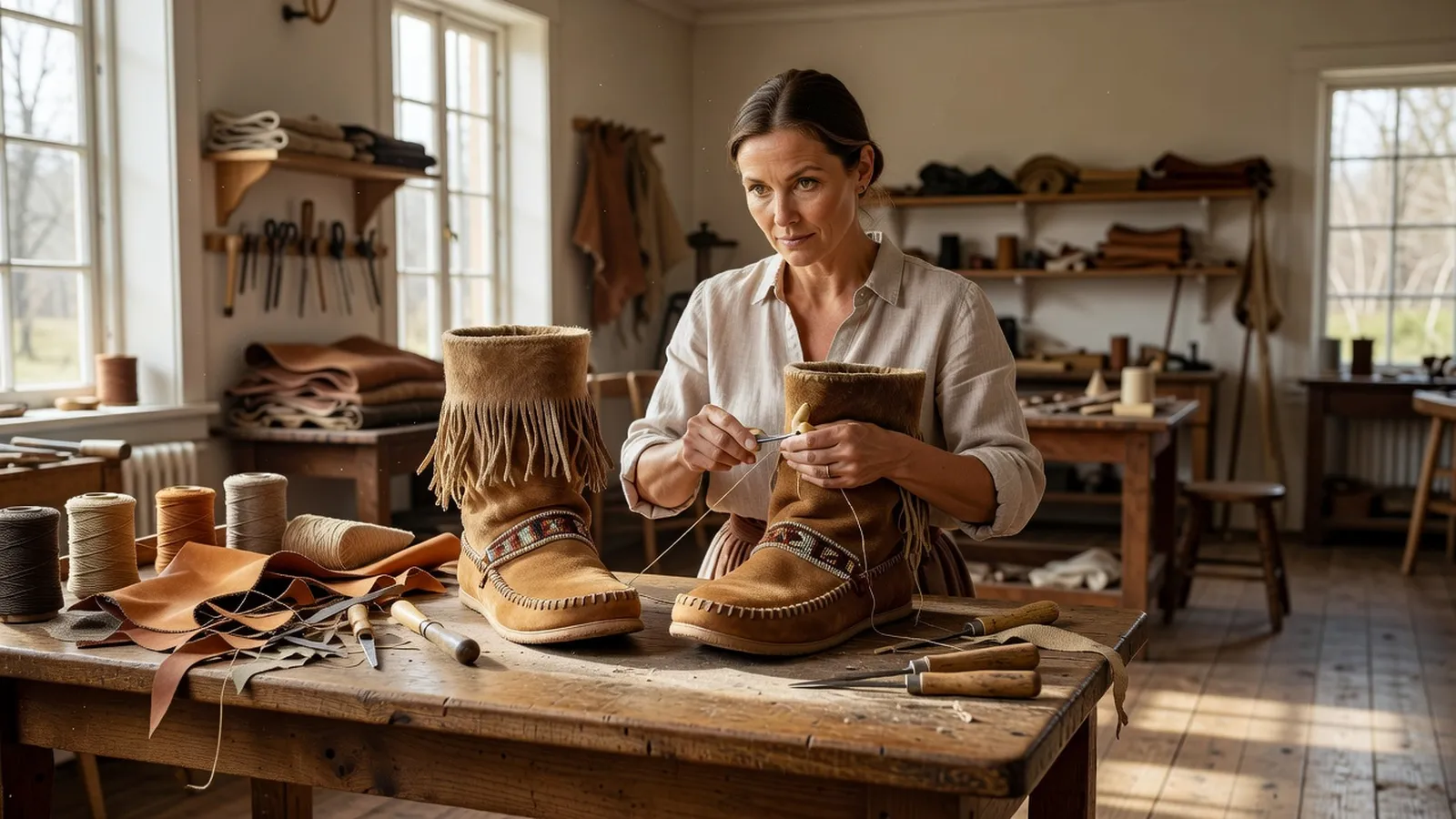
Canada has more winter boot makers than most shoppers can name, and the claims around them are not all equal. A company can be founded in Winnipeg or Montréal, design in Ontario and manufacture elsewhere. This guide sets out seven makers with Canadian roots, taken from their own pages, with the exact nuance each one writes, then shows how to read an origin label and how to judge a maker without relying on a slogan.
How this guide was built
The rule here is simple: a fact about a company appears only if the company's own page says it. Founding dates, home towns, owners and ranges come from the "about" or "story" page of each maker. Where a page is silent, the guide writes "not specified by the source" and leaves it there. A silence is not a denial, and it is not a confirmation either.
That discipline matters because origin is the easiest thing to blur in footwear. A brand name, a maple leaf and a Canadian address can sit next to a product assembled in a different country. None of that is necessarily improper, but it changes what a reader should conclude. The sections below keep three questions apart: where the company comes from, where the boots are manufactured, and what kind of boot the company mainly sells.
There is no ranking in this guide, no price and no link to a shop. When a maker's page is linked, it is there as the source of a fact, nothing more. The method used across the site is described on the about and method page.
Seven makers at a glance
The table gives each maker's Canadian origin as its own page writes it, the place of manufacture only where the page states it, a date only where one is written, and the type of boots described. The order is not a ranking.
| Maker | Canadian origin, as the source writes it | Manufacture | Date | Type of boots | Source |
|---|---|---|---|---|---|
| Manitobah | Based in Winnipeg, Manitoba; started from a trading post run by Sean McCormick, a Métis entrepreneur | Not specified by the source | Company founded in 1997; trading post in 1990 | Mukluks and boots described as Indigenous-designed | Manitobah, Our Story |
| Kamik | Founded on the South Shore of Montréal | Plants in Québec, Canada; 70 % of footwear made in North America | 1890s | Winter boots within a family range that also includes rain boots, clogs and sandals | Kamik, About |
| Baffin | Founded by the Hubner family in Stoney Creek, Ontario, where it is still based | One collection is labelled made in Canada; the rest of the range is not said to be | 1979 | Technically advanced cold-climate footwear and apparel | Baffin, Our Story |
| Pajar | Montréal brand with Canadian heritage; factory opened in Montréal's Plateau district | Not specified for current production; pattern making and styling done in-house, materials sourced worldwide | Founded 1963; own factory 1973 | Performance footwear and winter boots | Pajar, The History of Pajar |
| Cougar | Foundation laid in Burlington, Ontario | Not specified by the source | No founding year given | Waterproof, insulated, slip-resistant footwear for harsh Canadian winters | Cougar, Our Story |
| Acton | Started by Alfred Lambert, a Québec businessman, first in Acton Vale | Not specified by the source | 1928; trademark of Chaussures Régence Inc. since a 2004 acquisition | Winter boots, overshoes, rain boots and work footwear | Acton Canada, Brand |
| Kodiak | Calls itself Canada's boot maker; predecessor started in Berlin (now Kitchener), Ontario | Not specified by the source | Since 1910 | Not described on the timeline page read | Kodiak, Timeline |
Two cautions before reading the notes. First, a company date is the date the company gives, and old brands sometimes trace themselves through several owners. Second, the "type of boots" column reflects the page read, which is often a corporate history rather than a product catalogue.
Maker notes
Manitobah: from a trading post to a certified company
Manitobah states that it was founded in 1997 and is based in Winnipeg, Manitoba. Its story goes back further: Sean McCormick, a Métis entrepreneur, built a trading post in 1990 where Indigenous artisans exchanged handmade mukluks and moccasins for leather and furs. The company describes its products as Indigenous-designed mukluks and boots and places its headquarters on Treaty 1 Territory.
Two further details are worth keeping apart. The company reports becoming a certified B Corporation in 2023, which is a statement about corporate governance and reporting, not about where boots are manufactured. And the page does not say where the boots are made. A reader who wants that answer has to ask the company or read the product page of a given model.
Kamik: Québec plants, a North American figure
Kamik says it was founded in the 1890s on the South Shore of Montréal and that it has made durable footwear for over 125 years. It says its footwear is produced in plants in Québec, Canada. Then comes the nuance that the rest of the page requires you to carry: 70 % of its footwear is made in North America. The figure covers the continent. It cannot be read as 70 % Canadian, and the page does not break it down by country.
On range, Kamik lists winter boots inside a family collection that also holds rain boots, clogs and sandals. That is a different profile from a maker devoted entirely to cold-weather boots, and neither profile is better in itself; it simply tells you how much of the company's attention winter occupies.
Baffin: engineered in Canada, one collection made here
Baffin says the Hubner family founded it in 1979 in Stoney Creek, Ontario, where it is still based. Its focus, in its own words, is technically advanced cold-climate footwear and apparel, and its tagline reads "Engineered in Canada. Tested Worldwide." Read that tagline precisely: it speaks of engineering, not of manufacturing.
Ownership has moved. Baffin reports that it joined Canada Goose in 2018 and, in 2026, became part of L.P. Royer inc., a Canadian family-owned footwear company. On manufacturing, its site has a collection labelled as made in Canada, kept apart from the rest of the range. The maker does not say its whole range is made in Canada, and this guide does not say so either.
Pajar: a Montréal brand, in-house design
Pajar says Paul Golbert founded the brand in 1963 and that the name draws on the first letters of the names Paul, Jacques and Rachel. In 1973 he opened his own factory in Montréal's Plateau district, according to the company. Pajar presents itself as a Montréal brand of performance footwear and winter boots with Canadian heritage, and the page does not claim that all production takes place in Canada.
Its quality page adds a distinction that is useful to remember: pattern making and styling are done in-house, while materials are sourced worldwide. In footwear, the designing of a boot and the sourcing of its materials are different steps from where it is assembled, and labels can speak about any of them.
Cougar: Burlington roots, few dates
Cougar's story page says the foundation of the brand was laid in Burlington, Ontario, with a focus on footwear for harsh Canadian winters. It gives no founding year, so none is given here. It describes its range as waterproof, insulated and slip-resistant footwear and publishes temperature ratings on a separate page. The page does not state where the boots are manufactured.
Acton: rubber footwear from Acton Vale
Acton states that Alfred Lambert, a Québec businessman, started it in 1928 to make rubber footwear, first in Acton Vale, Québec. It now describes itself as a registered trademark of Chaussures Régence Inc. since its 2004 acquisition, and as known for winter boots, overshoes, rain boots and work footwear. The brand's roots are Québécois on the page; the page does not tell where today's production happens. The ownership line is a good example of why a historical origin and a current manufacturing site are separate questions.
Kodiak: a long timeline
Kodiak calls itself "Canada's boot maker" and dates that claim to 1910. The firm it grew from was set up in Ontario, in the town then called Berlin and now Kitchener, with Charles E. Greb among its co-founders, under the name Berlin Shoe Mfg. Co. Ltd. The timeline says Greb bought the company owning the Kodiak trademark in 1959, and that Kodiak became part of Workwear Outfitters in 2021. The timeline page read for this guide does not describe the current range in detail. The name of the owner suggests an orientation toward work footwear, but that is an inference from a company name, not a statement from the page, so confirm the range on the maker's own site before counting on it for a particular use.
Mukluks: what the Canadian Encyclopedia says
Mukluks deserve their own section because they sit apart from industrial boot brands. The Canadian Encyclopedia presents them as supple hide footwear that Inuit designed to stay warm and allow free movement in the North, and traces the word to the Yupik maklak, meaning "bearded seal". The same article notes that modern styles often have rubber soles and that European explorers and traders adopted mukluks in the 17th century.
Manitobah's page offers a related but distinct statement: it presents the mukluk as the original winter boot, designed about 10,000 years ago by Indigenous peoples to stay warm. That is the company's presentation of history, and it is attributed here as such. The encyclopedia entry is the neutral reference for what a mukluk is and who designed it.
For a buyer, the encyclopedia's note about rubber soles is practical. A traditional soft sole and a rubber sole behave differently on a wet or icy sidewalk, and the choice depends on whether the boot is meant for slow walking in dry snow or for city slush. Winter conditions across the country vary widely, which is the subject of the guide to winter boots for the Canadian climate.
Reading an origin label
Because some brand histories blur origin, it helps to know what the federal competition regulator actually says. The Competition Bureau's page on "Made in Canada" claims sets out several points, and they are easier to remember when split into short rules.
First, a business is not required to state a product's country of origin. If it chooses to, the claim must be accurate and truthful.
Second, for a "Made in Canada" claim, the Bureau generally will not challenge it when at least 51 % of total direct production or manufacturing costs were incurred in Canada. The claim also requires that the last substantial transformation took place in Canada. And a qualifying statement has to accompany it, such as "Made in Canada with imported parts", or the version that mentions both domestic and imported parts.
Third, "Product of Canada" is a higher bar. At least 98 % of total direct production or manufacturing costs must be incurred in Canada, and the last substantial transformation must occur in Canada.
Fourth, the Bureau does not approve or certify these claims. It recommends terms such as "Assembled in Canada" or "Designed in Canada" when the criteria are not met. The business makes the claim and answers for it.
Fifth, the Bureau judges a claim by its general impression, which includes images or symbols such as a maple leaf, not only the literal words. A boot with a prominent leaf and no qualifying wording can therefore still raise a question.
The enforcement guidelines were first published in 2009 and updated after the 23 June 2022 amendments to the Competition Act, and the guide page shows a modification date of 2025-03-17. Rules change, so the Bureau's own guidance is the place to confirm the current text. This section describes what the Bureau publishes; it is not legal advice.
A short method for reading a label
- Find the exact phrase: "Made in", "Product of", "Assembled in", "Designed in" or "Engineered in". Each says something different.
- Look for the qualifying statement. A "Made in Canada" claim is expected to carry one.
- Separate the company from the product. A Canadian company can sell a boot manufactured in another country, and the reverse.
- Treat a symbol as part of the claim. The Bureau considers the overall impression.
- When the label and the product page disagree, write to the maker and keep the answer.
Fake or misleading listings are a separate problem, handled in the guide to spotting fakes and buying safely in Canada, which focuses on vendors, labels and recourse.
Why a company page can be more careful than it looks
Read the maker notes again with the label rules in mind. Baffin's phrase is "Engineered in Canada", and a separate collection carries the made-in-Canada label. Kamik gives a regional figure, not a national one. Pajar separates in-house patternmaking from worldwide material sourcing. These are carefully worded statements, and careful wording is what a reader should look for. A page that avoids a sweeping claim is often better evidence of a reliable maker than a page that makes one.
Nothing in this guide says any maker has broken a rule. It says the opposite: the pages, as summarized, tend to stay inside what they can support. The reader's job is to stay inside it too, and not to read "Canadian" as shorthand for "made in Canada".
How to choose a maker or a craftsperson
Choosing among makers is less about the maker's rank than about the fit between a boot and a use. The following questions work for a large company and for a small workshop alike.
What is the boot for? A walk to a bus stop, a shift outdoors, a weekend on the lake and a night at an outdoor rink ask different things of a boot. Occupational-health guidance from the Canadian Centre for Occupational Health and Safety says the best match for demanding work in the cold is a leather-topped boot with a rubber base, felt lining and removable felt insoles, since sweat can evaporate through leather (a work context, not a city one). The same source warns that fully waterproof boots protect from slush but trap sweat, which can wet the insulation faster. These are reminders that a feature is a trade-off, whoever makes the boot.
What does the temperature rating mean? Ratings are set by each maker. Kamik's product page for its Nation Plus men's boot states a rating of -40 °C, a removable liner with 145 g HeatMX insulation, seam-sealed waterproof construction and a self-cleaning-lug outsole; the page does not describe the test method behind the number, and this guide has not verified it. Baffin defines its "Polar Rated" category as comfort during moderate activity, at 55 to 69 % of maximum heart rate, in places that have recorded -45 °C to -60 °C, a category it says rests on its own testing team at the North and South Poles. Two numbers that look comparable are built on different definitions, and no shared standard was found for boot ratings in the sources read. Compare the definition, not just the figure.
How will it fit with real socks? The same occupational guidance says to try boots on with the type of sock you will actually wear, because socks that are too thick compress inside the boot, lose insulation and squeeze the foot. A boot that fits only with thin socks is a boot with a hidden limit. How socks and other layers work together is covered in the guide to dressing for winter.
What will the maker say about where it was made? Ask for the specific model's origin in writing and compare it with the phrases above. A maker that answers precisely, including "not all of our range is made in Canada", is giving useful information.
What happens when the boot wears out? See the next section.
Choosing a craftsperson
Small workshops, including makers of mukluks and moccasins, make a different bargain. The guide's sources do not name individual craftspeople, and none is presented here. What can be said in general is what to ask: where the hides come from and how they are treated, whether the sole is soft or rubber, whether the maker can resole or patch, what the lead time is, and how the boot should be cared for. A craftsperson who answers each question plainly deserves the same scrutiny as a large company, applied the same way.
Manitobah's own account gives one historical reference point: its beginnings are in a trading post where Indigenous artisans exchanged handmade mukluks and moccasins. A reader interested in handmade work can start from that kind of exchange of materials and skill, while checking each claim against the maker.
Repair, care and durability
A boot's lifespan depends on what is built into it and how it is treated afterwards. The facts gathered for this guide do not cover repair services offered by any of the seven makers, so this section stays qualitative and asks the reader to confirm with the maker.
Some design features help in practice. Kamik's Nation Plus page lists a removable liner, which can be taken out and dried separately from the shell. Baffin describes the Impact boot as having a removable multi-layer inner boot. Removable linings are not a guarantee of durability, but a liner that comes out is easier to dry, and a damp liner is a common reason a warm boot stops being warm. Mukluks with rubber soles, as the Canadian Encyclopedia notes about modern styles, raise a question to put to the maker: can that sole be replaced?
Care itself, including cleaning, drying, and what to avoid with salt and heat, is covered in the guide to boot care and cleaning. Following a maker's own care instructions matters more than any general tip, and a maker's silence on repair is itself a reason to ask before buying.
Durability, finally, is partly a question of use. A boot worn daily on salted city pavement ages differently from one kept for weekends in dry snow, and a pair rotated with a second pair has time to dry. These are everyday observations, not measured claims, and no figure on boot lifespan is offered here.
Names left out, and why
Readers may notice that some well-known names are missing. They are missing because their Canadian origin could not be confirmed from a primary source read for this guide, not because they are known to be foreign.
- Sorel: the maker's Canadian site refused automated access, and no other primary source was read. The brand is not presented as Canadian here.
- La Canadienne: the brand's page was restricted when attempted, and a similarly named company found elsewhere turned out to be unrelated. No claim is made.
- Bergan: no Canadian brand of that name could be identified.
- Steger Mukluks: the maker's official history page places its production in Ely, Minnesota, under a "Made in USA" label, so it does not belong in a list of Canadian makers.
This is a statement about the limits of the research, not a verdict on any company. Adding a maker would require a documented primary source.
Where this guide fits
The seven makers described above are a documented starting point, not a complete directory. Canada has many other makers, large and small, and the same method applies to each: read the maker's own page, note what it says and what it leaves out, apply the origin rules, then compare on fit, climate and care.
For the climate side, which governs most boot decisions, the winter boots guide linked earlier is the place to start. Maintenance, and buying with confidence, are covered by the care and fakes guides linked above.
The Frost & Fleece editorial team
Frequently asked questions
Which Canadian winter boot brand is the best?
This guide does not rank makers. It documents what each company says about its origin, dates and range, so that a reader can compare on the points that matter for their own winter: climate, activity, fit and what the maker will stand behind.
Is a boot made by a Canadian company automatically made in Canada?
No. A company can be founded and headquartered in Canada while some or all of its production happens elsewhere. Kamik, for example, writes that 70 % of its footwear is made in North America, a figure that covers the continent. Look for the exact wording on the product page and on the label.
What does 'Made in Canada' require under Competition Bureau guidance?
According to the Bureau, the last substantial transformation must take place in Canada, and the Bureau generally will not challenge the claim when at least 51 % of total direct production or manufacturing costs were incurred in Canada. The claim must come with a qualifying statement, such as the mention of imported parts.
How is 'Product of Canada' different?
The Bureau's threshold is much higher: at least 98 % of total direct production or manufacturing costs incurred in Canada, with the last substantial transformation also in Canada. The Bureau does not approve or certify either claim, so the wording remains the business's own.
Where does the mukluk come from?
The Canadian Encyclopedia describes mukluks as soft hide boots designed by Inuit for manoeuvrability and warmth in northern environments, with a name from the Yupik word for the bearded seal. Manitobah presents the mukluk as the original winter boot, a claim it dates to about 10,000 years ago.
Sources
Verified on
- Manitobah, Our Story, Manitobah, 2026.
- Kamik, About, Kamik, 2026.
- Baffin, Our Story, Baffin, 2026.
- Baffin, Outdoor footwear made in Canada, Baffin, 2026.
- Pajar, The History of Pajar, Pajar, 2026.
- Pajar, Pajar's Quality, Pajar, 2026.
- Cougar Shoes Canada, Our Story, Cougar Shoes Canada, 2026.
- Acton Canada, Brand, Régence Footwear, 2026.
- Kodiak, Kodiak Timeline, Kodiak, 2026.
- René R. Gadacz, Mukluk, Historica Canada, The Canadian Encyclopedia, 2025.
- Bureau de la concurrence Canada, Made in Canada claims, Gouvernement du Canada, 2026.
- Bureau de la concurrence Canada, "Product of Canada" and "Made in Canada" claims: enforcement guidelines, Gouvernement du Canada, 2025.
- Kamik, NATION PLUS Winter Boots, Men, Kamik, 2026.
- Baffin, Polar Rated: Cold Comfort Rating, Baffin, 2026.
- Centre canadien d'hygiène et de sécurité au travail (CCHST), Cold Environments - Control Measures, Centre canadien d'hygiène et de sécurité au travail (CCHST), 2025.