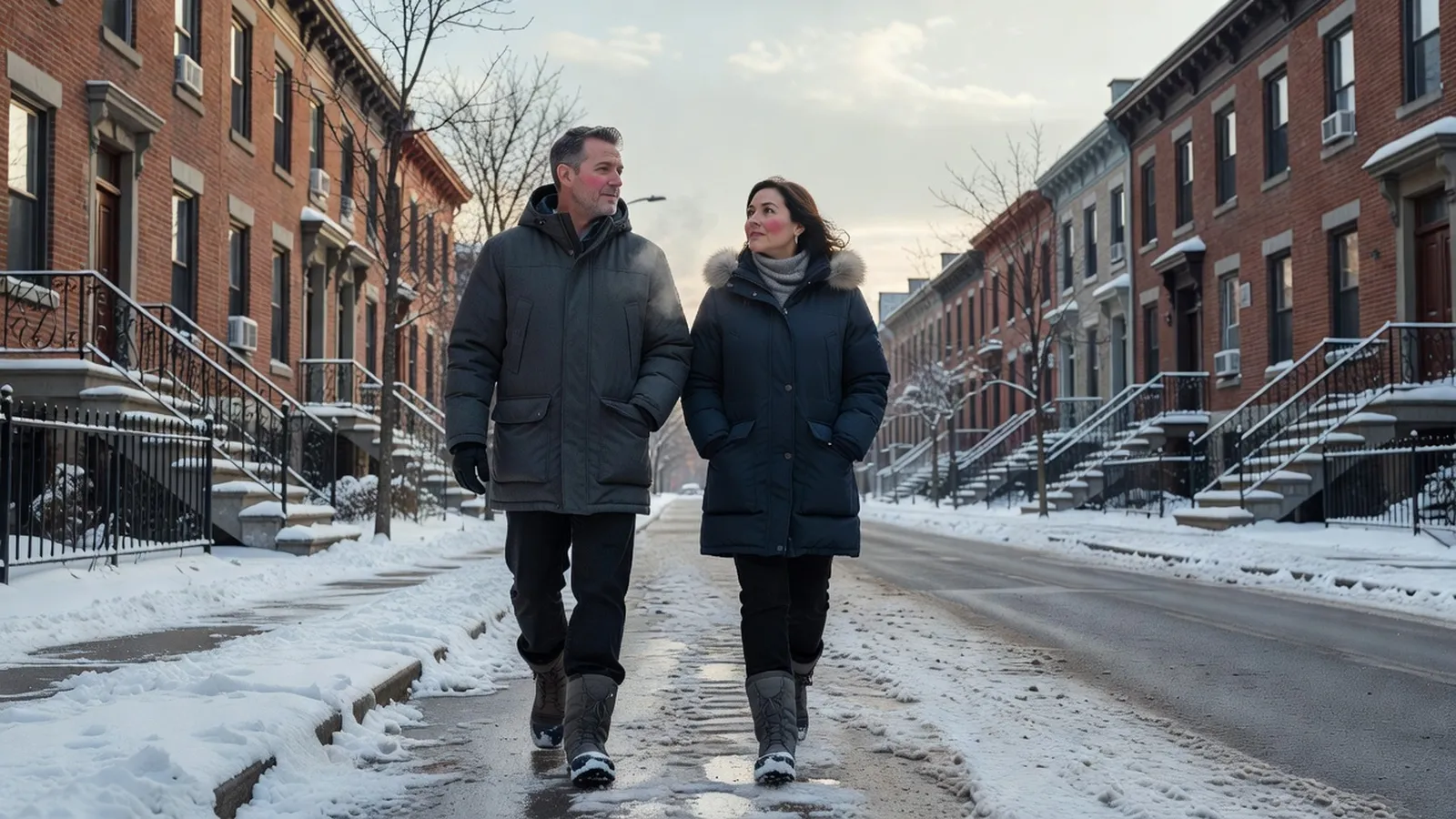
A winter boot for Canada has to suit the place, the temperature and the way you move, not just a number printed on a label. In January, the daily mean is -9.2 °C in Montréal, -16.3 °C in Winnipeg, -5.0 °C in Toronto and 4.1 °C in Vancouver, according to Environment and Climate Change Canada's 1991-2020 normals. This guide sets those four climates beside the criteria that matter (insulation, outsole, waterproofing, fit) and four families of boots, so the choice starts from conditions rather than slogans.
Four cities, four very different Januaries
Canada does not have one winter. It has several, and they ask different things of a boot. The most useful way to see this is to put official numbers side by side. The figures below are the 1991-2020 climate normals published by Environment and Climate Change Canada for Winnipeg Richardson airport, Montréal Trudeau airport, Toronto Pearson airport and Vancouver International airport. They are airport stations, so a downtown street, a valley or a lakeshore can run colder or milder on a given day, but as a comparison between regions they are solid.
| City (station) | January daily mean | January daily minimum | January daily maximum | January days with a maximum of -10 °C or colder | January days with at least 0.2 cm of snow |
|---|---|---|---|---|---|
| Winnipeg (Richardson airport) | -16.3 °C | -21.2 °C | -11.4 °C | 17.0 | 12.2 |
| Montréal (Trudeau airport) | -9.2 °C | -13.5 °C | -5.0 °C | 7.6 | 15.4 |
| Toronto (Pearson airport) | -5.0 °C | -8.9 °C | -1.2 °C | 2.6 | 12.7 |
| Vancouver (International airport) | 4.1 °C | 1.4 °C | 6.8 °C | 0.0 | 2.7 |
Source: Environment and Climate Change Canada, Canadian Climate Normals 1991-2020. Quality code A for Montréal and Winnipeg, B for Toronto and Vancouver.
Two things stand out. First, cold and snow do not travel together. Winnipeg is the coldest of the four in January but has fewer snowy days than Montréal, which averages 52.0 cm of snow in January and 216.6 cm over the year, against 25.0 cm and 126.2 cm for Winnipeg. Second, the footwear problem changes with the city. In Winnipeg the problem is sustained cold; in Montréal it is cold plus a lot of snow; in Toronto it is a milder winter with real snow days; in Vancouver, snow is occasional and the main question is whether a boot can handle a cold, wet day.
Winnipeg: sustained cold
In Winnipeg's January normals, a maximum of -10 °C or colder happens on average on 17.0 days, a maximum of -20 °C or colder on 5.3 days and a maximum of -30 °C or colder on 0.17 days. In other words, the day does not warm up much, and the cold is a steady condition rather than a passing event. For footwear, that points to insulation that keeps working for hours, a sole that stays supple on frozen ground and enough room inside for warm socks without compression. Snow is less of a problem than in Montréal (12.2 snowy days in January, 25.0 cm on average), so a boot built mostly for standing around or walking in dry, hard-packed snow can make sense here.
Montréal: cold with a great deal of snow
Montréal's January daily mean is -9.2 °C, which is milder than Winnipeg's, but the city gets 15.4 days with at least 0.2 cm of snowfall in January, and 7.6 January days have a maximum of -10 °C or colder. February stays cold as well, with a daily mean of -8.0 °C against -14.1 °C in Winnipeg, -4.4 °C in Toronto and 4.7 °C in Vancouver. The footwear question is therefore a double one: warmth for the very cold days and a sealed lower section for snow that packs, melts on a heated bus floor and refreezes at the curb. Water protection and a tread that does not clog count for more here than the last few degrees of insulation.
Toronto: milder, but not mild
Toronto's January daily mean is -5.0 °C, with a daily minimum of -8.9 °C and a maximum of -1.2 °C, and the city averages 12.7 snowy days in January and 114.5 cm of snow over the year. Only 2.6 January days have a maximum of -10 °C or colder. That is a winter in which an extreme-cold boot is often more than the day requires, yet where waterproof, warm footwear is still the sensible default, since the Government of Canada lists waterproof footwear and warm socks among its recommended winter items. A boot with moderate insulation, a waterproof base and a grippy outsole covers most days.
Vancouver: rain more than snow
At Vancouver International airport the January daily mean is 4.1 °C, the daily minimum 1.4 °C and the maximum 6.8 °C. Snow arrives on 2.7 January days on average, January snowfall averages 12.3 cm and the annual total is 36.6 cm. A deep-cold boot would be wasted on the coast most of the time. What counts is keeping feet dry on cold, wet days, and being able to walk on a slick surface; that is the territory of insulated rain boots and light waterproof boots, with a heavier option kept for trips to the mountains or inland.
Reading the cold beyond the thermometer
The temperature in the table is the air temperature. What feels cold on skin is a different quantity. Environment and Climate Change Canada's wind chill page explains that wind chill is a measure of the chill that air temperature and wind together produce on bare skin, a quantity no thermometer will show. It does not make objects or the air colder: with air at -20 °C and a wind chill of -30, objects still only cool to -20 °C. For boots, that nuance matters. Wind chill tells you how fast exposed skin can freeze, which is a reason to cover the ankle and the neck, but a boot is not cooled below the air temperature by wind. What wind does is strip warmth from a foot that is already losing heat through a thin or compressed insulation layer.
The same source describes an exposure scale. Wind chill from 0 to -9 is a low risk, with slight discomfort; from -10 to -27 the risk is moderate, with a danger of hypothermia and frostbite after a long time outdoors without adequate protection; from -28 to -39 exposed skin can freeze in 10 to 30 minutes. These thresholds apply to the face and hands first, but they frame how much of your day is spent in conditions where cold feet are a safety question, not just a comfort one. The department also says that its cold warnings take wind chill into account and that cold injuries can occur at moderately cold temperatures, even with little wind (see its page on extreme cold and cold warnings). Warning thresholds vary by region and have recently been reorganized into impact guides, so check the current alert for your area rather than relying on an old number.
A practical consequence: the layers above the boot count. Our guide to dressing for winter in layers explains how the body, the legs and the hands share the load; boots do their best work when the legs and torso are also dressed for the day.
Insulation: the rating on the box is a starting point
Ask five people what a "-40 boot" means and you will get five answers. The sources consulted for this guide found no common standard that defines the temperature ratings printed on winter boots. What exists are manufacturer definitions. Kamik's product page for its Nation Plus men's boot, consulted on 2026-11-27, lists a temperature rating of -40 °C, a removable liner with 145 g of HeatMX insulation, seam-sealed waterproof construction and an outsole with self-cleaning lugs (Grip XT). The page gives the number but not the test method behind it, and that method could not be verified.
Baffin's description of its Polar Rated category takes another route. The company defines the category as comfort during moderate activity (55 to 69 % of maximum heart rate) in regions where temperatures from -45 °C to -60 °C have been experienced, based on testing by its own team at the North and South Poles. Notice what changed: the definition ties the rating to an activity level and to a kind of place. Baffin's page for its Impact men's boot goes further and describes the boot as suited to long periods in extreme cold where activity is low to moderate, with a removable multi-layer inner boot and a waterproof base.
What follows from this? Three practical rules.
- Ask what the number assumes. A rating built for a person who is walking briskly says little about someone standing at a bus stop or watching a child's hockey practice, where less body heat reaches the foot.
- Compare constructions, not only digits. A removable liner, a thicker insulating layer, a sealed lower section and a sole that separates the foot from frozen ground all change how a boot behaves for the same stated rating.
- Do not compare ratings across brands as if they were measured on one scale. Each maker uses its own method, and a number from one maker does not translate directly to another's.
Our approach to sources is documentary: facts come from official pages and maker pages, dated and cited, as described on the about and method page. That is why you will not find a ranking of "warmest boots" here. No source we consulted supports one.
Outsole: grip, flexibility and a tread that does not clog
The outsole is the part nobody photographs and everyone remembers after the first icy sidewalk. No ministry page consulted for this guide gives rules about slip-resistant soles, so this section stays qualitative, and the details below come from what makers and reference works say about their own products.
Three qualities matter. The first is grip on varied surfaces: packed snow, ice, wet pavement and salted slush behave differently, and a tread pattern that works on one may skate on another. The second is flexibility in the cold: a sole that stiffens up in low temperatures makes walking tiring and reduces the contact between foot and ground. The third is a tread that sheds what it picks up. Wet snow packs into deep lugs and can turn a sole into a smooth surface, which is the reason some makers highlight self-cleaning designs; Kamik's Nation Plus page, for example, mentions self-cleaning lugs.
The sole also takes part in insulation, since it separates the foot from the frozen ground, which conducts cold. The Canadian Encyclopedia notes that modern mukluk styles often have rubber soles, which says something about how a traditional design has adapted to hard city surfaces: a soft hide upper for movement, a rubber base for wet pavement.
When you try on boots, stand on a hard floor, flex the forefoot, and look at the lug depth. Then picture the worst surface you walk on every week, whether it is a gravel lane, a stair with ice at the edge or the entrance of a transit station, and ask whether the tread would cope.
Waterproofing and breathability: keeping slush out without trapping sweat
Slush, the grey mix of snow and water at the curb, is the reason many city boots are sealed at the base. The Canadian Centre for Occupational Health and Safety (CCOHS) makes a point that surprises many people. Its guidance on working in the cold says that boots which are fully waterproof shield the foot from slush and cold water but also retain sweat, so insulation and socks are soaked sooner, and the chance of a cold injury goes up. That statement comes from a work context, but the physics of a foot in a sealed boot is the same for a walk to the office.
The same guidance says that, for heavy work in the cold, felt-lined, rubber-bottomed, leather-topped boots with removable felt insoles suit best, because leather lets sweat evaporate. That does not mean that everyone should wear leather boots with felt liners, but it does give a useful rule of design: the part of the boot that meets slush should be sealed, and the part around the leg should be able to let moisture out. Removable liners are the practical version of this idea, because they can be taken out and dried between outings.
So the question to ask is not "is it waterproof?" but "how long will I be wearing it, and how active will I be?". For short trips between a heated car and a heated building, full waterproofing is an advantage and breathability is a minor concern. For an afternoon of shovelling or a long walk, a boot that traps sweat will feel warm at first and cold later. Switching to dry socks and removing the liner overnight are habits worth building, and our boot care and cleaning guide covers how to dry and refresh boots without damaging them.
Wool and synthetic fibres hold up better than cotton when damp, according to CCOHS, which does not recommend cotton because it gets damp quickly and loses its insulating properties. That applies to socks as much as to jackets.
Fit and socks: the criterion that undoes the others
A perfectly insulated boot that fits badly is a cold boot. CCOHS recommends wearing the same kind of socks you will use with the boots when you try them on. Overly thick socks get flattened inside the boot, which costs them their insulating ability, and they press on the foot, slowing circulation and making a cold injury more likely. The conclusion is counterintuitive: more socks is not warmer. A foot that has room to move, with a layer of air that is not crushed, tends to stay warmer than a foot packed into a snug boot.
What does a good fit look like?
- Room at the toes. You should be able to move the toes, and the heel should stay in place without lifting.
- Right volume across the instep. Not so tight that circulation is limited, not so loose that the foot slides on descents.
- Try late in the day, when feet are at their largest, and with the socks you plan to wear on the coldest days.
- Test removable liners both in and out if the boot has them, since the fit with and without the liner can differ.
For children, the Canadian Paediatric Society advises boots that are warm and waterproof, with enough space for a second pair of socks and free toe movement, and recommends taking wet boots off right after play. Boots that are a size too big for the sake of growth should not be so large that the child trips. The Society's winter safety page also notes that if hands and feet are warm, the clothing is usually right, and that overdressing can lead to sweating and then chilling. This is general information, not medical advice; for questions about a child's circulation or a suspected cold injury, ask a health professional.
Four families of winter boots
Boots for a Canadian winter fall into a handful of families. The table compares four of them on the criteria above, keeping to what the sources say and staying qualitative where they do not. Individual models vary a great deal, so treat each cell as a tendency, not a guarantee.
| Family | Typical strength | Typical limit | Where it fits best |
|---|---|---|---|
| Mukluks | Soft hide upper designed for manoeuvrability and warmth | Traditional hide is not a sealed shell; modern versions often add rubber soles | Dry, very cold days with a lot of walking |
| Work-style boots with removable liners | Removable liner, sealed lower section, deep-lug outsole | Bulk and weight; can feel heavy for light city use | Long days outdoors, standing, shovelling, slush |
| Sheepskin boots | Soft, close, warm feel for casual use | Quality, treatment and construction vary; check the maker's information on water resistance and care | Short outings, dry cold, house and car |
| Insulated rain boots | Sealed from sole to shaft, easy to rinse | Little breathability; insulation level varies by model | Wet, near-freezing days; coastal winters |
The comparison is about trade-offs. No family wins on every criterion, which is why many households keep two pairs: one for slush and one for deep cold.
Mukluks
The Canadian Encyclopedia defines mukluks as supple hide footwear that Inuit created to keep the wearer warm and mobile in the North, and traces the word to the Yupik maklak, "bearded seal". It notes that European explorers and traders adopted them in the 17th century. That history explains their appeal: a close fit, a flexible sole and a design refined over generations of use in extreme cold. The trade-off is that a soft hide is not a sealed shell. In wet conditions, the maker's guidance on treatment and use deserves a read. The Canadian makers and artisans behind these designs, along with the other houses that dominate the market, are profiled in our guide to Canadian winter boot brands and makers.
Work-style boots with removable liners
This is the family where the CCOHS findings apply most directly. A removable liner can be taken out and dried; a rubber or sealed lower section stands up to slush; a leather or textile shaft lets some moisture out. Kamik's Nation Plus page lists exactly this combination: a removable liner, seam-sealed waterproof construction and a self-cleaning lug outsole. Baffin's Impact page describes a removable multi-layer inner boot and a waterproof base, aimed at long stretches in extreme cold with low to moderate activity. The price of this construction is weight, which makes it a less natural choice for a short stroll through a mall parking lot.
Sheepskin boots
Sheepskin boots are a familiar sight on Canadian streets in winter. Our complete guide to sheepskin boots covers their materials, construction and use. For the purposes of this guide, two cautions apply. First, construction and treatment differ widely from one maker to another, so a pair that suits a dry, cold day may be a poor choice for slush; read the maker's own information on water resistance. Second, a soft, warm interior is not the same as a high-traction outsole, so check the sole as carefully as the lining.
Insulated rain boots
On Canada's west coast, and in any city where days hover near freezing with a lot of wet, a sealed rubber-based boot with an insulating lining is a practical answer. Kamik lists rain boots among its range alongside winter boots, clogs and sandals, which reflects how much of the footwear business sits in this overlap between wet and cold. Because these boots are sealed all the way up, they are the clearest example of the sweat-retention issue raised by CCOHS: warm and dry for a short outing, damp and cool after a long one.
Putting it together: typical days
The following situations are typical, not personal accounts. They are built from the official normals above and from the sources cited, and they show how the criteria combine.
A January commute in Winnipeg. With a daily maximum of -11.4 °C on the normal January day and a mean of -16.3 °C, a walk of ten minutes to a stop and a wait of ten more is mostly an exposure problem. The priorities are warmth for a foot that stays still, a sole that remains flexible, and room for warm socks. A boot with a removable multi-layer liner and a thick sole answers this well, and wind chill, rather than air temperature, is the number to watch for the face and hands.
A slushy week in Montréal. January averages 15.4 days with snow, and the cold is serious but not extreme. A sealed lower section and a tread that sheds wet snow come first, then moderate insulation. A pair that comes apart into liner and shell helps, because boots that sit damp in a closet overnight start the next morning cold.
A cold-but-brief Toronto morning. A daily minimum of -8.9 °C and a maximum of -1.2 °C describe a day that is manageable in a boot with moderate insulation. The aim is to stay dry through the first snowfall and keep the sole grippy on salt, not to reach for the heaviest option on the shelf.
A wet, near-freezing day in Vancouver. At a January mean of 4.1 °C and a daily minimum of 1.4 °C, dry feet matter more than deep insulation. An insulated rain boot or a light waterproof boot suits, and the heavy pair can wait for a trip inland.
A short checklist before choosing
- Name your city and your typical January day, then compare with the normals in the table.
- Decide how active you will be: standing, walking briskly or working outdoors.
- Read how the maker defines any temperature rating, and treat it as a starting point.
- Check the lower section: sealed or not, and how it handles slush.
- Look for a removable liner if you will be out for long periods.
- Try on with your real winter socks, late in the day.
- Test the outsole on a hard floor and check the lug depth.
- Plan for care: drying, brushing off salt, and storing boots away from direct heat. The care guide above walks through the steps.
Care and a second pair
Winter boots last longer when the lining dries between outings, when road salt is cleaned off before it dries into a crust and when the boots are not left on a heat source. Having two pairs to rotate is the simplest way to guarantee a dry boot each morning; it also lets you assign one pair to deep cold and another to slush, instead of asking one boot to do both. Cost matters here, but this guide does not quote prices, since none of the sources consulted supply them and prices change; the question to ask is whether a second, less specialized pair would cover the days when your main pair is not the right tool.
Official advice on what to wear
The Government of Canada's guidance on preparing for extreme cold lists these as winter essentials: an insulated jacket, footwear that keeps water out, warm socks, gloves or mittens, a toque, and a scarf or other face covering. It also warns that a bright, sunny day can look deceptively mild during a cold event, and advises dressing for the wind chill and heading for the closest heated space once fingers or toes start to go numb. Its preparation page for extreme cold is worth a read before the season starts, along with the Canadian Centre for Occupational Health and Safety's guidance on controlling exposure to cold, which covers layers, boots and socks in more detail.
If you are curious about how people dress where winters are even longer, the overview of winter in Russia and Eastern Europe compares what is worn there and what a Canadian reader can take from it.
Frequently asked questions
What temperature rating should a winter boot have for Canada?
There is no single answer, because ratings are defined by each manufacturer and no common standard turned up in the sources consulted. Kamik, for example, lists -40 °C for its Nation Plus men's boot, while Baffin ties its Polar Rated category to moderate activity in regions where -45 °C to -60 °C has been experienced. Read how the maker defines the number, think about how much you will be moving, and treat the rating as a starting point.
Are fully waterproof boots always the best choice for winter?
Not always. Occupational-health guidance from the Canadian Centre for Occupational Health and Safety says fully waterproof boots protect from slush and cold water but retain sweat, so the insulation and socks get wet faster. For long, active days a removable liner you can dry out matters; for short trips through slush, waterproofing matters more.
How should winter boots fit?
Try them on wearing the same type of socks you plan to use with them. Socks that are too thick get compressed, lose their insulating ability and squeeze the foot, which slows circulation. For children, the Canadian Paediatric Society advises boots roomy enough for an extra pair of socks and for wiggling the toes.
Is Toronto cold enough to need serious winter boots?
The January normal at Toronto Pearson (airport) is a daily mean of -5.0 °C and a daily minimum of -8.9 °C, with 12.7 days of snowfall of at least 0.2 cm on average (1991-2020). That is a long way from Winnipeg, but it is still a climate where warm, waterproof footwear is on the Government of Canada's list of recommended winter items.
What is the difference between a mukluk and an insulated work boot?
Mukluks are soft hide boots designed by Inuit for manoeuvrability and warmth in the North, according to The Canadian Encyclopedia. Work-style winter boots usually combine a waterproof lower section with a removable liner. They answer different needs: one favours flexibility and a close feel, the other favours standing and slush.
Sources
Verified on
- Environnement et Changement climatique Canada, Canadian Climate Normals 1991-2020 Data: MONTREAL TRUDEAU (AIRPORT), Gouvernement du Canada, 2025.
- Environnement et Changement climatique Canada, Canadian Climate Normals 1991-2020 Data: WINNIPEG RICHARDSON (AIRPORT), Gouvernement du Canada, 2025.
- Environnement et Changement climatique Canada, Canadian Climate Normals 1991-2020 Data: TORONTO PEARSON (AIRPORT), Gouvernement du Canada, 2025.
- Environnement et Changement climatique Canada, Canadian Climate Normals 1991-2020 Data: VANCOUVER INTERNATIONAL (AIRPORT), Gouvernement du Canada, 2025.
- Centre canadien d'hygiène et de sécurité au travail (CCHST), Cold Environments - Control Measures, Centre canadien d'hygiène et de sécurité au travail (CCHST), 2025.
- Société canadienne de pédiatrie, Winter safety: Advice for parents and kids, Société canadienne de pédiatrie, 2023.
- Sécurité publique Canada / Gouvernement du Canada, Extreme Cold - Get prepared: how to prepare, Gouvernement du Canada, 2026.
- Kamik, NATION PLUS Winter Boots, Men, Kamik, 2026.
- Baffin, Polar Rated: Cold Comfort Rating, Baffin, 2026.
- Baffin, IMPACT | Men's Boot, Baffin, 2026.
- Environnement et Changement climatique Canada, Wind chill and the Wind Chill Index, Gouvernement du Canada, 2025.
- Environnement et Changement climatique Canada, Extreme cold and cold warnings, Gouvernement du Canada, 2025.
- René R. Gadacz, Mukluk, Historica Canada, The Canadian Encyclopedia, 2025.