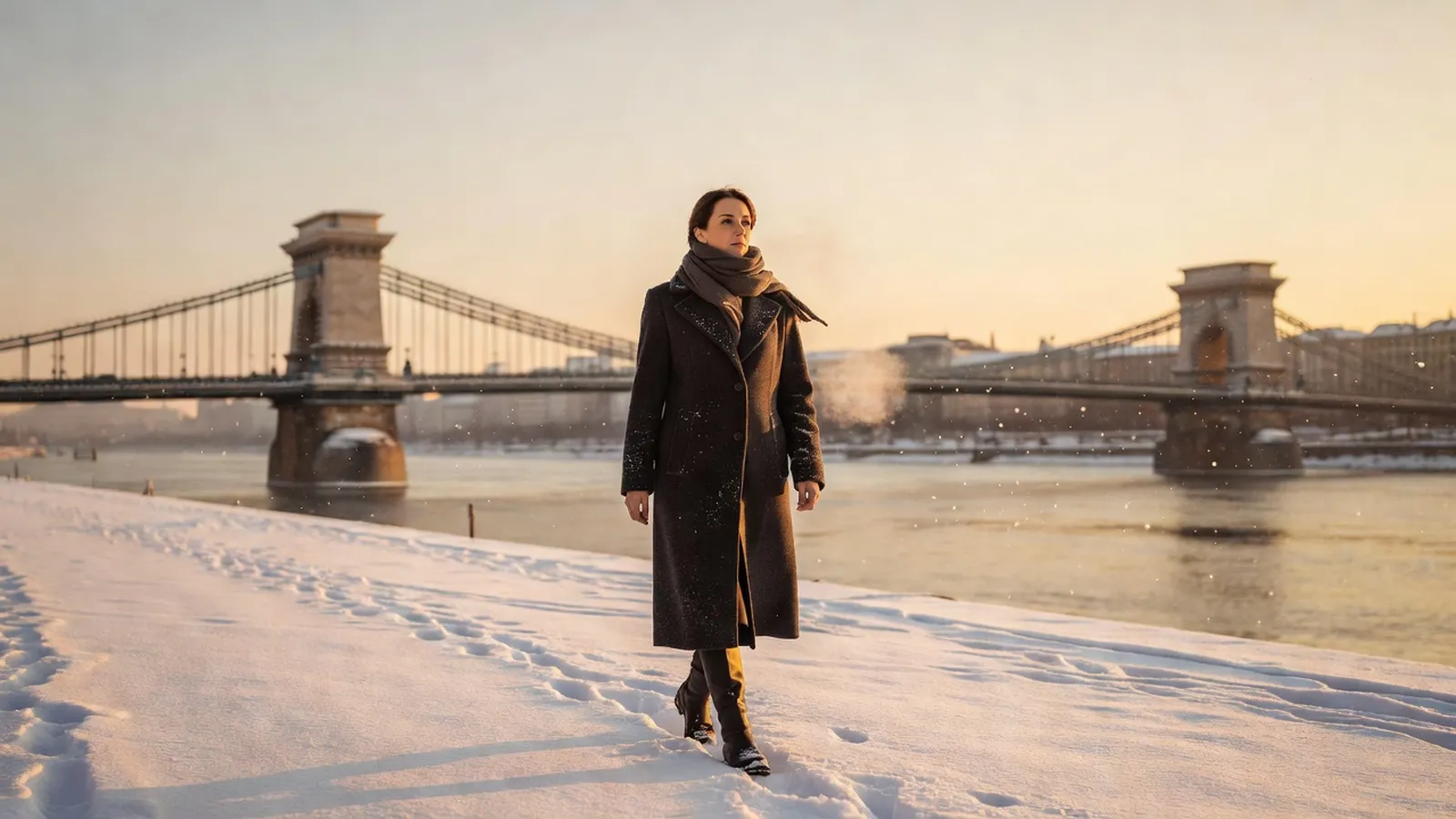
For a Budapest winter, start with a coat you can close over a sweater, a wool or synthetic top, and boots that fit with warm socks. Add a toque, scarf and mittens for a wait outdoors. Budapest's January climate leaves room for both cold mornings and afternoons above freezing, so choose footwear for the pavement as well as the air. A removable middle layer earns its place when a walk ends on a tram or inside a museum.
What January in Budapest tells you about the rest of the day
Budapest's average January low is -3.0 °C and its average high is 2.6 °C, according to the World Meteorological Organization's Budapest climate record. The observations come from the Hungarian Meteorological Service and cover 1981–2010. The first figure averages the daily minima; the second averages the daily maxima. They describe different parts of a winter day. Neither is the average temperature for the month, and the city record does not give a traveller a morning low and an afternoon high for the same date.
The distinction matters at the front door. With a below-freezing start in the forecast, take the scarf and mittens even if the afternoon looks mild. With wet pavement outside, consider boots that keep water out, even if the air is colder than you expected. There is no need to assume a daily cycle of fresh snow, thaw and refreezing to make those decisions. The Budapest temperature figures do not tell you how many snowy days to pack for.
For the country as a whole, HungaroMet's account of Hungary's temperatures puts January first for cold on its 1991–2020 averages. In a particular year, however, another winter month can take that place. HungaroMet also describes a decrease in annual mean temperature from the southwest towards the northeast, due in part to the cooling influence of the Siberian anticyclone. That is a national pattern, not a reason to adjust a Budapest forecast by some fixed amount for the next stop. If the trip takes you beyond the capital, check the destination rather than carrying the city's numbers with you. The same distinction between a city reference and a regional winter runs through our guide to winter clothing in Eastern Europe.
A coat for the street, a layer to keep on indoors
Lay out what you would wear without the coat first. For a day spent partly indoors, that might be a long-sleeved wool top and a cardigan. The top stays on; the cardigan can come off without changing the rest of the outfit. Now put the coat on over both. Close it, wind the scarf as you would wear it outside, and reach forward. If the sleeves bind or the front will only close without the cardigan, those pieces are not a particularly useful combination for a day of walking and waiting.
There is a reason to leave that room. In its guidance on clothing for cold work, the Canadian Centre for Occupational Health and Safety (CCOHS, 2025) explains the insulating role of the air between garments. It recommends wool or suitable synthetics next to the skin to carry moisture away, insulation that can be opened or removed, and a waterproof exterior in wet conditions. Cotton, by contrast, can become damp readily and lose insulation. This is workplace guidance, but the distinction between the jobs of the garments is useful when putting together an ordinary city outfit.
For a dry day, a wool coat might be the outer piece you want. For a wet one, you might keep wool in the sweater and wear a waterproof outer layer instead. The Budapest Museum of Ethnography's account of a felt coat identifies the cloth of the Hungarian cifraszűr as thick, rough felt. It documents a particular garment, not what commuters wear today, and it does not tell you how your own wool coat will perform in wet weather. For a contemporary outfit, the more useful questions are what the coat will go over and what it will have to keep out.
A cold morning at the tram stop
Picture a January morning with snow at the stop and a wait ahead. It is the below-freezing side of the Budapest climate record that matters for this example, not the prospect of a milder afternoon. Dress for the part of the journey you cannot do at a brisk walk. A coat closed over the middle layer, a toque over the ears, mittens and a scarf make a sensible starting point. Put the accessories on before the wait rather than leaving them under everything else in a bag.
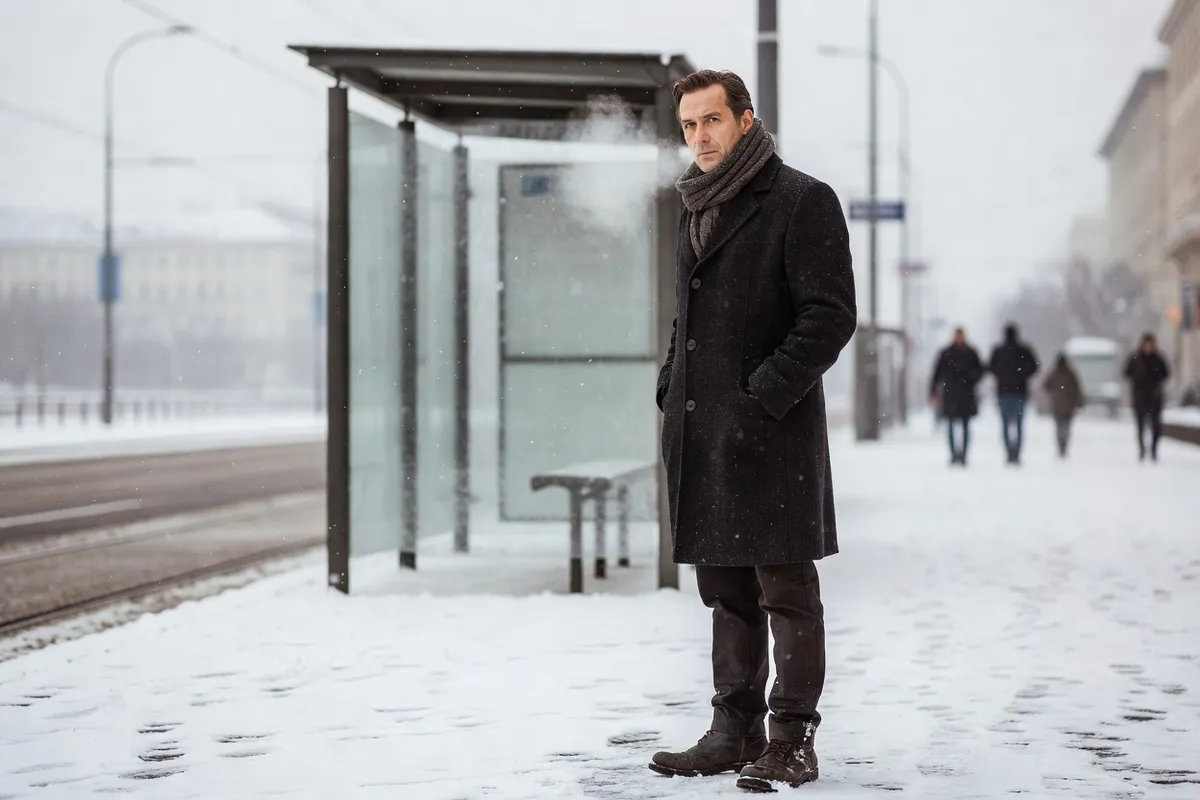
Consider the collar as well as the body of the coat. Can it close with the scarf in place? Can you turn your head comfortably to look for the tram? On a windy morning, exposed skin is part of the clothing decision. Environment and Climate Change Canada (ECCC, 2025) describes wind chill as the combined effect of air temperature and wind on exposed skin. It does not mean the air or the tram-stop bench has dropped to the wind chill value. Use the wind information to decide what to cover, not to assign a temperature rating to a coat.
Boarding changes what you need from the same clothes. Unwind the scarf and open the coat if the carriage is warm; keep the mittens together in a pocket for the next stretch outside. With a long walk after the ride, a cardigan that opens down the front gives you another adjustment short of taking the coat off altogether. With another wait instead, it can stay closed. The point of our guide to dressing in layers is especially tangible on a trip like this: the outfit for the stop and the outfit for the ride can be the same clothes worn differently.
A walk that ends at a museum
Now consider an afternoon walk with a dry route and a long indoor visit at the end. A forecast above freezing would be consistent with Budapest's January average high, though it says nothing about how warm the museum will be. Here, start with the clothes in which you want to spend the visit. If a wool top is enough indoors, choose a sweater you can take off and carry. If you would prefer to keep the sweater on, a coat that comes off cleanly over its sleeves makes the transition easier.
On the walk, pay attention before the base layer feels damp. ECCC's winter preparedness guidance (2026) advises adjusting a layer before perspiration builds up. That gives a front opening a practical advantage: you can undo it on the approach to the museum, then decide at the door what to remove. Think through where the loose pieces will go. A bag with room for a cardigan and a coat pocket large enough for the toque may be more useful on this outing than an additional sweater left at your accommodation.
The boots, unlike the coat, may stay on throughout the visit. Try the combination you intend to wear for both parts of the day. CCOHS (2025) advises fitting boots with the kind of sock that will actually go inside. A thick sock squeezed into a close-fitting boot loses some of its insulating value and presses on the foot. If your everyday pair fits well with a warm sock, do not assume an even bulkier sock will improve it. Allow for sitting down in the boots as well as walking; you are choosing what to spend the afternoon in, not just what to cross the threshold in.
Keep an eye on the return journey when deciding what to carry. The bulky layer you took off on arrival still has a job if you leave to find a colder street and a wait for the ride back. A dry middle layer in the bag gives you that option. Wearing it through the whole visit simply to avoid carrying it defeats much of the purpose of choosing a removable piece.
Wet pavement on the way back
For a different January outing, suppose there is slush at the crossings and water along the route home. Budapest's average low and high sit on either side of freezing; this is a plausible condition to plan for, not a claim about how often it occurs. Start at ground level. If the problem is stepping into wet slush, a thicker sweater will do nothing about it. Choose footwear intended to keep water out and leave room for the socks you have already tried with it. For the upper body, give the waterproof layer the outside position if conditions are wet.
Water can also come from inside a boot. CCOHS (2025) notes that fully waterproof footwear keeps out cold water and slush but holds in perspiration; both socks and insulation can become damp. The guidance concerns people working in the cold, not a prescribed boot for Budapest. Its practical use on a long walk is to distinguish a dry exterior from a dry sock. If you expect to spend much of the afternoon in the same boots, tuck a dry pair of socks where you can reach them during an indoor stop.
When you come inside, take off the boots and check the socks before setting off on another errand. Health Canada (2021) advises changing out of wet clothing promptly. With a boot that has a removable liner or insole, check that piece too, following the care directions for the pair. A fresh sock does not make damp insulation dry. If the outside needs attention, use the material and the maker's instructions to choose the next step; our guide to caring for winter boots treats that as a separate question from what to wear on the street.
Budapest beside Winnipeg and Montréal
Compare like with like before deciding how much of a Canadian winter outfit to take. The Budapest column uses the Hungarian Meteorological Service's January observations published by the WMO for 1981–2010. The Canadian column uses 1991–2020 January normals from Environment and Climate Change Canada at Winnipeg Richardson and Montréal Trudeau airports. These are different reference periods, and the Canadian measurements describe airport stations, not the pavement outside a particular home.
| Topic | There | Here |
|---|---|---|
| Average daily low in January | Budapest: -3.0 °C (WMO, 1981–2010). | Winnipeg: -21.2 °C; Montréal: -13.5 °C (ECCC, 1991–2020). |
| Average daily high in January | Budapest: 2.6 °C (WMO, 1981–2010). | Winnipeg: -11.4 °C; Montréal: -5.0 °C (ECCC, 1991–2020). |
| Snowfall as a footwear reference | The Budapest temperature figures do not establish how often you will encounter snow or slush. | January snowfall averages 25.0 cm at Winnipeg Richardson and 52.0 cm at Montréal Trudeau (ECCC, 1991–2020); these are amounts of snowfall, not depths underfoot. |
Look across the afternoon figures. In the WMO record, Budapest's average high is above freezing. At both Canadian stations the average high remains below it. That is a useful reason for a Winnipeg reader to think twice before packing an outfit designed solely for standing outside through a cold afternoon. It is not a reason to leave every warm accessory behind. A scarf and mittens can serve on a chilly Budapest morning without committing you to wearing your heaviest coat all day.
The snowfall row makes a different point for a Montréal reader. Of the Canadian stations, Montréal Trudeau has the greater January snowfall in these ECCC normals, while Winnipeg Richardson has the lower temperatures. Snowfall and cold are not interchangeable measures of what a boot has to do. Nor can either Canadian snowfall amount fill in for a missing Budapest figure. Our Canadian winter boot guide is a useful companion when sorting the pairs you already own by fit, insulation and protection from water.
What earns a place in the bag
Give the clothes a rehearsal at home rather than trying to find a Hungarian equivalent for every item in a Canadian winter wardrobe. Wear the top you want for an indoor afternoon, add the sweater, and close the coat. Then take off the coat as if you had just stepped off the street. If the sweater has to come off too, make sure you have somewhere to put it. If the coat alone provides nearly all the insulation, consider what you will wear during a visit when you would rather not keep it on.
Do the same with the smaller pieces. Put the mittens and toque in the pockets you will use on the tram. Set out the boots with the socks that fit them, not the thicker pair you might add at the last minute. For a wet forecast, give a change of socks space in the bag and check which outer garment is intended for water. For a forecast dominated by cold wind and a long wait, give the collar, scarf and mittens another look.
What travels well between Winnipeg, Montréal and Budapest is the habit of dressing for the whole outing. The climate record helps narrow down what to pack. At the door in Budapest, the choice is more immediate: the condition of the crossing, the wait at the stop and what you want to be wearing once the coat comes off.
Frequently asked questions
Do I need to take my Canadian winter parka to Budapest?
If it is the coat you own and it opens easily over a removable layer, it can be a practical choice. Think about the time you will spend waiting outdoors as well as the time you will spend walking or sitting inside.
Is January always the coldest month in Hungary?
No. HungaroMet identifies January as the coldest month on average over 1991–2020, but another winter month can be colder in an individual year.
Are waterproof boots worth packing for Budapest?
They make sense if the forecast and the state of the pavement point to slush or water. Try them with your intended socks, and allow for a change of socks if the pair you are wearing gets damp.
Does wool have to be the outer layer?
No. A wool top next to the skin or a wool sweater under a coat lets you use the fibre for insulation and choose the outer garment separately for wind or wet weather.
How does a January afternoon in Budapest compare with one in Canada?
The WMO's 1981–2010 January average high for Budapest is 2.6 °C. Environment and Climate Change Canada's 1991–2020 airport normals give average highs of -5.0 °C for Montréal and -11.4 °C for Winnipeg; none is a forecast for an individual afternoon.
Sources
Verified on
- Organisation météorologique mondiale, World Weather Information Service : Budapest, OMM, 2026.
- HungaroMet, Temperature conditions of Hungary, HungaroMet, 2026.
- Edit Katona, Decorative Felt Coat, 1873 (Artefact of the Month, July 2019), Néprajzi Múzeum, Budapest, 2019.
- Centre canadien d'hygiène et de sécurité au travail (CCHST), Cold Environments - Control Measures, Centre canadien d'hygiène et de sécurité au travail (CCHST), 2025.
- Environnement et Changement climatique Canada, Wind chill and the Wind Chill Index, Gouvernement du Canada, 2025.
- Environnement et Changement climatique Canada, Be prepared for winter weather, Gouvernement du Canada, 2026.
- Santé Canada, Extreme cold (It's Your Health), Gouvernement du Canada, 2021.
- Environnement et Changement climatique Canada, Canadian Climate Normals 1991-2020 Data: WINNIPEG RICHARDSON (AIRPORT), Gouvernement du Canada, 2025.
- Environnement et Changement climatique Canada, Canadian Climate Normals 1991-2020 Data: MONTREAL TRUDEAU (AIRPORT), Gouvernement du Canada, 2025.