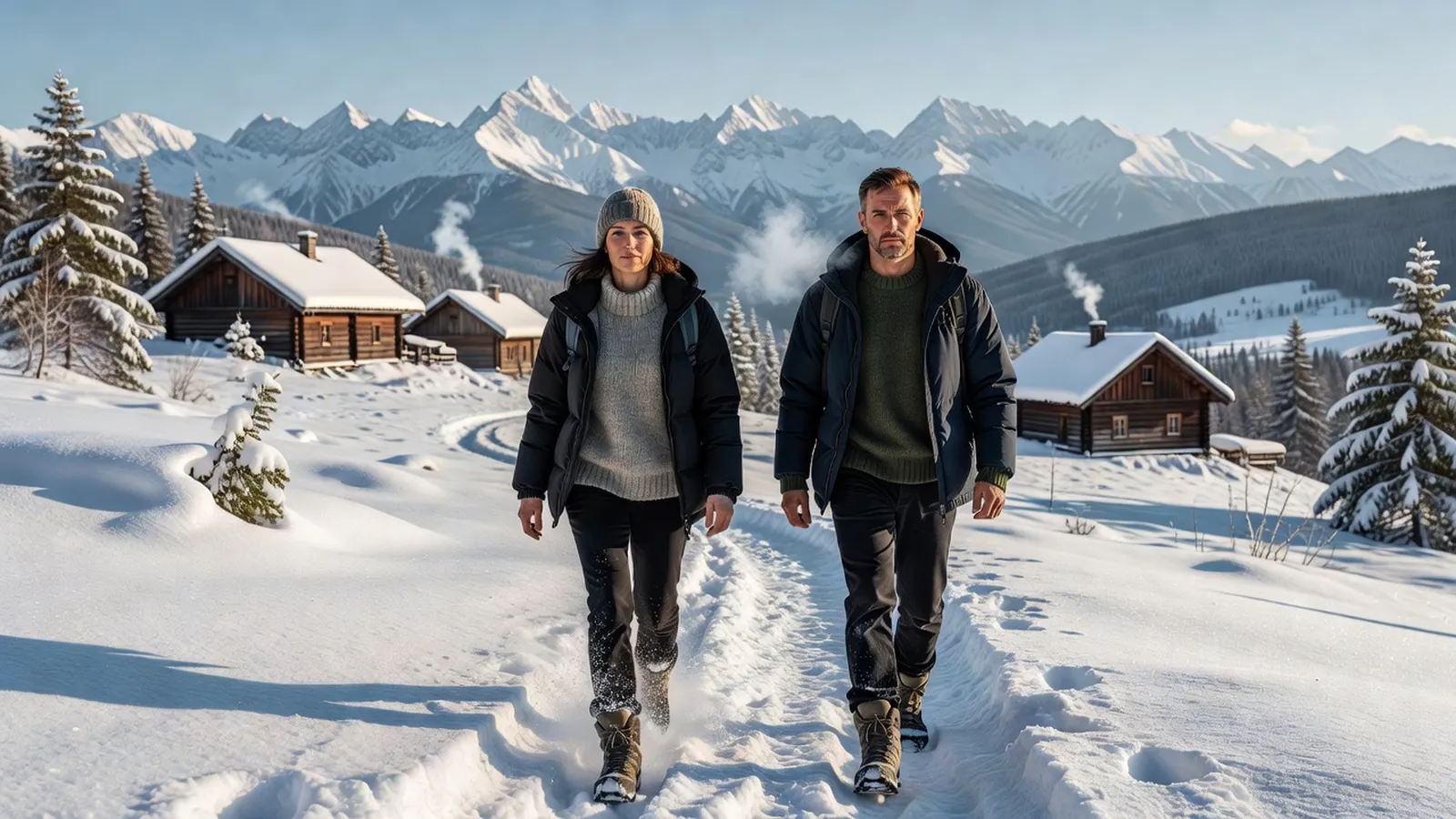
For Warsaw in winter, dress for the walk and the tram stop: wear a wool or synthetic base, an insulating layer that opens, and a wind-resistant coat. Choose boots for the ground you expect, with room for your warm socks. For Zakopane and the Tatras, keep the adjustable layers but check the local forecast rather than packing to Warsaw's average. Podhale has a distinctive sheepskin coat, the kożuch; you needn't reproduce it to dress comfortably for a winter day there.
What a Warsaw January asks of a wardrobe
Warsaw sits close enough to freezing in the January averages that a Canadian might be tempted to pack for a thaw. The IMGW-PIB climate normals for 1991–2020 put the January daily mean at −1.5 °C at Warsaw synoptic station 12375. The same institute gives a mean January minimum of −4.0 °C for that station and period. Neither number is a lower limit. In particular, the minimum is an average of lows, not the coldest morning for which a visitor should prepare.
A more revealing measure for someone who plans to stay out until afternoon is the daytime high. At the Warsaw station, January averaged 11.4 days when even the high remained below 0 °C, according to IMGW-PIB's 1991–2020 normals. On such a day, taking a later tram home would not mean waiting for it in above-freezing air. A layer that felt unnecessary on a brisk walk may be precisely the one to have at hand for the wait.
Snow underfoot raises a different question. IMGW-PIB recorded a January average of 12.3 days with more than 1 cm of snow cover at the Warsaw station in 1991–2020. That is snow on the ground, not necessarily snow falling that day. Nor is it a survey of street corners. For footwear, the useful next piece of information is what lies along the route: a dry pavement, a snowy courtyard or a wet crossing. For a broader comparison, the guide to winter clothing in Russia and Eastern Europe starts with the same distinction between a regional destination and the conditions of an actual outing.
Put together a city outfit you can change on the move
Start with the garment that will stay on indoors. A wool or synthetic long-sleeved top can go under a sweater that opens at the front. In its 2025 guidance on cold environments, the Canadian Centre for Occupational Health and Safety (CCOHS) identifies wool, polyester and polypropylene as options for a base that moves moisture away from the skin. It advises against relying on cotton for insulation in the cold because it becomes damp readily and loses insulating value. The useful packing choice is a base you can comfortably wear on its own, not just one that looks substantial folded in a drawer.
Give the sweater a different job from the coat. The sweater provides insulation; choose one you can undo or take off without dismantling the rest of the outfit. The outer garment faces the weather: wind resistance matters on an exposed wait, and CCOHS calls for a waterproof outer layer in wet conditions. Try the combination closed, with the sweater underneath. If you have to choose between fastening the coat and wearing the sweater, the garments don't give you the options they appeared to offer separately.
Environment and Climate Change Canada's winter guidance (2026) advises taking off a layer before you start to sweat. A practical time to make that decision is at the beginning of a sustained walk, not after arriving at the stop with a damp back. Keep a toque, mittens and scarf where you can reach them without putting your bag down. For a day with frequent changes of pace, the guide to dressing in layers explains why the air between garments matters as much as the choice of fabric.
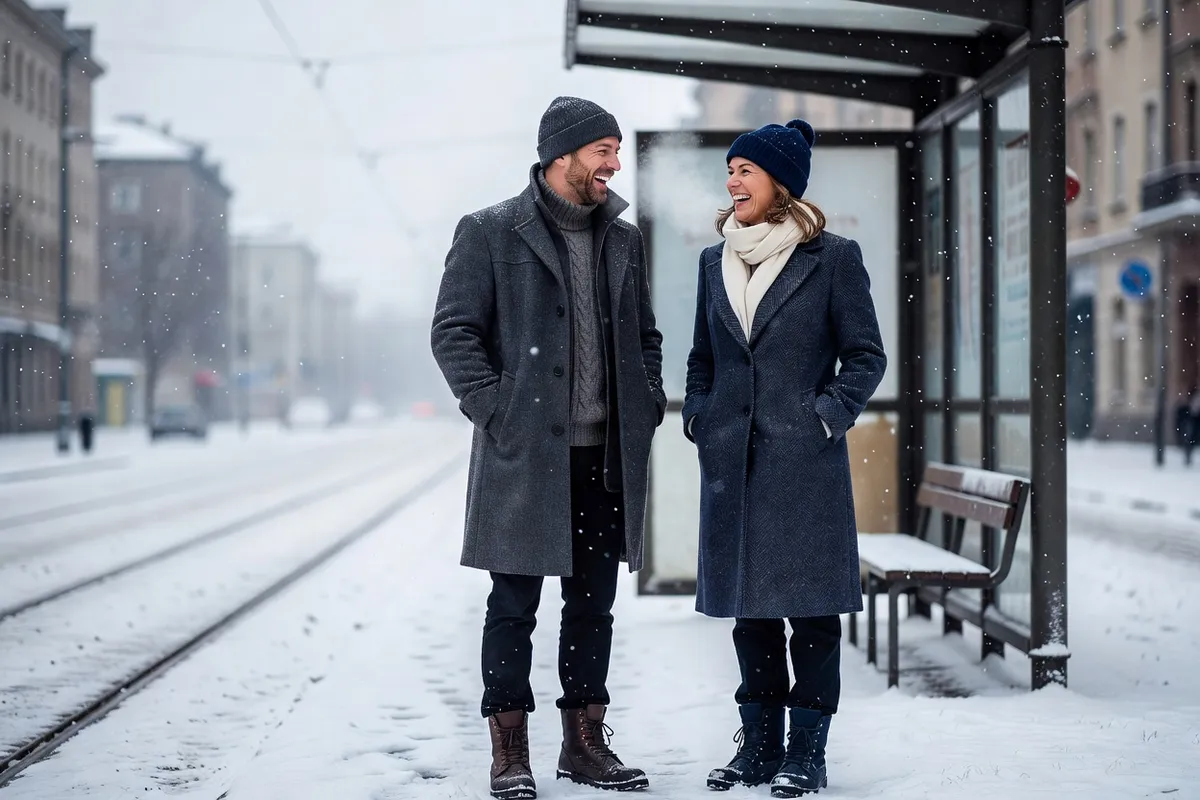
Before packing, take the sweater off and see where it will go. A coat worn over a removable layer works rather differently if the only place for that layer is a suitcase back at the room. A little space in a day bag lets you dress for the walk, carry the sweater indoors and still have it for the way back. The same reasoning favours a spare pair of dry socks over wearing every pair at once.
Sheepskin in Podhale, wool cloth and felt in a boot
The brown coat associated with Podhale has a specific name and context. In its account of Podhale highlander dress, etnoZAGRODA (2018) identifies the kożuch as a winter sheepskin coat worn in both the men's and women's regional outfit. Its coloured embroidery and saffian leather trim are identifying details. That description belongs to Podhale. It isn't evidence that a sheepskin coat is standard street wear in Warsaw, or that one is necessary for a visitor to Zakopane.
Even within the regional clothing, not every substantial woollen garment is sheepskin. The State Ethnographic Museum in Warsaw (2026) describes men's gunia and cucha coats and trousers in thick, fulled cloth whose colour is that of the sheep's fleece. The distinction is worth taking home: a coat made from wool cloth is not the same object as a coat made from a skin. And neither description tells you how a pair of boots will handle a puddle. For footwear specifically, the guide to sheepskin boots keeps the lining question separate from the construction of the rest of the boot.
Felt provides a useful example of that distinction. In its guidance for working in the cold, CCOHS (2025) describes a boot for heavy work with a rubber bottom, leather upper, felt lining and removable felt insole. The leather allows moisture from perspiration to escape. The recommendation concerns the whole construction and a particular kind of work. It is not a requirement to wear felt on a Warsaw pavement. If a boot you already own has a felt lining, ask what surrounds it and whether the insole can come out, rather than treating “felt” as its complete specification.
For a wet route, CCOHS notes a trade-off: a fully waterproof boot keeps out cold water and slush but also holds in perspiration. Socks and insulation can get damp from the inside. Try the boots with the socks intended for the trip. CCOHS cautions that an overly thick sock can be squeezed flat and lose insulation while crowding the foot. If the everyday sock fits comfortably and the bulky pair does not, adding thickness hasn't improved that particular combination.
Three outings, three different clothing decisions
Walking to a Warsaw tram, then waiting
Picture a January day of the kind counted in the Warsaw normals, with the temperature staying below freezing through the afternoon. The route starts with a purposeful walk through the neighbourhood and ends with a wait beside the tracks. Dress for both parts: a base and a sweater under a coat that closes against the wind, warm socks in winter boots, and mittens in a coat pocket. On the walking leg, open the insulating layer or stow it if it becomes too warm. At the stop, it should be possible to close up again without unpacking the bag.
Pay particular attention to what the forecast says about wind. Environment and Climate Change Canada explains in its wind chill guidance (2025) that the index describes the combined effect of wind and air temperature on exposed skin. It isn't a second air temperature. For the person waiting, the practical response to a windier forecast might be to have a scarf ready for the face and a toque over the ears. It is not a reason to read a wind chill value as the temperature of the pavement or as a specification for a boot lining.
A snowy courtyard with a child
For a family staying in Warsaw, imagine an afternoon when there is snow on the ground but none falling. That distinction, captured by the IMGW-PIB snow-cover measure, changes the packing question. Looking out of the window for flakes tells you little about where a child will put their feet during play. If the courtyard is wet underfoot, start with the boots rather than adding another sweater to the child's outfit.
The Canadian Paediatric Society's winter guidance (2023) calls for warm, waterproof boots with room to move the toes and space for extra socks. Check with the socks actually on: the point is to preserve room, not to fill it. For the rest of the outfit, the Society describes layers an adult can readily add or remove, a hat that covers the ears, and mittens in preference to gloves. If play becomes energetic, an adjustable middle garment gives the adult something to change without taking away the weather-facing layer.
Plan for the doorway at the end of play, too. The Society advises taking wet boots off promptly rather than leaving a child in them indoors. Have dry socks and indoor footwear at hand. That small arrangement answers a problem another pair of socks inside the boots would not: the child can leave the wet things at the door instead of wearing them through the rest of the visit.
A walk based in Zakopane
For the Zakopane part of a trip, set aside the Warsaw average. A January measurement from the capital is not a Tatra forecast. Decide where the walk will actually go and check conditions there; don't assign a mountain temperature by subtracting an arbitrary amount from the city figure. For a walk in town followed by a stop outdoors, lay out a wool or synthetic base, an insulating garment you can carry, and an outer layer chosen for the forecast wind or wet. Pick the boots after checking the intended ground conditions.
Now consider the pause rather than the departure. If the sweater comes off on the way out, can you put it back on before standing around? If the route is wet enough to call for fully waterproof boots, is there a dry pair of socks available afterwards? Those questions give each item in the bag a reason to be there. A plan that extends into the Tatras calls for a fresh decision based on that destination. A town outfit assembled for an afternoon in Zakopane should not pass unexamined as mountain clothing.
January in Warsaw, Winnipeg and Montréal
Compare like measurements first. The Warsaw figures below are from IMGW-PIB's 1991–2020 January normals for the Warsaw synoptic station. The Canadian January normals are from Environment and Climate Change Canada for the same period, at Winnipeg Richardson and Montréal Trudeau airports. The means and mean minima can be read straight across. The snow row deliberately keeps the measure beside each number because the Polish and Canadian figures describe different things.
| Topic | There | Here |
|---|---|---|
| January daily mean, 1991–2020 | Warsaw: −1.5 °C (IMGW-PIB) | Winnipeg: −16.3 °C; Montréal: −9.2 °C (Environment and Climate Change Canada) |
| January mean daily minimum, 1991–2020 | Warsaw: −4.0 °C (IMGW-PIB) | Winnipeg: −21.2 °C; Montréal: −13.5 °C (Environment and Climate Change Canada) |
| January snow measure, 1991–2020 | Warsaw: 12.3 days with more than 1 cm already on the ground, on average (IMGW-PIB) | Average January snowfall: 25.0 cm in Winnipeg and 52.0 cm in Montréal (Environment and Climate Change Canada) |
For someone leaving Winnipeg, the temperature rows give a reason to reconsider an outfit normally kept fully fastened on the way to work. The January daily mean at Warsaw is milder even than Winnipeg's January mean daily maximum of −11.4 °C (Environment and Climate Change Canada, 1991–2020). Consider taking a middle layer you can carry through the afternoon instead of making every bit of your insulation part of the coat. That choice leaves room for a cold day without committing you to the same outfit at every stop.
For someone leaving Montréal, the snowfall comparison has a useful limit. Centimetres of new snow over a month cannot tell you how many days a Warsaw crossing will be slushy. Nor can a count of snow-cover days tell you how much new snow fell in Montréal. Use the climate figures to decide what options deserve space in a bag; use the condition of the street to decide which boots go on that morning. The same approach works in reverse when choosing winter boots for conditions back in Canada.
What to bring back into a Canadian winter routine
Keep the habit of laying out an outfit by stages of the day. For a morning walk and an afternoon ride home, put the walking clothes on the chair and the waiting clothes beside the bag. If the same coat serves both, the difference may come down to the sweater inside it and the mittens that would otherwise have stayed in a drawer. Keep what worked about the arrangement without expecting a Warsaw combination to cover a Winnipeg forecast unchanged.
Give boots their own check. Set the socks beside the pair you intend to wear, try them together, and decide what will happen if the socks get wet. On a slushy Montréal morning, keeping water out matters; on a day that includes a long indoor visit, being able to get out of damp footwear matters as well. A familiar pair with enough room for its intended socks answers a more useful question than the name of an unfamiliar lining.
The kożuch can remain what the Podhale account describes: a particular brown sheepskin coat, not a packing obligation. For a traveller, the more useful souvenir is knowing which piece to change. Open the sweater for the walk. Keep the mittens for the wait. Leave the dry socks where they can actually be reached.
Frequently asked questions
What should I wear for a January day in Warsaw?
Start with a wool or synthetic base, an insulating layer you can remove, and a wind-resistant coat. Bring a toque, mittens and warm socks, and choose waterproof footwear if the route is wet.
How does Warsaw compare with Montréal and Winnipeg in January?
Warsaw has the milder daily mean: −1.5 °C in the IMGW-PIB 1991–2020 normals, compared with −9.2 °C at Montréal Trudeau and −16.3 °C at Winnipeg Richardson in Environment and Climate Change Canada's normals for the same period.
Can I use the Warsaw average to pack for Zakopane?
No. The Warsaw figure describes a station in the capital. Use a forecast for your actual destination and consider how much of the outing you will spend walking or standing.
What is a Podhale kożuch?
The regional cultural centre etnoZAGRODA describes a brown sheepskin coat with coloured embroidery and saffian leather trim in both men's and women's winter dress in Podhale.
Are sheepskin boots necessary for a Polish winter?
No particular lining follows from the destination. Look at how the whole boot handles the conditions you expect, and try it with your winter socks rather than relying on the material name.
Sources
Verified on
- IMGW-PIB, Climate normals 1991-2020 : mean daily air temperature, Institut de météorologie et de gestion de l'eau, Institut national de recherche, 2026.
- IMGW-PIB, Climate normals 1991-2020 : mean minimum air temperature, Institut de météorologie et de gestion de l'eau, Institut national de recherche, 2026.
- IMGW-PIB, Climate normals 1991-2020 : days with maximum temperature below 0 C, Institut de météorologie et de gestion de l'eau, Institut national de recherche, 2026.
- IMGW-PIB, Climate normals 1991-2020 : days with snow cover above 1 cm, Institut de météorologie et de gestion de l'eau, Institut national de recherche, 2026.
- Stanisława Trebunia-Staszel, The costume of Podhale Highlanders, etnoZAGRODA, Małopolskie Centrum Kultury SOKÓŁ, 2018.
- Państwowe Muzeum Etnograficzne w Warszawie, Regional Types - Traditional Polish Folk Costumes, Google Arts & Culture, 2026.
- Centre canadien d'hygiène et de sécurité au travail (CCHST), Cold Environments - Control Measures, Centre canadien d'hygiène et de sécurité au travail (CCHST), 2025.
- Environnement et Changement climatique Canada, Be prepared for winter weather, Gouvernement du Canada, 2026.
- Environnement et Changement climatique Canada, Wind chill and the Wind Chill Index, Gouvernement du Canada, 2025.
- Société canadienne de pédiatrie, Winter safety: Advice for parents and kids, Société canadienne de pédiatrie, 2023.
- Environnement et Changement climatique Canada, Canadian Climate Normals 1991-2020 Data: WINNIPEG RICHARDSON (AIRPORT), Gouvernement du Canada, 2025.
- Environnement et Changement climatique Canada, Canadian Climate Normals 1991-2020 Data: MONTREAL TRUDEAU (AIRPORT), Gouvernement du Canada, 2025.