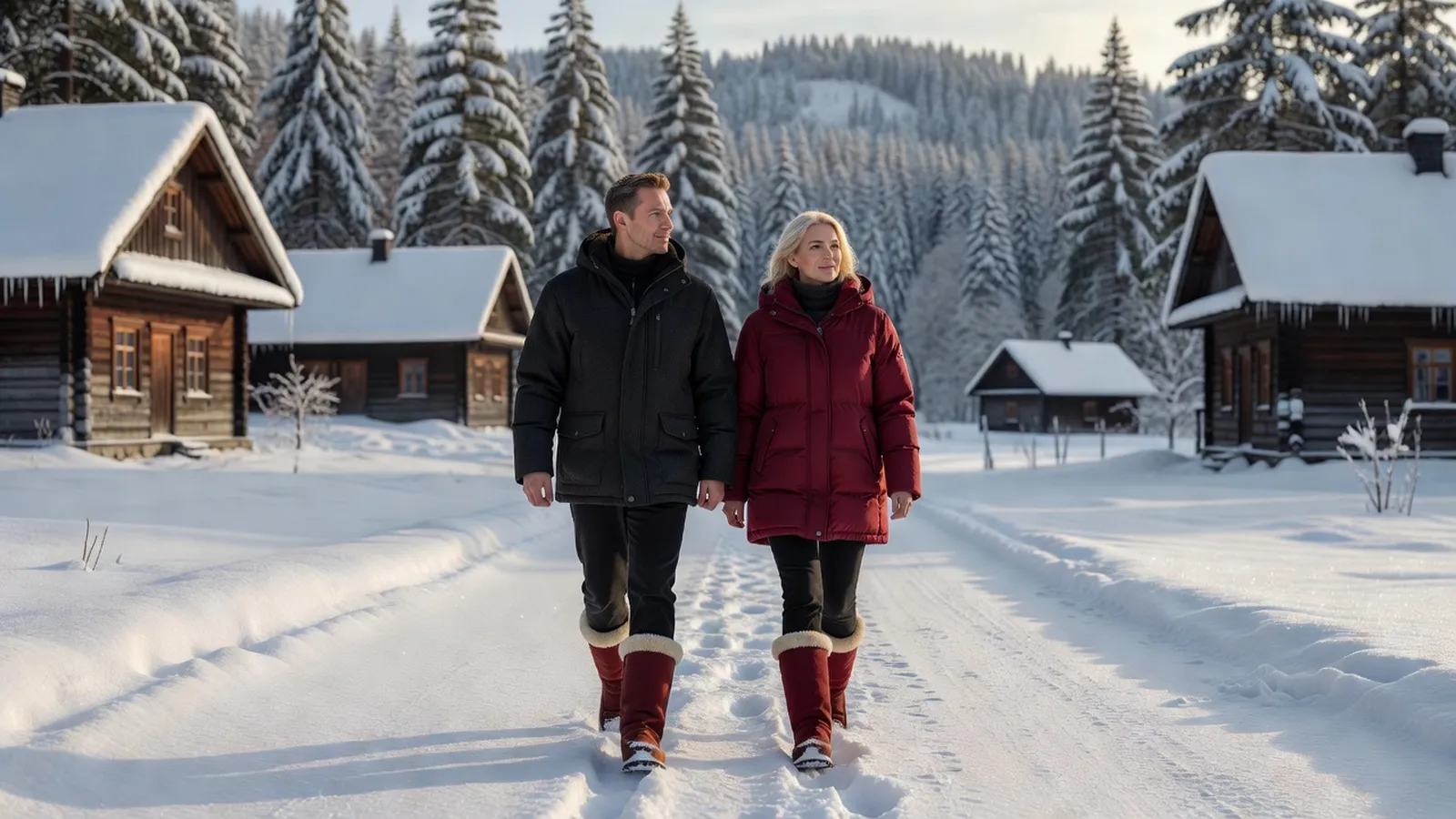
In January, Kyiv sits around the freezing mark rather than far below it: the Central Geophysical Observatory gives a mean air temperature of -3.2 °C for 1991-2020, a good deal gentler than a Montréal or Winnipeg January. What people wear there follows that profile: layers that can be opened, boots that stay dry, and warmer linings where standing still is the problem. This page sets the figures beside ours and says what a Canadian reader can keep.
The January climate in Kyiv, in official numbers
Two official sources give the reference figures for the Ukrainian capital, and they agree on the broad picture. The Central Geophysical Observatory, which reports to the State Emergency Service of Ukraine, lists an average January air temperature of -3.2 °C for the 1991-2020 normal period, with 37 mm of precipitation that month. The World Meteorological Organization's weather information service for Kyiv, drawing on the Ukrainian Hydrometeorological Center and the same 1991-2020 averaging, reports, for January, an average overnight low of -5.5 °C and an average afternoon high of -0.7 °C.
Put those three numbers side by side and a pattern appears. The average day starts a few degrees below zero and finishes just under it. Over a month, that is a city that lives on the edge of the freezing point: mornings that bite, afternoons that are cold but not brutal, and a ground that can be hard one hour and wet the next. The averages cannot tell you how often a given day departs from them, and they say nothing about a cold snap. They describe the usual January, and that is the right place to start when you are deciding what to put on.

Two cautions keep this honest. First, the figures belong to one city and one set of stations; they are not a portrait of a country that stretches a long way east to west and rises into mountains in the south-west. Second, the two sources do not report the same quantities: one gives a daily mean and a precipitation total, the other gives a mean minimum and a mean maximum. We use each for what it says and do not blend them into a single number. The sources we consulted also gave no official count of January snow days for Kyiv, so you will not find one here; the precipitation figure is a total in millimetres for all forms, and it should not be set against the snowfall in centimetres that Canadian stations publish.
What the figures ask of clothing
A mean minimum of -5.5 °C and a mean maximum of -0.7 °C describe a swing of about five degrees across an ordinary January day. That is not a large swing, but it straddles the freezing point, and that detail drives most of the practical choices.
When the air hovers just under zero, the main threats are damp and sweat, not the kind of dry cold that makes skin crack in minutes. Snow that falls at -5 °C and is trampled at -1 °C turns into slush. Boots take the brunt of it. A body that walks briskly to a tram stop and then boards a heated carriage overheats quickly, then chills when it steps back outside. Canadian occupational-health guidance puts the issue plainly: the Canadian Centre for Occupational Health and Safety (CCOHS) advises layering: an insulating inner layer that wicks moisture, middle layers that open or come off easily, and a waterproof shell in wet weather. It also steers away from cotton, which absorbs water quickly and then insulates poorly, unlike wool and synthetics, which hold their warmth when wet.
That guidance was written for working in the cold, but the physics of a damp layer next to the skin does not change at a Kyiv tram stop. The same document adds that air held between layers does more insulating than the garments do, and that extra layers mean one can be removed ahead of any sweating. For a climate where the average afternoon is -0.7 °C, that last point is the whole game: the aim is not to be as insulated as possible, but to be able to adjust.
What gets worn: layers, felt and sheepskin
The sources consulted for this page do not survey what people in Kyiv or in the Carpathians wear today, and we will not pretend otherwise. There is no official statistic on coats, hats or boots, and any description of street fashion would be an impression, not a fact. What we can do is reason from two kinds of evidence: the climate figures above, and what cold-weather guidance and museum collections say about clothing that works at these temperatures.
On the practical side, the pattern the figures suggest is a three-part one. Next to the skin, a fabric that handles moisture. Over it, a middle layer that traps warm air and can be unzipped or removed when a heated room, a metro platform or a brisk walk calls for it. On top, a shell or a coat that blocks wind and keeps off wet snow. Feet get their own logic. For strenuous work in the cold, the CCOHS names felt-lined boots with a rubber base, a leather upper and removable felt insoles as the best fit, leather being what lets sweat evaporate. It also observes that a fully waterproof boot keeps out slush and cold water yet retains perspiration, with the result that socks and insulation dampen sooner and frostbite risk grows. In a city where slush is common, that trade-off is worth knowing about, and it is why a dry foot is a better target than a thick sole.
As for sheepskin, the sources consulted are collection records, not a survey of habits. The Ivan Honchar Museum in Kyiv holds early 20th-century sheepskin coats called kozhukh, one from Podolia and one from the Middle Dnipro region, and a Ministry of Culture museum portal lists a women's winter kozhushok from the Ternopil region; that is all this page claims about it, and for a fuller picture of sheepskin as footwear you can turn to the guide to sheepskin boots.
Three situations, built on the numbers
The scenes below are typical situations, not accounts of anything the site's editors did. Each rests on the dated figures quoted above and on the Canadian guidance cited, and each says where the figures run out.
A weekday walk in Kyiv
Take an ordinary January weekday in the capital. The morning sits near the mean minimum, -5.5 °C; by mid-afternoon the temperature approaches the mean maximum, -0.7 °C. A person leaves home, walks ten minutes, rides public transport and walks again. The challenge is not the cold at either end of the trip, it is the middle: a heated carriage with a heavy coat buttoned to the chin.
A system of layers answers that. A light base layer in wool or a synthetic fabric stays on all day. A mid layer comes off, or opens at the front, once the person sits down inside. The outer coat is worn open or over the arm. Cotton against the skin is the thing to avoid, because after the carriage it will be damp when the person steps outside. The CCOHS point about removing a layer before you sweat is, here, a daily routine rather than an emergency tip.
A weekend in the Carpathians
Here the numbers stop. The sources consulted give no climate figures for the Carpathians, so this page quotes none, and a reader planning a trip should look at the forecast from the national hydrometeorological service for the specific valley or ridge and the specific dates. What can be said without a figure is about activity.
Baffin, a Canadian boot maker, defines its Polar Rated category by comfort during moderate activity, a heart rate held at 55 to 69 percent of its maximum, in places where temperatures of -45 °C to -60 °C have occurred; the rating rests on its own testing team and is the company's definition, not a standard. The useful lesson is the dependence on activity. Someone who hikes uphill generates heat and needs ventilation. Someone who waits at a lift, takes photos, or sits down for lunch loses that heat quickly and needs a spare insulating layer in the pack. The same person can be too hot and too cold within the hour, which is another reason for layers that open and close.
A wet-snow day on foot
The third scene is the one that the near-zero averages make most likely: a long walk on a day when snow has softened underfoot. The hazard is wet feet. A boot that leaks soaks the sock, and a wet sock stops insulating. A boot that is fully sealed has the opposite weakness, trapping sweat, as the CCOHS notes. The practical answer is a balance: a boot that keeps slush out at the sole and welt, with a lining that can be pulled out and dried overnight, and socks changed once they are damp.
CCOHS likewise recommends trying boots on with the socks you intend to wear, since excessively thick socks get crushed in the boot, lose their insulating value and pinch the foot, slowing circulation. In a wet-snow city, where people walk a lot and the boot is the only barrier, that fitting detail is easy to get wrong and costly to discover on the street. Cleaning and drying come next, and the boot care guide covers the routine.
There and here: the comparison
The table sets Kyiv's January reference figures beside the 1991-2020 normals of two Canadian cities published by Environment and Climate Change Canada: Montréal (Trudeau airport station) and Winnipeg (Richardson airport station). The columns come from different organizations and station types, so treat the comparison as a sense of scale, not as a precise measurement.
| Topic | There | Here |
|---|---|---|
| January mean daily temperature | Kyiv: -3.2 °C (Central Geophysical Observatory, 1991-2020) | Montréal: -9.2 °C; Winnipeg: -16.3 °C |
| January mean daily minimum | Kyiv: -5.5 °C (WMO service, 1991-2020) | Montréal: -13.5 °C; Winnipeg: -21.2 °C |
| January mean daily maximum | Kyiv: -0.7 °C (WMO service, 1991-2020) | Montréal: -5.0 °C; Winnipeg: -11.4 °C |
| January days with a maximum of -10 °C or colder | Not found in the sources consulted | Montréal: 7.6 days; Winnipeg: 17.0 days |
| January days with a maximum of -20 °C or colder | Not found in the sources consulted | Winnipeg: 5.3 days |
| What the day demands of clothing | Layers that open, dry feet, wet-snow management | Same layers, plus more insulation and more skin cover |
Run the subtraction and the gap is plain. Montréal's January mean is about 6 degrees colder than Kyiv's, and Winnipeg's about 13 degrees colder. At the mean minimum the gaps widen to about 8 degrees for Montréal and about 16 for Winnipeg, and at the mean maximum they are about 4 and about 11. In other words, an average Kyiv afternoon is warmer than an average Montréal afternoon by a margin that a Montréaler would feel, and it is a different world from a Winnipeg one.
Two things the table does not say deserve spelling out. It does not say Kyiv never gets cold; averages hide extremes, and the sources consulted do not report them. And it does not rank the two countries, because a 30-year January average in one city is not a verdict on a country's winter.
What a Canadian reader can keep
The first takeaway concerns the swing around zero. Winnipeg's problem is depth of cold; Kyiv's is proximity to freezing. In Montréal, a thaw followed by a refreeze creates the same slush-and-ice cycle, which is why Kyiv's methods carry over to a lot of eastern Canadian days. If you live somewhere with frequent thaws, the priorities that fit best are the ones above: a moisture-handling base, a removable middle, a wind-blocking shell, and a boot that you can dry.
The second concerns wind. Kyiv's figures do not include wind data, so this page cannot say anything about wind chill there. In Canada, though, Environment and Climate Change Canada explains that wind chill describes the chill that bare skin feels when temperature and wind act together, a figure no thermometer shows. A Canadian dressed for the air temperature alone can be caught out; the official chart, for example, gives -18 at -10 °C with a 20 km/h wind. That habit, checking the wind chill and not just the thermometer, is worth keeping wherever you travel.
The third concerns the boots, and here the Canadian reader has the advantage of a long tradition of cold-weather footwear. The guide to winter boots for the Canadian climate goes through temperature ratings, linings and fit with Canadian normals in hand. What Kyiv adds is a reminder that for a near-freezing winter, the boot is judged less by its rated temperature than by how well it handles wet and sweat.
The fourth is the way to read this page against its neighbours. The overview of winter in Russia and Eastern Europe places Kyiv within a wider comparison, and the layering guide turns the principles above into a full method for Canadian conditions, using the official wind chill scale and the guidance of Health Canada and the CCOHS.
Frequently asked questions
How cold is Kyiv in January?
According to the Central Geophysical Observatory, the average January air temperature over 1991-2020 is -3.2 °C. The WMO service lists a mean daily minimum of -5.5 °C and a mean daily maximum of -0.7 °C for the same month.
Is a Ukrainian winter colder than a Canadian one?
Compared with the January normals of Montréal (-9.2 °C mean) and Winnipeg (-16.3 °C mean), Kyiv's January average is milder. That is a statement about one city's averages, not about the whole country or the mountains.
What about the Carpathians?
The sources consulted for this page give no mountain figures, so none are quoted here. Check the forecast of the national hydrometeorological service before travelling, and dress for the wind and for standing still.
Do people in Ukraine still wear sheepskin coats?
The sources consulted are museum records: the Ivan Honchar Museum in Kyiv holds early 20th-century sheepskin coats, and a Ministry of Culture portal lists another. None of them measures present-day habits, so this page does not claim one.
What can a Canadian take from Kyiv's winter?
Mostly the method: layers that open, boots that let sweat out and keep slush out, and more insulation when you are not moving. Canadian guidance from CCOHS, Health Canada and Environment and Climate Change Canada says the same.
Sources
Verified on
- Observatoire géophysique central Boris Sresnevsky, Climate data for the city of Kyiv, Service d'État des situations d'urgence de l'Ukraine, 2026.
- Organisation météorologique mondiale, World Weather Information Service : Kyiv, OMM, 2026.
- Musée national Ivan Honchar, Kozhukh (fur coat) decorated with applique, КН-12448, Musée Ivan Honchar, Kyiv, 2026.
- Musée national Ivan Honchar, Kozhukh (fur coat) decorated with applique, КН-11466, Musée Ivan Honchar, Kyiv, 2026.
- Ministère de la Culture de l'Ukraine, Women's sheepskin coat (Ternopilskyi Regional Local History Museum), Portail des musées du ministère de la Culture, 2026.
- Environnement et Changement climatique Canada, Canadian Climate Normals 1991-2020 Data: MONTREAL TRUDEAU (AIRPORT), Gouvernement du Canada, 2025.
- Environnement et Changement climatique Canada, Canadian Climate Normals 1991-2020 Data: WINNIPEG RICHARDSON (AIRPORT), Gouvernement du Canada, 2025.
- Centre canadien d'hygiène et de sécurité au travail (CCHST), Cold Environments - Control Measures, Centre canadien d'hygiène et de sécurité au travail (CCHST), 2025.
- Environnement et Changement climatique Canada, Wind chill and the Wind Chill Index, Gouvernement du Canada, 2025.
- Baffin, Polar Rated: Cold Comfort Rating, Baffin, 2026.