Australian sheepskin boots began as a local product with a blunt nickname, and the sources read for this article disagree even on the year the first trademark was registered. A 1971 newsreel shows a surfboard maker stitching lambskins in a Botany factory. A United States court opinion from 2018 explains how the word later turned into a registered brand, and why a judge refused to call it generic in the American market. Canada's registry is a separate story, told further down.
What the surfers' story rests on
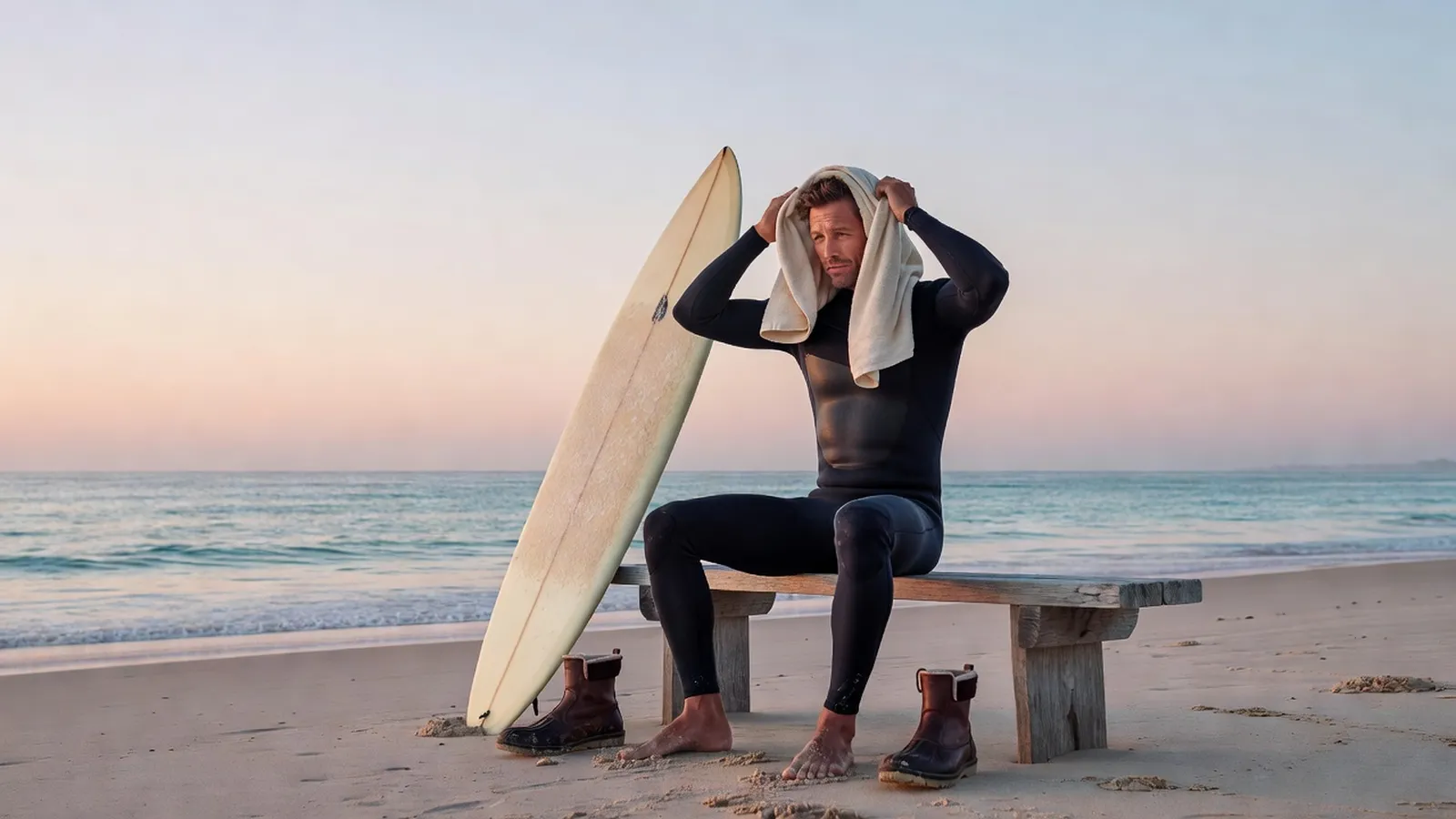
Ask where Australian sheepskin boots come from and the answer usually arrives wrapped in a picture: surfers pulling on a warm, shapeless boot after a cold morning in the water. It is a good picture. It is also the part of the story that the official sources read for this article document least. Nothing found at a museum, a wool body or a government archive gives a date for the first pair, a name for the first maker or a figure for how many surfers wore them.
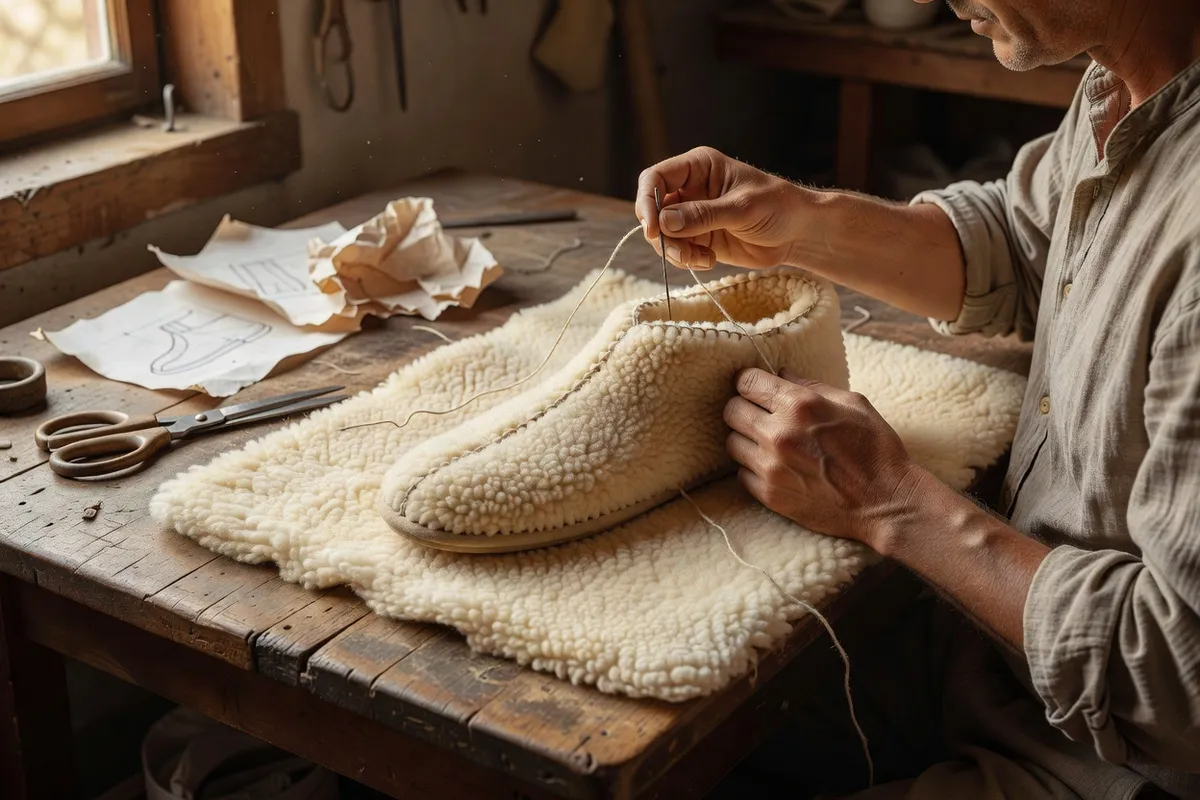
What the record does contain is narrower and more interesting. The National Film and Sound Archive of Australia describes a newsreel from 1971 that shows a surfboard maker, Shane Stedman, and his workers in a factory in Botany, New South Wales. On screen they cut lambskins and sew them together with glued-on soles. The archive adds that 1,500 pairs were being sold each week at that time. You can read the archive's own account in its article on the birth of an Aussie fashion icon.
So the link between surf culture and the boots is real in one respect: the man shown at the sewing table made surfboards for a living. Why the boots suited people who spent their days wet and cold is a plausible explanation that sources read here do not spell out, and this article will not invent one. For the practical question of what sheepskin does and does not do against the cold, the warmth breakdown at minus 20 degrees works from official climate data instead of legend.
Before the 1960s, the trail goes quiet. Popular accounts sometimes reach back to earlier, rural uses of sheepskin footwear. None of the sources read here covers that period, so this article offers no dates and no names for it.
A nickname, as the maker tells it
The same archive article quotes Stedman on the name. According to the archive, he said the boots got their nickname because they were ugly. He also said that others were making them as well, with one person selling pairs at the roadside, and the article presents him as the man who popularised them in Australia.
Two details are worth holding on to. First, the explanation of the word is attributed to one person, reported by an archive, and nobody else's version appears in the sources. Second, the passage describes a product with several makers. That detail matters later, because a word that several makers use for a type of boot is a different legal animal from a word that identifies one company.
Here, and only here in this article, the brand needs introducing. UGG® (a trademark of Deckers Outdoor Corporation) is the name of a company's product line today. The word began, in the telling of the archive, as a label for a kind of footwear. The rest of this article is about the distance between those two meanings, and about what courts and registries have actually written on the subject.
Two sources, two years for the first registration
The archive says Stedman registered a trademark in 1968 and later sold UGH to Deckers. The American court opinion, which recites the history of the marks, dates his Australian registration of UGH-BOOTS to 1971, followed by UGH in 1982. The two sources disagree on the year and neither one explains the gap.
A gap like this can come from many places: an application filed in one year and registered in another, two different marks, a summary written decades later. The sources read do not say which, and guessing would be a way of manufacturing a fact. The table lays out what each one states.
| Item | What the archive's article says | What the 2018 court opinion says |
|---|---|---|
| First Australian trademark by Stedman | 1968, a trademark registered because others were making the boots | UGH-BOOTS registered in 1971; UGH registered in 1982 |
| Sale to Deckers | Stedman later sold UGH to Deckers | Deckers purchased the UGH-BOOTS mark in 1996 |
| End of the Australian registrations | Not mentioned | Both marks stayed on the register until 2006, then were removed for non-use |
The last row deserves a second look. Marks removed for non-use were not cancelled because a tribunal declared a word generic. The opinion gives non-use as the reason for removal, not a finding about the word's meaning. A separate decision of the Australian trademark office from 2006 is sometimes cited for the idea that the word became generic in Australia, but that decision could not be read for this article, so the claim is left alone here.
From a factory in Botany to an American company
The court opinion also tells a second origin story, this time on the other side of the Pacific. It recounts that Brian Smith, born in Australia, moved to the United States in 1978 and founded the sheepskin-boot company known today as UGG. Deckers acquired UGG Holdings and its UGG trademark in 1995.
The sentence is worth reading slowly. The company and the Australian trademarks in the earlier section are two different strands. One strand is a set of marks registered in Australia and later bought by Deckers. The other is a company founded in the United States by an Australian-born man, later acquired along with its mark. By the mid-1990s, a single owner held both.
According to the same opinion, the company made all of its footwear in Australia from 1979 to 1985. Manufacturing then moved to China, Vietnam and elsewhere, while most of the sheepskin kept coming from Australia. In 2015 the business rebranded from UGG Australia to UGG. The opinion also records, on the evidence before the court, that the brand has had global annual sales above US$1 billion every year since 2011 and that Deckers repositioned it as a luxury brand after acquiring it in 1995. These are the opinion's recitals of the record, not an independent audit, and they are reported here as such.
For readers shopping in Canada, there is a practical lesson in that paragraph. The place a pair was made and the place its sheepskin came from are two separate questions, and labels are where the first one is answered. The court found that Deckers accurately labels the inside of each pair with the country of manufacture, and it rejected the argument that the slogan UGG Australia was deceptive for boots not made in Australia. The same habit of reading labels is at the heart of the guide to spotting fake sheepskin boots.
The Illinois case: who sued whom, and why
The ruling that shaped much of the public conversation comes from a United States federal court in the Northern District of Illinois. Deckers Outdoor Corp., owner of the brand, sued Australian Leather Pty. Ltd. and its owner for trademark and design patent infringement over boots sold as "ugg boots". The defendants did not simply deny the claim. They argued that the word is a generic term for a type of sheepskin boot, and they counterclaimed to cancel the brand's registrations.
That defence follows a familiar pattern in trademark law in general: if a word has come to mean the product itself, rather than one company's version of it, it can lose protection. The question for the judge was therefore not who made the first boot or who said the word first. It was what the word means to the people who buy footwear in the American market.
The court's memorandum opinion and order is dated 13 September 2018, not 2019, as it is sometimes reported. It ruled on cross-motions for summary judgment on some of the counterclaims and defences. In plain terms, the judge granted Deckers's motion in part and denied the one filed by Australian Leather. The full text is available from the U.S. Government Publishing Office, and it is the only court document on the question that was read in full for this article.
What the judge decided about the word
Deckers won its motion for partial summary judgment against Australian Leather on three of the latter's theories: fraud, generic status and the foreign equivalents doctrine. It denied the motion on Australian Leather's damages calculation. Those three grounds, and the one the court left open, make a compact scorecard.
| Question before the court | Result recorded in the opinion |
|---|---|
| Fraud claims by Australian Leather | Deckers's motion granted |
| Whether the word is generic | Deckers's motion granted; no showing of generic status among American footwear buyers |
| Foreign equivalents doctrine | Deckers's motion granted |
| Australian Leather's damages calculation | Deckers's motion denied |
On the genericness question, the reasoning is the part worth quoting in substance. On the evidence it was given, the court found that Australian Leather had not shown the word to be, or ever to have been, generic among footwear customers in the United States, which it treated as the relevant public. The judge leaned on a 2017 survey in which 98 % of 600 respondents saw the word as a brand name, and on dictionary and database searches that turned up no generic use.
The court also took up the Australian angle. It wrote that the way Australians use the word could be relevant, but that generic usage in Australia is not enough on its own to infer a generic meaning in the United States. It held, too, that the foreign equivalents doctrine is not a perfect fit for English-to-English disputes, since the doctrine is generally used for non-English terms in the American marketplace. It added that, even if the term were assumed to be generic in Australia, no reasonable jury could find it generic in the United States.
That last sentence is easy to misread. The judge did not rule that the word is not generic anywhere. The judge ruled that, on the record in that case, the American market could not be shown to treat it as generic.
What the ruling does not say
Three limits keep the Illinois decision in proportion.
First, it is about the United States. The opinion's finding concerns American footwear buyers, and it is not a ruling on Canadian law. A Canadian court, or the Canadian registry, would approach the question with its own statute and its own evidence.
Second, it is a ruling on motions. A grant of summary judgment on some claims is not a finding that the whole dispute has ended on the judge's preferred terms, and the opinion's own wording is about what could be shown on the evidence submitted.
Third, a district court opinion is one voice in a legal system with appeals. Which brings up the next section.
The appeal: what the docket page shows, and what it does not
The Federal Circuit's own docket page for appeal no. 20-2166, Deckers Outdoor Corporation v. Australian Leather Pty Ltd, lists a Rule 36 judgment. The page marks it nonprecedential and posts it for 7 May 2021. That is the whole of what the page conveys: it does not give the reasoning, and the judgment document itself could not be downloaded for this article.
For that reason, this article does not say what the appeal court decided in substance, and it does not describe its motives. The docket page by itself does not tell a reader which party the court sided with on which question, and the word "affirmed" appears nowhere in what was read. Anyone who needs to know should open the Federal Circuit's own docket page and, for legal consequences, consult a lawyer.
In Canada: three registry records
Canada's trademark register is a different source, and a simpler one to read. The records consulted for this article show three registered word marks owned by Deckers Outdoor Corporation. Each of them reads as follows.
| Registration | Registered | Expiry | Goods and services listed |
|---|---|---|---|
| TMA574621 | 29 January 2003 | 29 January 2033 | Shoes made of sheepskin; used in Canada since at least October 1992, per the record |
| TMA709158 | 7 March 2008 (filed 1 October 2004) | 7 March 2033 | Handbags and other bags, pillows, throws, rugs, jackets, shoes and boots, various clothing and footwear |
| TMA726883 | 24 October 2008 | 24 October 2033 | Water and stain repellent and cleaner for sheepskin and leather; retail, mail order and online retail services for footwear, clothing, handbags and home accessories |
All three show the status REGISTERED. The Canadian Intellectual Property Office's database pages are public; the one for registration TMA574621 is a good starting point, and the other two are on the same database under application numbers 1232457 and 1322554.
Section 19 of the Trademarks Act explains what such a registration does. Unless it is shown to be invalid, registration of a trademark for given goods or services gives its owner the exclusive right to use it throughout Canada for those goods or services. That is the statute's wording in substance, and the text of the section is short.
Now the boundary. These three records are the only Canadian status facts read for this article. No Canadian court decision and no registry note about generic use was found. This article therefore says nothing about whether the word is generic in Canada, and the Illinois ruling cannot be borrowed to fill that silence. Whether a particular product or sign infringes anything is a question for a lawyer.
One word on two registers
The Australian register adds a final wrinkle. The Australian Government's trade mark register, kept by IP Australia, shows a figurative mark, number 1013798, containing the words UGG AUSTRALIA PTY LTD. It is registered for class 25, for footwear described in the record as sheepskin boots and headgear, and it belongs to Ugg Australia Pty Ltd, due for renewal on 2 August 2034. An opposition lodged by Deckers Outdoor Corporation Inc. appears in the record as finalised.
Put the pieces side by side and the picture is untidy but clear. In Australia, a figurative mark owned by an Australian company coexists with the history of marks bought and later removed. In the United States, a court found no proof of generic use among the relevant buyers. In Canada, registry records show registered word marks. A single English word can live three different legal lives, and the facts for one country say little about the next. The Australian entry is public on IP Australia's trade mark search, but this article reaches no conclusion about it beyond what the record displays.
Reading a pair of boots when the name is contested
Back to the footwear. The history above is a story about words, and a reader in Canada mostly has to deal with objects: a pair in a shop window, a listing online, a gift to be wrapped. Four habits carry over from the history without any legal argument.
- Read the inside label. The court found that the label of the brand it examined gives the country of manufacture. A pair with no readable label, or a label that contradicts the listing, tells you something before any trademark question comes up.
- Separate the material from the name. Sheepskin is a material, with specific behaviours in wet, cold and salty conditions. The complete guide to sheepskin boots covers what the material is and how pairs are built.
- Treat a brand story as a story. The surfers, the roadside seller and the Botany factory are details from an archive and a court opinion. Neither tells you how a given pair will behave in slush.
- Match the boot to the weather rather than to the legend. Alternatives exist for people who do not want animal fibres at all, and the comparison of vegan alternatives looks at synthetic linings on their own terms.
Anyone worried about copies sold under a famous name will find the method in the fakes and safe-buying hub. It stays away from vendor lists on purpose and teaches how to check a seller and a label instead.
The short version, with no loose ends
The Australian story and the American one are both true to their sources, and they do not merge into one tidy narrative. In Australia, an archive shows a surfboard maker at work in 1971 and quotes his explanation of a rude nickname. In Illinois, a judge in 2018 weighed a survey, dictionary searches and an Australian usage argument, and found no showing of generic status among American buyers. In Canada, three registry records show registered word marks, and nothing read here speaks to genericness. On appeal in the United States, the docket page lists a short, nonprecedential Rule 36 judgment and stops there.
What remains outside the record is just as informative. Nothing read dates the earliest rural boots. No wool body or museum page documents the surfers' habits. No decision of an Australian office on genericness could be read. The honest account of the history of Australian sheepskin boots therefore has holes, and those holes are better left visible than filled with a story that sounds right.
Meanwhile, the footwear question is simpler than the legal one. A sheepskin boot is judged by its hide, its stitching, its sole and the weather it is asked to face. For readers weighing sheepskin against a Canadian-style alternative, the comparison of mukluks and sheepskin boots picks up where this history stops.
The Frost & Fleece editorial team
Frequently asked questions
Where do Australian sheepskin boots come from?
The National Film and Sound Archive of Australia describes a 1971 newsreel of a surfboard maker and his workers cutting lambskins and sewing them with glued-on soles in a Botany factory. The same article says other people were making the boots too, so the record points to several makers rather than a single inventor.
Where did the boots' nickname come from?
The archive's article reports the surfboard maker Shane Stedman as saying the boots got their nickname because they were ugly. That is one man's recollection, quoted by the archive; the sources read for this article do not settle the word's origin beyond it.
Did a court decide that the word is generic?
In the 2018 Illinois ruling, the judge found that the challengers had not shown the word to be generic among footwear buyers in the United States. The ruling concerns the American market only, and it does not decide how Canadian law treats the word.
Is the word registered as a trademark in Canada?
The Canadian registry records read for this article list three word marks, registered between 2003 and 2008 and held by the same owner, all with the status REGISTERED. Under section 19 of the Trademarks Act, a registration gives its owner the exclusive right to use the mark for the listed goods or services, unless it is shown to be invalid.
What happened on appeal in the American case?
The Federal Circuit's docket page for appeal no. 20-2166 lists a Rule 36 judgment, marked nonprecedential, posted for 7 May 2021. The page does not give reasons, so this article reports nothing more than what it displays.
Sources
Verified on
- United States District Court, Northern District of Illinois (Judge Manish S. Shah), Deckers Outdoor Corp. v. Australian Leather Pty. Ltd., No. 16 CV 3676, Memorandum Opinion and Order (13 September 2018), U.S. Government Publishing Office (GovInfo), 2018.
- United States Court of Appeals for the Federal Circuit, 20-2166: Deckers Outdoor Corporation v. Australian Leather Pty Ltd [Rule 36 Judgment], Nonprecedential, U.S. Court of Appeals for the Federal Circuit, 2021.
- National Film and Sound Archive of Australia (Tara Marynowsky), Ugg boots: birth of an Aussie fashion icon, National Film and Sound Archive of Australia, 2017.
- IP Australia, Trade Mark 1013798 | IP Australia | Trade Mark Search, Gouvernement de l'Australie, 2026.
- Office de la propriété intellectuelle du Canada, Base de données sur les marques de commerce canadiennes : fiche 0737338 (TMA574621), Gouvernement du Canada, 2026.
- Office de la propriété intellectuelle du Canada, Base de données sur les marques de commerce canadiennes : fiche 1232457 (TMA709158), Gouvernement du Canada, 2026.
- Office de la propriété intellectuelle du Canada, Base de données sur les marques de commerce canadiennes : fiche 1322554 (TMA726883), Gouvernement du Canada, 2026.
- Ministère de la Justice du Canada, Trademarks Act (R.S.C., 1985, c. T-13), section 19, Gouvernement du Canada, 2026.