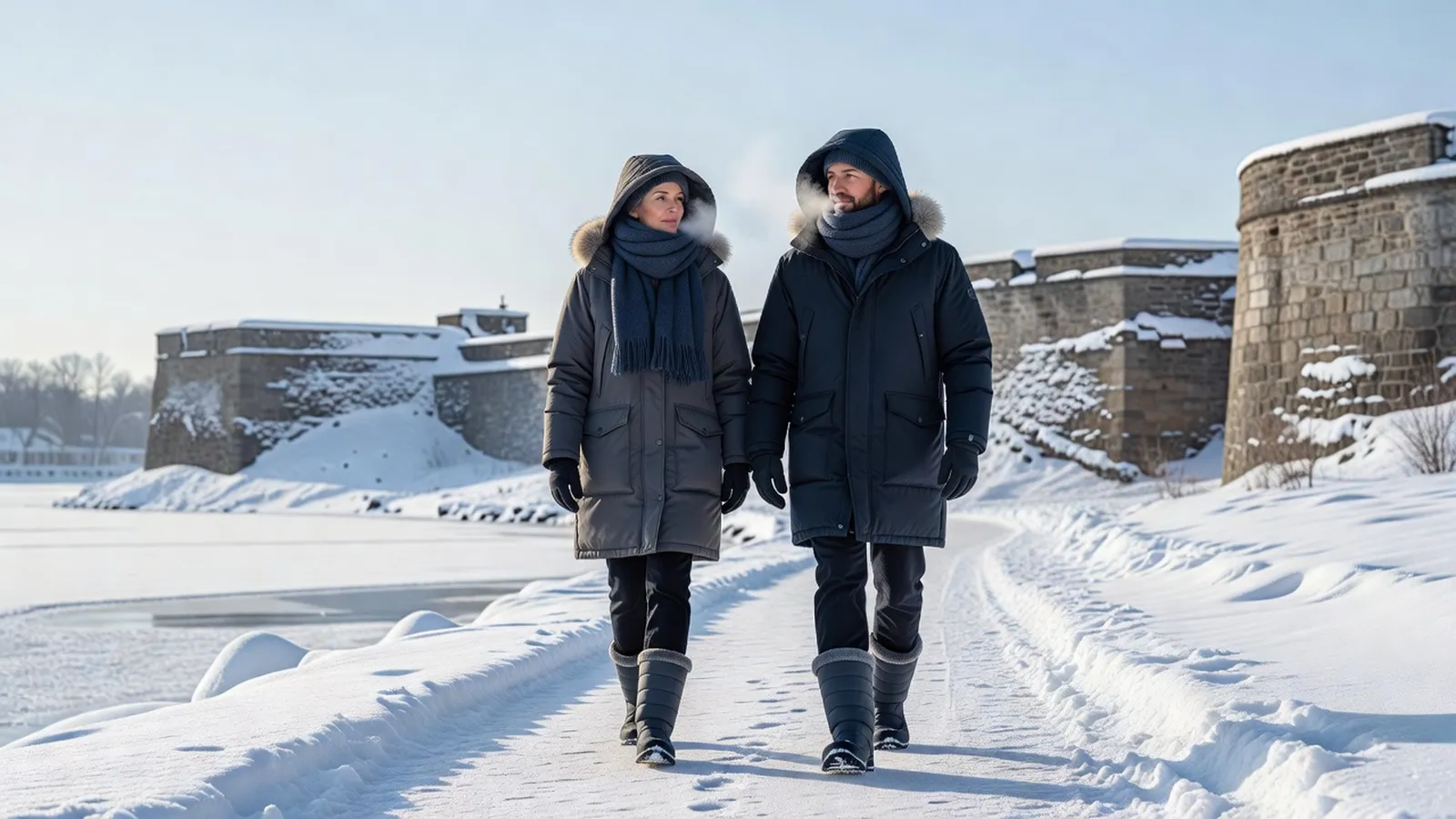
Sheepskin can help keep feet warm at -20 °C, but a wool lining is not a promise of comfortable toes. Its curled fibres hold still air close to the foot and can take up moisture before they feel wet. Neither property tells you how well the outsole separates you from cold ground, what happens when slush reaches the boot, or how you'll feel waiting for the bus. Choose for the part of the outing when you won't be walking, too.
What does the maker's temperature claim actually cover?
Start with a fairly precise claim. In its 2026 FAQ, Manitobah Mukluks gives a lower design temperature of -32 °C for its sheepskin-lined mukluks and boots in cold, dry weather. The words after the figure matter as much as the figure itself. They describe the setting the maker has in mind. The subject matters, too: Manitobah is describing its footwear, not giving a temperature rating to the sheepskin that another maker might use in a different boot.
For someone heading out at -20 °C, it's tempting to read the difference between the forecast and the maker's figure as a comfortable margin. That would take a design claim and turn it into a prediction about a particular pair of feet. There is no independent comfort test in the sources here that supports that calculation. Nor does the claim tell you how long you can stand on a platform after the walk there. Adding a time to the temperature would be putting words in the maker's mouth.
A useful way to read a boot description is to finish this sentence: The maker says this about this boot, worn in these conditions. If all you can fill in is the material, you have some information about insulation but none about the conditions of use. If you can fill in the boot and the conditions, compare those conditions with your route. A dry walk might be a reasonable match for the intended use. A crossing awash in meltwater calls for information the dry-weather claim doesn't supply.
This distinction is especially useful when comparing styles that may have some materials in common. Our comparison of mukluks and sheepskin boots starts with the footwear rather than treating the names as rival temperature ratings. A mukluk can itself contain sheepskin. The more revealing comparison is between what each pair puts around and beneath the foot, and which of those features the maker has actually described.
Read the boot from the footbed down
Picture an unoccupied boot with the opening turned towards you. The wool you can see at the ankle answers a narrow question: what's here, at the opening? It is much harder to tell from that view what will be under the ball of your foot. Start there instead. Find the description of the surface the foot rests on, distinguish it from the lining around the foot, then look for a separate account of the sole that meets the ground.
Take the footbed in Manitobah's 2026 FAQ. The company says it uses shearling underfoot in most of its mukluks and in some moccasins, and that the surface takes on the shape of the foot. That's useful detail if you're trying to picture where the wool sits. It isn't a measurement of the insulation left beneath a standing wearer. A foot-shaped impression doesn't tell you how much heat has passed through the sole. It needn't be read as proof of either good insulation or its failure.
The outsole deserves a question of its own, particularly for a trip with a wait at the far end. What does the description say about the construction between the footbed and the ground? If it describes only the softness of the inside, the answer is still open. There's no basis here for specifying a sole thickness for a snowy bus stop, or for working backwards from the depth of the wool at the ankle to a temperature limit under the heel. The slush-season guide for Montréal looks at soles and socks for exactly those days.
For a pair you already own, it helps to separate what you know about its original construction from questions about its present condition. If the concern is the sole itself, our boot repairer's interview on sole work and winter wear is a more relevant starting point than a fibre description. For the names of the parts and a broader view of the footwear, the guide to sheepskin boots keeps the lining in the context of the whole pair.
The useful space between curls
Woolmark's 2026 account of the wool fibre starts with keratin, the protein that makes up the fibre grown by the sheep. Woolmark connects the fibre's layered structure with its ability to manage moisture and help moderate temperature. For warmth in a boot, there's another feature that's easier to picture: the fibre doesn't lie straight. Woolmark's 2025 explanation of breathability describes a curl in three dimensions. Among those bends are little spaces where air stays relatively still.
Think of the difference between naming an ingredient and explaining its job. “Wool” names the ingredient. The still air among the fibres helps explain the job: slowing the movement of heat from the warmer foot towards the colder surroundings. In its 2026 footwear toolkit, Woolmark credits that arrangement with particularly strong protection against heat loss in sheepskin boots. It's an industry body's account of why the material works, not an independent comparison of pairs worn on the same winter pavement.
That explanation also puts the word warm in perspective. In the context of trapped air, it describes keeping some of the foot's warmth close, not bringing the inside of every boot to a set temperature. You can take the mechanism seriously without making such a promise. It explains why wool is useful along the sides of the foot even if you still have questions about the ground below it. The wool needn't do the outsole's job to do its own.
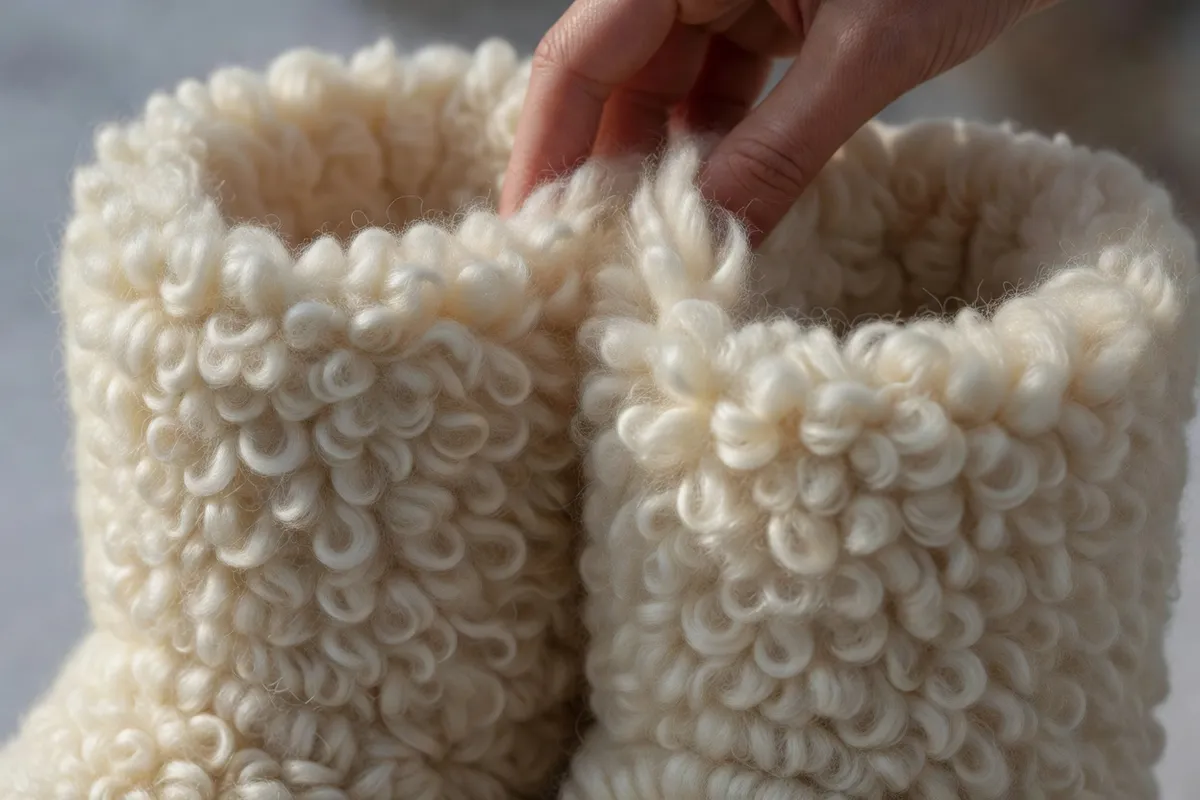
A close look at the curls can tell you more than a distant view of a fluffy cuff, but it has its limits as well. Parting the lining lets you see where the fibres are. It doesn't reproduce the space available with your usual sock and foot inside. For that part of the decision, leave the empty boot behind and consider the conditions on the other side of the wool: skin, a sock and the moisture produced during a walk.
How can a lining hold moisture and still feel dry?
The key word is vapour. Wool can take up moisture from the air around it; it doesn't have to be sitting in a puddle. In its 2025 fact sheet on wool and breathability, Woolmark says the fibre can take up moisture equivalent to as much as 35% of its own weight before it feels wet to the wearer. The percentage refers to the wool. It isn't a fraction of the weight of the boot, and it isn't the amount of slush you can step in.
For the walk to a bus stop, that difference is quite practical. A lining can help keep the immediate surroundings of the foot feeling drier while the walker perspires. At the stop, a sock that doesn't feel clammy is welcome. But its feel isn't evidence that no perspiration has entered the lining. Nor, if the sock later feels damp, is that alone enough to identify a leak. The sensation tells you something about comfort at that moment, rather less about the route the water took.
Woolmark's 2025 fact sheet also describes heat being released as wool takes up moisture. It links this effect to the feeling of warmth in damp cold. This is a different point from the still air among the curls: one concerns what happens during moisture uptake, the other concerns insulation. Neither is a reason to wet a lining before going out or to count on a damp sock for extra warmth during the wait home.
There's a useful question to ask whenever a material is described as breathable: Which material? A statement about the wool right beside a sock needn't describe the outside of the boot at all. It's quite possible for the lining to take up vapour as described and for the wearer still to be unhappy with the dampness inside. To make sense of that combination, look beyond the wool to the boot enclosing it.
A dry sidewalk and a slushy crossing call for different things
Manitobah makes the distinction within its own footwear. In its 2026 FAQ, the company describes its untreated suede and leather styles as porous, a quality it considers useful in severe dry cold. It contrasts them with its sealed waterproof styles, which it says are less breathable and may feel damp from perspiration. It's a comparison between constructions from this maker, not a rule that any boot with a suede appearance belongs on dry snow or that any sealed boot will leave you uncomfortable.
From a workplace perspective, the Canadian Centre for Occupational Health and Safety (CCOHS) describes a similar trade-off in its 2025 guidance on working in the cold. A fully waterproof boot keeps slush and cold water out. It can also hold perspiration in, leaving socks and insulation damp more quickly and increasing the risk of cold injury. The point isn't to give up the barrier where cold water is the problem. It's to recognize what that barrier can and cannot keep dry.
| Part of the route | What the boot needs to address | What to look for in the description |
|---|---|---|
| Dry ground on the walk out | Heat loss without an expected crossing through water | Where the insulation sits and whether the maker specifies dry use |
| A slushy curb on the return | Liquid water against the outside | A statement about water protection for that boot, not just about its lining |
| A walk in a sealed pair | Perspiration on the inside | How the maker describes breathability as well as waterproofing |
| A wait after the walk | The condition of the socks and lining when movement stops | Information about the footbed and sole, separate from the upper |
Suppose the only wet part of a trip is a crossing near the destination. Its short place on the itinerary doesn't turn it into dry terrain. Conversely, a route entirely on dry ground doesn't acquire a need for a sealed outer just because the forecast is cold. Describe the specific problem before choosing the feature. “I need to keep cold water out at the curb” leads to a rather different choice than “I want the lining to feel less damp when I arrive.”
Try the sock in the boot, not beside it
A thick sock laid on a bench looks like insulation you could simply add to what's already in the boot. Put it on and the question changes: is there room for it to do that work? CCOHS, writing for workplaces in 2025, advises matching sock thickness to the available space. If a sock is squeezed inside a boot, it can lose insulating value. If the combination constricts the foot, CCOHS says circulation can slow and the risk of cold injury can rise.
Try the pair with the socks intended for the outing and fasten it as you would outside. Pay attention to what changes when the boot closes around the sock. If the foot now feels squeezed, don't credit the sock with all the insulation it seemed to offer on the bench. Compare it with a less bulky sock in the same boot. The aim isn't to find the thinnest sock; it's to avoid relying on thickness that the boot cannot accommodate.
This is one place where an explanation about compression is supported, but its subject is the sock. It would be a leap to use the CCOHS guidance to assign a heat-loss figure to shearling under the wearer's weight. It would be another to decide that an extra footbed must improve warmth regardless of fit. If you change what sits beneath the sock, try the combination again rather than assuming that the room you had before is still there.
There's a modest advantage to settling this question indoors. You can compare two combinations without trying to interpret a change of wind, a damp crossing or a delayed bus at the same time. What you learn is quite specific: which combination fits without squeezing. You haven't established how long either one will feel comfortable outdoors, but you have removed a poor fit from the things you need to resolve at the stop.
At the stop, read the wind chill as well as the thermometer
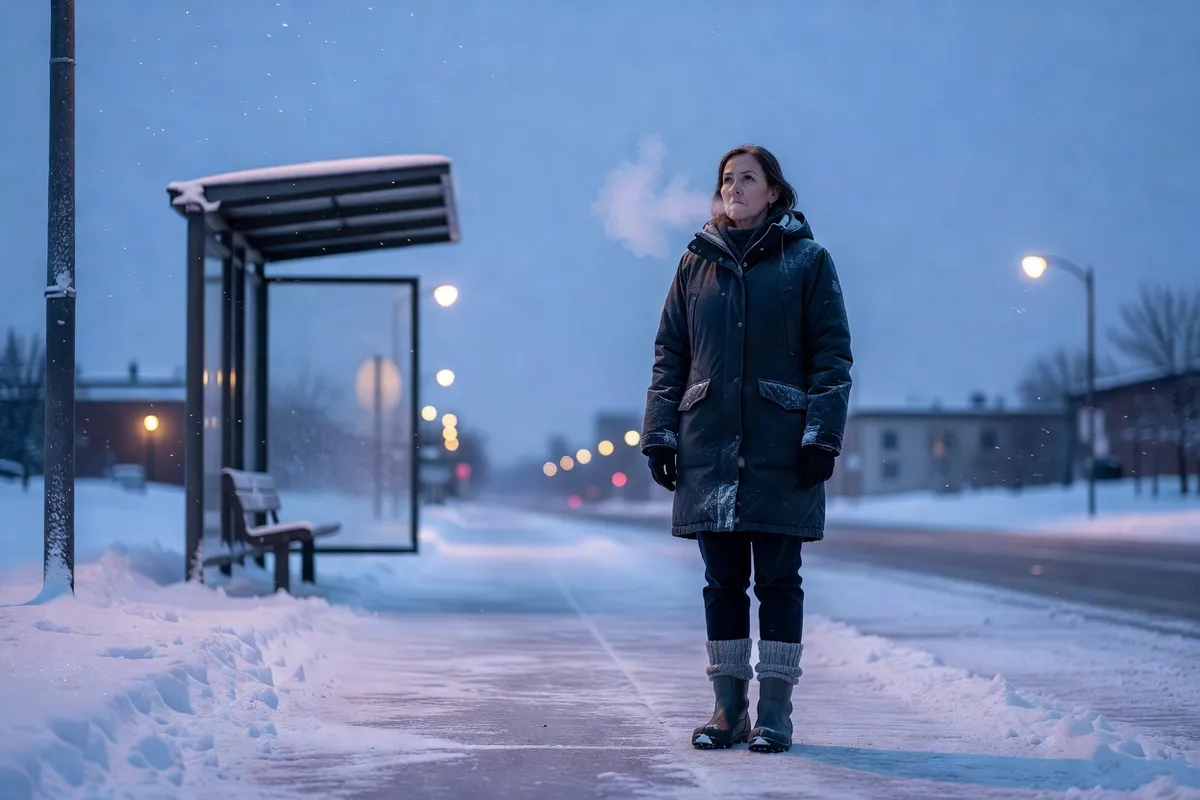
Environment and Climate Change Canada (ECCC) distinguishes air temperature from the combined effect of wind and cold on bare skin. Its 2025 wind chill chart gives a useful example for a bus stop: at -20 °C, a wind of 20 km/h produces a wind chill of -30. At the same air temperature with a 40 km/h wind, the index is -34. Notice what hasn't changed between those entries: the air is still at -20 °C.
This matters if you are trying to decide what the pavement, or an empty boot left outside, will cool to. In ECCC's 2025 example with air at -20 °C and a wind chill of -30, the object doesn't cool to -30 °C on account of the wind. The number below the air temperature describes an effect on exposed skin. It isn't a second thermometer reading, a figure for the inside of an occupied boot or a correction to apply to a manufacturer's claim.
Yet it would be a mistake to dismiss the index because it doesn't rate footwear. ECCC's 2025 scale puts a wind chill from -28 to -39 in its high-risk range, where exposed skin can freeze in 10 to 30 minutes. Both versions of the bus-stop example fall in that range. The time refers to exposed skin, not to toes inside lined boots. Don't turn its upper end into a suggested waiting time, or its lower end into a test of how good the lining is.
Instead, use the two pieces of weather information for different decisions. The air temperature helps put a maker's description of cold-weather use in context; the wind chill draws attention to what the boots don't cover. Health Canada, in its 2021 overview of extreme cold, includes feet among the extremities commonly affected by frostbite, along with hands, nose and ears. At a windy stop, the gap between a toque and a raised collar deserves attention in its own right. A well-chosen pair of boots doesn't change the forecast for bare ears.
Dress for the return trip, including the wait
Work backwards from the part of the outing that offers the least choice. On a neighbourhood walk you might decide when to turn for home. On a transit trip the wait comes when the walk is over, and you don't necessarily decide when it ends. The question isn't just whether the boots feel pleasant on leaving the house. It's what you'll be wearing at the stop after spending the outward leg in that same lining, with those socks, on that ground.
For a dry route with a walk at each end, a roomy-enough combination of wool lining and socks makes use of the insulation Woolmark describes. If a long outdoor wait is also on the itinerary, look as closely at what's underfoot as at what wraps the ankle. Don't award the pair extra waiting time on the strength of its dry-weather rating. Where the wait is uncertain, an indoor place to spend it is a more useful part of the plan than an imagined limit for the boots.
Change the return route to one with slush, and the first unresolved question shifts to the outside of the boot. Look for water protection appropriate to that crossing. If you choose a sealed pair, take the condition of the socks after the walk into account; a dry exterior isn't the test that matters against the foot. For the rest of the outfit, the guide to dressing in winter layers takes the same outing beyond the feet. Plan the walk and the stationary part as parts of one trip, not as separate occasions to dress for.
Sheepskin earns its place in that plan for a fairly precise reason: it puts insulating air and a fibre that can take up vapour close to the foot. You needn't ask the wool to keep curb water out, explain the wind chill or tell you when the bus will come. Match the outside of the boot to the ground, leave room for the sock on the inside, and make a separate plan for the wait. Those decisions tell you more about the suitability of the pair than a temperature printed next to the word sheepskin.
Frequently asked questions
Are sheepskin boots warm enough for -20 °C?
They can help keep feet warm, but the sources here do not establish an independently measured comfort rating for sheepskin at that air temperature. Consider the whole boot, the ground underfoot and any time spent standing still.
Does a dry-feeling wool lining mean the boot is dry?
Not necessarily. Woolmark's 2025 breathability fact sheet explains that wool can take up water vapour before it feels wet against the skin. Touch alone cannot tell you how much moisture is present or where it came from.
Should I wear my thickest socks with lined boots?
Only if they fit properly together. The Canadian Centre for Occupational Health and Safety says in its 2025 workplace guidance that an overly thick sock can get squeezed, insulate less effectively and make the boot too tight.
Does a shearling footbed tell me how well the outsole insulates?
No. A footbed description identifies what sits beneath the foot inside the boot. It does not measure the protection provided by the rest of the sole against cold ground.
Can I compare wind chill directly with a boot's temperature claim?
No. Environment and Climate Change Canada's 2025 index describes the combined effect of air temperature and wind on exposed skin. A manufacturer's figure describes its own products under its stated conditions.
Sources
Verified on
- Woolmark (The Woolmark Company / Australian Wool Innovation), What is the Wool Fibre?, Woolmark (The Woolmark Company / Australian Wool Innovation), 2026.
- Woolmark (The Woolmark Company / Australian Wool Innovation), Wool is naturally breathable, Woolmark (The Woolmark Company / Australian Wool Innovation), 2025.
- Woolmark (The Woolmark Company / Australian Wool Innovation), Merino wool: Footwear (Treading lightly), Woolmark (The Woolmark Company / Australian Wool Innovation), 2026.
- Manitobah Mukluks, Frequently Asked Questions (FAQ), Manitobah Mukluks, 2026.
- Environnement et Changement climatique Canada, Wind chill and the Wind Chill Index, Gouvernement du Canada, 2025.
- Santé Canada, Extreme cold (It's Your Health), Gouvernement du Canada, 2021.
- Centre canadien d'hygiène et de sécurité au travail (CCHST), Cold Environments - Control Measures, Centre canadien d'hygiène et de sécurité au travail (CCHST), 2025.