
Slush season in Montréal is not a month on the calendar but a set of days when the air hovers around 0 °C, rain and snow trade places, and sidewalks turn to grey porridge. For those days, pick a boot whose upper suits how long you will stand in water, a sole with deep, self-cleaning lugs, and wool socks you can swap. Official climate normals show why one pair rarely covers the whole season.
What the climate numbers say about slush days
No official agency defines slush, so the useful approach is to look at what the weather records for Montréal-Trudeau actually show. Environment and Climate Change Canada publishes the 1991-2020 normals, and they describe a city that spends a long stretch of the year within a few degrees of freezing. The daily average temperature is 2.3 °C in November, -5.0 °C in December, -9.2 °C in January, -8.0 °C in February and -2.0 °C in March. November and March are the two months where the average sits closest to zero, and that is exactly where slush is born.
The same normals count days rather than averages, and the counts tell a more practical story. The daily minimum is at or below 0 °C on 146.3 days a year. Within that, there are 18.6 such days in November, 28.0 in December, 29.8 in January, 27.0 in February, 26.0 in March and still 11.4 in April. Nights, in other words, freeze almost every day from December to March, which is why a wet sidewalk at noon can be a skating rink by supper.
| Month | Average daily temperature | Days with minimum at or below 0 °C | Days with maximum at or below 0 °C |
|---|---|---|---|
| November | 2.3 °C | 18.6 | 3.8 |
| December | -5.0 °C | 28.0 | 16.4 |
| January | -9.2 °C | 29.8 | 23.0 |
| February | -8.0 °C | 27.0 | 19.5 |
| March | -2.0 °C | 26.0 | 9.6 |
Source: Environment and Climate Change Canada, Canadian Climate Normals 1991-2020, Montréal-Trudeau.
Read across a row and the pattern is clear. In November only 3.8 days stay frozen all day, so most days climb above zero and the first wet snow melts on contact. In January the balance flips: 23.0 days never leave freezing, which means the snow stays dry and squeaky. Then March arrives and the story reverses again, with only 9.6 frozen days and the snowbanks starting to weep. Slush follows the thaw, and the thaw does not wait for spring.
Thaws in the middle of winter
Even in midwinter the city has softer interludes. The normals report 8.0 days in January and 8.8 in February with a daily maximum above 0 °C, and 21.4 days in March. Those are not many, but a person who walks to work every day will meet them. A boot that is perfect for a dry minus-15 morning may be the wrong tool for a plus-2 afternoon in a puddle the width of a lane. This is the argument for thinking about slush as its own category rather than as "a bit of winter".
Rain and wet snow: why the in-between months are the wettest
Cold alone does not make slush. Water does. Across a year, Montréal-Trudeau receives 818.3 mm of rain and 216.6 cm of snow according to the same normals, and the way those totals split by month explains the November and March puzzles. November collects 67.4 mm of rain and 16.3 cm of snow. March sees 37.3 mm of rain and 37.1 cm of snow. April, when the snowpack is supposedly gone, still records 74.9 mm of rain and 14.8 cm of snow.
Rain days confirm it. Days with at least 0.2 mm of rain average 11.1 in November, 6.7 in December, 4.5 in January, 3.8 in February, 7.0 in March and 11.4 in April. A walker in November is therefore likely to meet rain on roughly one day in three, and a walker in April on a similar share. In January and February the proportion drops sharply, but it never reaches zero, and a rainy day in a month of hard frost is the one that ruins a pair of unprotected boots.
None of this means that every day in these months is wet. It means that the weather offers variety, and a footwear plan built on a single scenario will fail on the others. A sensible approach is to match the boot to the month: a boot that blocks water for the wet shoulder seasons, and a warmer, drier setup for the frozen core of winter. The broader guide to winter boots for the Canadian climate lays out how this month-by-month thinking fits with the rest of a winter wardrobe.
Waterproof or breathable: the trade-off nobody can avoid
Shoppers often assume that waterproof is simply better. The sources say it is more nuanced. The Canadian Centre for Occupational Health and Safety, writing about workers in cold environments, notes that fully waterproof boots keep out slush and cold water but also trap perspiration, so the insulation and socks get damp faster. The same page names felt-lined, rubber-bottomed, leather-topped boots with removable insoles as the best fit for heavy work in the cold, because porous leather lets sweat evaporate. That context is the workplace, not the weekend stroll, but the physics of a closed boot does not change with the occasion.
Manitobah Mukluks makes the same distinction from the maker's side. Its FAQ states that untreated suede and leather styles are porous and not waterproof, and that only models labelled waterproof are sealed. It also says the sealed waterproof styles breathe less and can feel damp inside from perspiration. This is attributed to Manitobah and its own products, not a rule for every brand, but it describes the compromise very clearly: the more a boot seals, the more it asks of your socks and your pace.
Three honest questions before choosing
- How long will the feet stand in standing water? A thirty-second crossing at a street corner asks little; an hour of waiting at a bus stop with meltwater pooling asks a lot.
- How hard will the body work? A brisk walk produces sweat, and a sealed boot keeps it. A slow commute produces less.
- Is there a place to dry the boots tonight? A pair that never dries between outings turns any theoretical advantage into a damp liability.
If the honest answers lean toward long exposure and little effort, a sealed waterproof boot makes sense. If the answers lean toward short exposure and lots of walking, a porous upper with careful care may be the more comfortable option. For the care side, the guide to boot care and cleaning covers what to check at the source.
Soles: lugs, grip and the trouble with meltwater
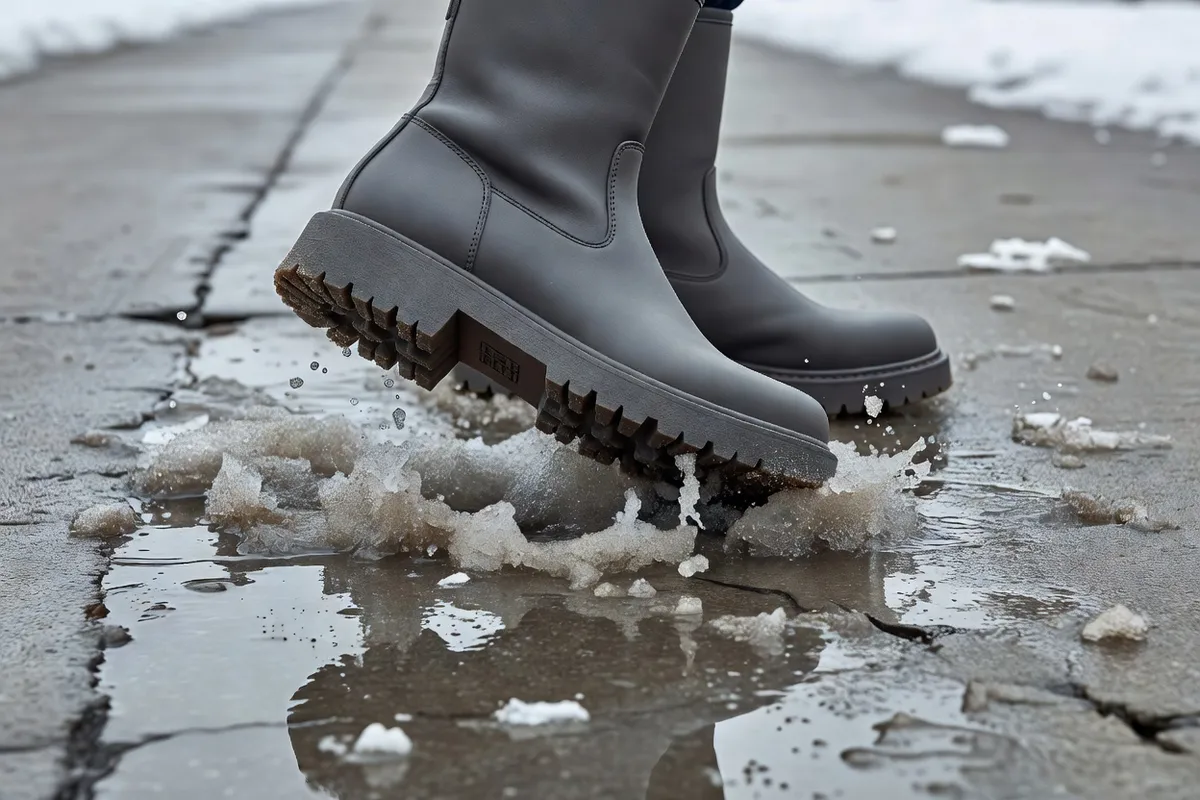
The upper keeps water out; the sole keeps you upright. Slush puts a particular strain on soles because it hides what lies beneath. A grey puddle at a curb might be two centimetres of water over bare asphalt, or a thin layer of water over polished ice. Footwear that clears itself helps, because packed slush in the grooves of a shallow tread turns it into a smooth slab.
Kamik's own product page for the Nation Plus (men's) gives a concrete example of how a maker describes a winter boot in these terms. It lists a -40 °C temperature rating, a 145 g HeatMX removable liner, waterproof seam-sealed construction and a self-cleaning cleated outsole it calls Grip XT. These are the maker's own specifications, not independent measurements, and the temperature rating in particular should be read as a statement by the manufacturer. What the page does show is the vocabulary worth looking for: cleats rather than a flat pattern, and a removable liner that can dry on its own.
A removable liner is a useful feature for slush days because it separates the part that gets wet from the part that holds heat. When boots come home soaked, taking the liner out gives both pieces a chance to dry. The same logic applies to the removable insoles that the CCOHS lists for cold-weather work boots.
Reading a sole in the shop or online
A few visual cues can tell you something without needing a laboratory. Deep, widely spaced lugs release slush more readily than shallow, tightly packed ones. The rubber compound matters too, but only the maker's own statement can tell you anything about it. A heel that has a defined edge helps on stairs and curbs. None of these cues replaces trying the boot on a wet surface, but they help narrow the choice before the first step.
Heavy treads are not free. They can be noisier on indoor floors and can pick up small stones and road grit. For someone who moves between a wet street and a polished lobby several times a day, that trade-off is worth weighing.
Sheepskin in slush: what to expect
Sheepskin boots are a common winter choice in Canada, and slush is where their limits show. The wool lining does a good job of managing moisture from inside the boot, and Woolmark states that wool can absorb up to 35 % of its weight in moisture before feeling wet against the skin, releasing heat as it does so. That is a statement about the fibre, not about a finished boot, and it says nothing about what happens when water arrives from the outside through an untreated upper.
That is the part a reader should keep apart. A fibre that handles perspiration well is not the same thing as a seam-sealed shell that blocks a puddle. For a day that is mostly cold and dry, with only a brief walk through wet snow, sheepskin may be comfortable; for a day that is mostly standing in meltwater, a sealed boot with a removable liner is a different tool. The comparison with other cold-weather footwear is developed in mukluks or sheepskin boots: which keep your feet warmer, and the question of what wool really does is answered in the piece on how sheepskin behaves at -20 °C.
| Situation | What matters most | What to look for |
|---|---|---|
| Short walk through wet snow | Grip, quick drying | Cleated sole, removable insole |
| Long wait in meltwater | Water exclusion | Sealed construction, waterproof label |
| Brisk commute with a lot of walking | Moisture release | Breathable upper, wool socks |
| Day starting below freezing, ending above | Versatility | Removable liner, spare socks |
Socks: the cheapest part of the system
Socks are the unglamorous layer that decides how the day feels. Parachute, the Canadian injury-prevention charity, gives two pieces of advice that bear directly on slush. First, wet clothes and shoes are among the biggest factors in frostbite, so getting out of them as quickly as possible matters. Second, a single pair of wool or wool-blend socks is better than cotton, which gives no insulation when wet.
The "single pair" detail is worth pausing on. People often layer two or three pairs when the temperature falls. The charity's advice, as summarized here, favours one good pair of the right material. This is information from a safety organization, not a personal prescription, and anyone with circulation problems should talk to a health professional.
Wool's behaviour in moisture, from Woolmark's statement, explains why it is the usual recommendation. Absorbing moisture without feeling wet means that the first bit of sweat or the first splash through a seam does not immediately chill the skin. Cotton does the opposite: it holds water and offers no insulation once wet, according to Parachute.
A spare pair is part of the kit
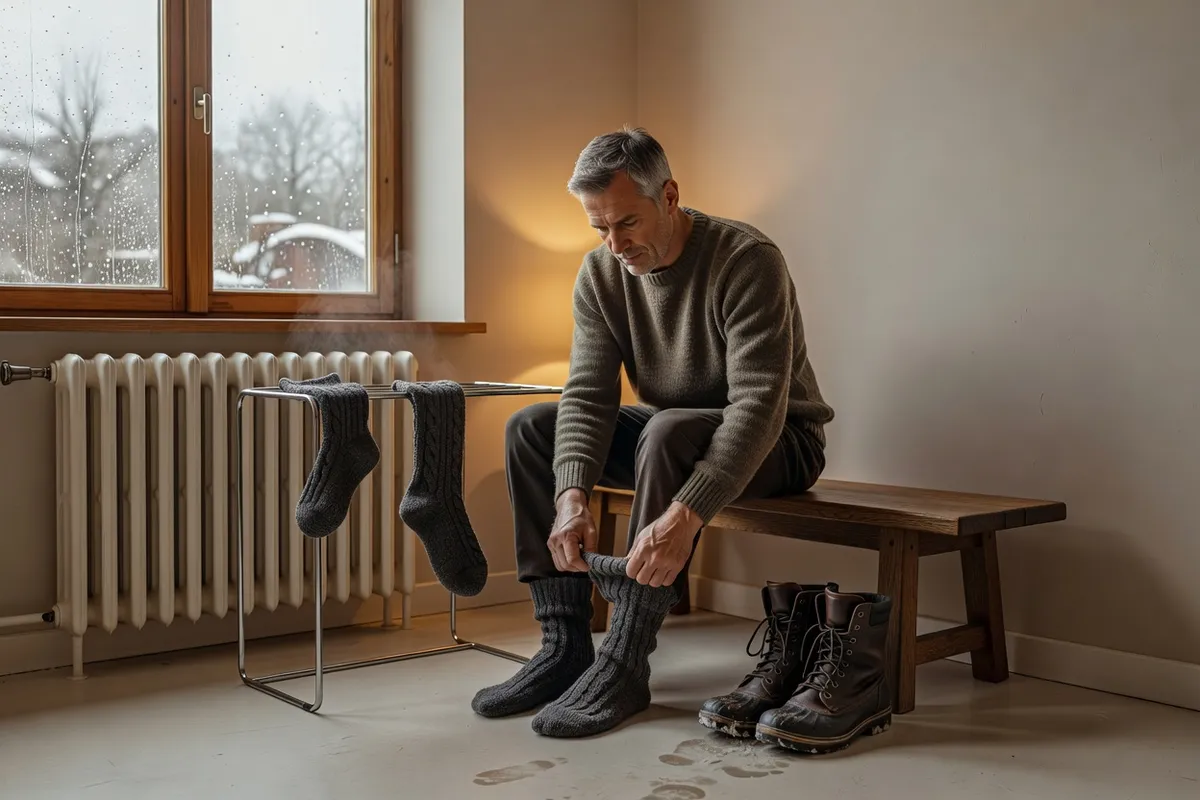
A second pair of socks in a bag costs almost nothing and handles the case where the first pair gets wet. For a long day with a thaw in the middle, being able to change at the office or in the car turns a miserable afternoon into an ordinary one. The principle follows from the same Parachute advice: if shoes and clothes are wet, getting out of them quickly is what counts, and dry replacements make that possible.
Freezing rain: the slush day that is actually ice
There is one wet day that is nothing like slush, and it deserves a separate mention. Environment and Climate Change Canada defines freezing rain or freezing drizzle as precipitation that falls as liquid, passes through a layer of cold air and freezes on contact with surfaces below freezing, forming a coating of ice. The agency adds that driving and even walking can be dangerous in those conditions.
The Montréal-Trudeau normals say it happens on average 4.9 days a year: 0.43 day in November, 1.3 in December, 1.3 in January, 0.90 in February and 0.69 in March. It is rare, and that rarity is the risk. A person who has dressed for slush, with a waterproof boot and a modest tread, may be unprepared for a sidewalk that looks wet and behaves like glass. On those days, the sole matters more than the upper, and shortening the walk matters more than either.
The cold-season hazards page from Environment and Climate Change Canada is the place to check current warnings and what the agency recommends. This article only describes what the normals and the definition say.
Wind chill and the cold side of the thaw
Thaw days are only one half of a Montréal winter. The normals for the city's airport station also report that the wind chill falls below -20 on average 40.2 days a year: 15.9 in January, 12.4 in February, 7.04 in December and 4.5 in March. It falls below -30 on 7.6 days a year. These are the days when a damp boot is most dangerous, because wet footwear loses its protection faster.
That is another reason to think about the full cycle. A boot that has spent the afternoon in meltwater and is put back on the next morning without drying, in a sub-zero wind, has two problems at once. The practical lesson is to treat drying as part of the system rather than an afterthought. Rotating between two pairs of footwear, removing liners and insoles, and giving the boots a night in a dry room are routine habits that the sources behind this article support in principle, even if they do not prescribe a method. For method, follow the care instructions of the maker of the boots.
Three typical days, three different setups
The following scenarios are situations built on the official numbers above, not accounts of tests carried out by the editors.
A November Tuesday. The month's average of 2.3 °C and 67.4 mm of rain describe the backdrop. The forecast says rain turning to wet snow in the late afternoon. A commuter walks ten minutes to the metro and ten minutes from the station. The priority is water exclusion for a short, wet walk, with enough tread to cope with leaves and wet pavement. A sealed boot or a boot treated for water makes sense, and since the exposure is short, the breathability penalty is small. Wool socks go in the bag as a spare.
A January Saturday. With 23.0 days a month at or below 0 °C for the daily maximum, most January days are properly cold, and the snow is dry. The risk here is wind chill, not water. A warm, insulated boot with a liner that can dry, and wool socks, do the work. A porous upper is not a problem when the snow does not melt on it, though a mild day of 8.0 in the month can arrive without notice.
A March afternoon. This is the month with 21.4 days above freezing for the daily maximum, 37.3 mm of rain and 37.1 cm of snow, and still 26.0 nights at or below 0 °C. The morning starts hard, the afternoon runs with meltwater, and the evening freezes again. This is the day for a sealed boot with a cleated sole, a removable liner and a spare pair of wool socks. It is also the day for slowing down at corners, because puddles hide ice and the ice returns after sunset.
A short field guide to the slush-day kit
Rather than a shopping list, here is a way to think about the system as a whole. Each item maps to a source in this article.
| Element | Role in slush | Source or basis |
|---|---|---|
| Upper | Keeps water out, or lets sweat out | CCOHS, Manitobah |
| Liner | Holds heat, can be removed to dry | Kamik product page, CCOHS |
| Sole | Grip and self-cleaning | Kamik product page |
| Socks | Insulate when damp, manage moisture | Parachute, Woolmark |
| Spare pair | Dry replacement after a soak | Parachute |
The way these elements combine with the rest of the clothing is covered in the guide to dressing for winter with layers, since a boot sits at the bottom of a system that includes trousers, coat and hat. Feet that are wet at the end of the day are rarely only a boot problem.
After the walk: what happens at home
Whatever the boot, the evening routine decides whether the next morning begins well. The sources point to a few principles without prescribing a procedure. Parachute stresses getting out of wet footwear as soon as possible, and the CCOHS highlights removable insoles. Manitobah's note that sealed models can feel damp inside from perspiration reminds us that even a dry-looking boot may hold moisture. In practice, that means removing the insoles and liners where the design allows it, and giving each piece time to dry before the next use.
Where the question becomes how to clean, protect or restore a particular material, the answer belongs to the maker's instructions and to the guide on removing salt stains from winter boots. Road salt is a separate subject with its own sources, and this article makes no claims about it beyond noting that slush is where it often meets the boot.
Choosing without overbuying
A final point about proportion. Montréal's slush season comes in short waves, and the data show that most of the cold winter is frozen rather than wet. Buying a boot built exclusively for slush may be a poor use of money if most days are dry and cold, and buying a boot built exclusively for deep cold may disappoint in March. The sensible compromise is often two modest layers of choice: one reliable boot for the commonest conditions, and a plan for the exceptions, such as a spare pair of socks, a second pair of footwear to rotate, or a route that avoids the worst corners.
The editors cannot recommend a particular model, and nothing here is a ranking. The only brands named are those cited for the facts they publish: Manitobah Mukluks, for what it says about porous and sealed styles, and Kamik, for the specifications on its own product page. If you want to explore how Canadian makers fit into the picture, the overview of Canadian winter boot brands and makers is the place to start.
Where to check the facts yourself
Every number in this article comes from a public source that you can open. The Montréal-Trudeau figures are in the Canadian Climate Normals 1991-2020, and the freezing-rain definition is in the federal page on cold season weather hazards. The advice on wet footwear and wool socks is part of Parachute's winter outdoor safety page, and the discussion of waterproof boots and perspiration is on the CCOHS cold environments page, which addresses workplaces. Manitobah's FAQ, Kamik's product page and Woolmark's factsheet are the sources for the maker and fibre statements.
Normals are averages over thirty years, not forecasts, and they come from one station at the airport. Downtown streets, the north shore and the Eastern Townships can be a few degrees apart on the same day. Treat the figures as a map of the range, not a promise about next Tuesday.
Frequently asked questions
Which months count as slush season in Montréal?
The official normals for Montréal-Trudeau (1991-2020) show the mix of rain and cold at its widest in November and from March to April. November averages 2.3 °C with 67.4 mm of rain, March averages -2.0 °C and April still has 11.4 days with a minimum at or below 0 °C. Midwinter thaws also happen: January has 8.0 days with a maximum above 0 °C.
Do I need fully waterproof boots for slush?
Not always, and not for every outing. The Canadian Centre for Occupational Health and Safety notes that fully waterproof boots keep out slush and cold water but retain perspiration, so insulation and socks get damp faster. Manitobah says the same about its sealed waterproof styles. The choice depends on how long you stand in water and how long you stay outside.
Why do sock choices matter in slush?
Parachute says wet clothes and shoes are among the biggest factors in frostbite and that a single pair of wool or wool-blend socks beats cotton, which gives no insulation once wet. Woolmark adds that wool can absorb up to 35 % of its weight in moisture before feeling wet against the skin.
How cold does it get on thaw days?
Thaw days are close to 0 °C by definition. The normals show 21.4 days in March with a daily maximum above 0 °C, yet the minimum still falls to 0 °C or below on 26.0 March days. That is why the same pair of boots meets both puddles and ice in a single day.
Is freezing rain common in Montréal?
On average it occurs 4.9 days a year at Montréal-Trudeau (1991-2020), with December and January at 1.3 days each. Environment and Climate Change Canada describes it as rain that freezes on contact with surfaces below freezing, and warns that driving and even walking can be dangerous.
Sources
Verified on
- Environnement et Changement climatique Canada, Canadian Climate Normals 1991-2020 Data: MONTREAL TRUDEAU (AIRPORT), Gouvernement du Canada, 2025.
- Environnement et Changement climatique Canada, Cold season weather hazards, Gouvernement du Canada, 2026.
- Parachute, Winter outdoor safety, Parachute, 2026.
- Centre canadien d'hygiène et de sécurité au travail (CCHST), Cold Environments - Control Measures, Centre canadien d'hygiène et de sécurité au travail (CCHST), 2025.
- Manitobah Mukluks, Frequently Asked Questions (FAQ), Manitobah Mukluks, 2026.
- Kamik, NATION PLUS Winter Boots, Men, Kamik, 2026.
- Woolmark (The Woolmark Company / Australian Wool Innovation), Wool is naturally breathable, Woolmark (The Woolmark Company / Australian Wool Innovation), 2025.