
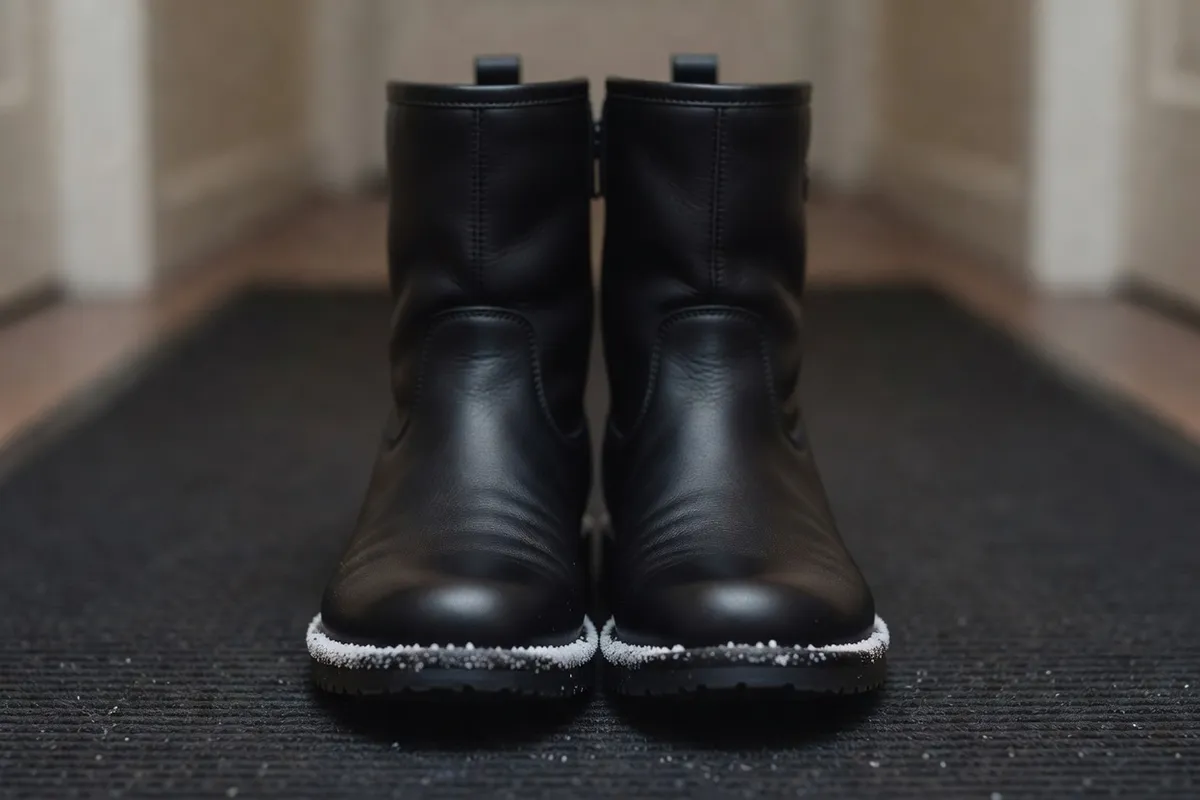
White tide-marks on winter boots are dried road salt, and most of them come off with little more than a damp cloth, a soft brush and some patience. The right method depends on the material: smooth leather, suede, sheepskin and fabric each ask for something different, and makers such as Manitobah, Pajar, Kamik and EMU Australia publish their own instructions. This guide walks through each case, then sets out a short routine that keeps the marks from coming back all season.
Why salt leaves a pale line, and what the sources actually say
Walk through a thaw and the pattern is familiar. Slush splashes up the toe and the sides, the water dries indoors, and a pale, crusty line appears a few centimetres above the sole. That line is what is left of the brine. Environment and Climate Change Canada describes road salts as de-icing and anti-icing chemicals used in winter road maintenance in Canada, which explains why the mark shows up on the boots of anyone who walks on a treated sidewalk, a station platform or a parking lot.
One point of honesty before the cleaning advice. The federal pages say the government is not banning road salts and that their focus is the effect of chlorides on the environment. They do not address damage to footwear at all. Everything said below about boots therefore rests on the manufacturers, not on a government study, and it is worth reading their wording closely.
The makers are consistent on the basic risk. Pajar's care guide says salt can stain winter boots, corrode materials and compromise waterproofing. Manitobah, in its FAQ, goes a step further and warns that salt is corrosive and can damage its footwear even when a protector spray has been applied. In other words, the white line is not only a cosmetic nuisance. Left alone through a whole season of repeat wetting and drying, it is a slow attack on the material and, according to Pajar, on the boot's ability to keep water out.
That is the argument for acting early. A mark that has been wiped off once a week is a short job. A mark that has been soaked and dried a dozen times is a long job, and sometimes one that no cloth can finish.
Step zero: work out what your boots are made of
Most cleaning mistakes come from treating every boot the same way. A method that suits smooth leather can flatten suede or strip the oils from sheepskin. Before reaching for a cloth, look inside the boot at the care label, and if there is none, think about what you can see and feel on the outside.
| Material | What the makers say | What to avoid |
|---|---|---|
| Smooth leather | Manitobah: gentle soap, soft brush, damp cloth for salt. Pajar: white vinegar and water on deposits after a hidden-spot test | Soaking, then drying near heat |
| Suede | Pajar: suede brush, suede eraser or vinegar-and-water mix, blot rather than rub, air-dry, brush again | Rubbing hard, saturating the surface |
| Sheepskin | EMU Australia: a little cold water and wool wash dabbed on with a clean cloth | Washing machine, heat, vigorous scrubbing |
| Canvas and wool uppers | Steger Mukluks: mild soap such as Woolite in water, then dry before wearing | Wearing them damp |
| Boots built to be rinsed | Kamik: lukewarm water, liners out where possible, air-dry | Machine washing |
Two things follow from the table. First, "salt" is only one of the problems; the material tells you which tool is safe. Second, several of these instructions come from brands that sell specific boots, so they describe what suits those products. When your boots come from a different maker, treat their guidance as a starting point and test on a hidden area, which is advice that two of the makers give in almost the same words.
If you cannot tell what the boots are made of, the most cautious route is the gentlest one: a slightly damp cloth, dabbing, no soap, and a look at the result once it has dried.
Smooth leather: wipe first, then clean
Smooth leather is the most forgiving surface, and it is where the simplest method works best. Manitobah recommends wiping salt off with a damp cloth and cleaning its leather with a gentle soap and a soft brush. Steger Mukluks adds a useful first move for the leather parts of its boots: brush off dried dirt before anything wet touches the surface, so that grit is not ground into the leather.
A sensible order, drawn from those instructions, looks like this.
- Knock off the loose material. Tap the boots together outdoors or brush them with a soft brush while they are dry.
- Wipe the salt line with a cloth that has been wrung out so it is damp rather than wet. Work along the line instead of scrubbing across it.
- If a pale shadow remains, use a little gentle soap on the cloth or the soft brush and work in small areas.
- For a stubborn line, Pajar suggests spot-cleaning the deposit with white vinegar and water. Pajar says to try this on a hidden area first, such as the inside of the tongue or the back of the heel, and to wait for it to dry before judging the result.
- Wipe again with a cloth wet only with clean water, so that no cleaner is left on the surface.
- Let the boots dry naturally, a point covered in the drying section below.
The vinegar step deserves a word of caution. None of the other makers cited here mention it, and Pajar frames it as spot-cleaning, not as a general wash. A dark or dyed leather can react differently from a pale one, which is exactly what the hidden-area test is for. If the test patch looks different once dry, stop and use soap and a damp cloth only.
Steger Mukluks also mentions that stubborn salt stains can be treated with a de-salting product, and names a branded one on its page. Nothing here depends on that product, and a damp cloth is a reasonable first attempt, but it shows that a dedicated product exists for the job when the simpler methods fall short. If you use any product of that kind, read its label for the materials it is meant for.
Suede: blot, brush and let the nap recover
Suede is the material that suffers most from enthusiastic cleaning. Its surface is a raised nap, and rubbing flattens or scuffs it. Pajar's advice for suede is built around that: reach for a suede brush, a suede eraser, or a mix of vinegar and water on the stain, applied by blotting, then leave the boot to air-dry and brush it once more to lift the nap.
Put in sequence, that is a gentle routine.
- Start dry. Brush the dried salt with a suede brush, in one direction, to lift what sits on the surface.
- Try the eraser on small marks. A suede eraser is a rubber-like block designed for the purpose, and it works by friction on a limited spot, so keep the movement light.
- For a visible line, move to the vinegar-and-water mix on a cloth, but blot. Press, lift, press again. Rubbing is the one thing Pajar tells you not to do.
- Dry at room temperature, with nothing pressed against the suede.
- Brush again once everything is dry. This last step is easy to skip and it is what makes the colour look even again.
A suede boot that has been through a whole winter of salt may show a darker, stiffer band where the water line sat. That is a sign the salt has been in the material for some time. A single cleaning session may soften it without erasing it, and a second round after full drying is often kinder than pushing harder the first time.
Sheepskin: cold water, a light touch and no machine
Sheepskin boots raise a different set of problems because the material is wool on the inside and often on the outside, and because the natural oils in the fleece matter. EMU Australia says its sheepskin boots can be spot-cleaned with a little cold water and wool wash dabbed on with a clean cloth, and that they should not go in a washing machine. It also advises testing any cleaner on a small hidden area first and cleaning gently, because vigorous scrubbing can remove the lanolin and natural oils in sheepskin.
That is a remarkably short list of permitted actions, and it is worth taking at face value. For salt on a sheepskin boot, it points to a modest approach: a clean cloth, a little cold water, a drop of wool wash if needed, and dabbing, not scrubbing. Warm water is not on the list, which fits another EMU instruction covered below, that warm water or heat shrinks the material and changes its shape.
Manitobah adds a note about fur, which applies to its footwear: the fur should not be pulled on or exposed to abrasive chemicals or salts, and once wet the footwear should dry naturally. For anyone who wears fur-trimmed or fleece-lined boots, this means the cuff and the trim need the same attention as the foot of the boot, even though the salt line shows less there.
Vinegar is not in any of the sheepskin instructions cited in this guide. Pajar's vinegar advice is written for its winter boots in general, and applying it to fleece is a step none of these sources takes. Without a care label that says otherwise, the cold-water, wool-wash method is the one with a maker behind it.
If you are still deciding which kind of boot suits your winters, the complete guide to sheepskin boots explains the material, and a look at how sheepskin performs in deep cold shows why the wool needs to stay in good condition in the first place.
Fabric uppers, mukluks and boots made to be rinsed
Not every winter boot is leather or fleece, and the instructions for the others are, if anything, more practical.
Kamik's FAQ says its boots should be rinsed with lukewarm water to remove dirt and salt, with the liners taken out where possible, then air-dried at room temperature, and never machine-washed. For fabric boots it adds that a mild, pH-balanced soap can be used if needed, and that the liners should be removed when possible and everything left to dry completely in the open air. The point about liners deserves attention. Salt and moisture collect in the part of the boot you cannot see, and a liner that stays damp can bring the problem back no matter how clean the outside looks.
Steger Mukluks gives a similar instruction for the canvas and wool uppers of its mukluks: a mild soap such as Woolite in water, then time to dry before the boots are worn again. The word "before" matters. Putting a half-dry fabric boot back on for the next commute is a common way to keep the dampness, and the salt with it, in circulation.
A few practical details follow from these instructions.
- Remove what comes out. Liners, insoles and laces can be handled separately, and the boot dries faster without them.
- Keep soap mild. Both Kamik and Steger point to gentle products, and neither suggests stronger cleaners.
- Skip the washing machine. Kamik and EMU Australia both say so for their products, which makes it one of the few points on which the makers fully agree.
For readers weighing mukluks against other options for a cold winter, there is a separate comparison of mukluks and sheepskin boots that looks at warmth and wet conditions.
Drying: where good cleaning goes to die
Many a careful clean has been undone in the last stage. A boot that has been dealt with perfectly and then set on a heater may crack, warp or shrink, and the damage is permanent in a way that a salt line is not.
The makers are close to unanimous. Pajar's advice is to let boots dry somewhere well ventilated, out of direct sun and away from radiators and heaters, stuffed with newspaper or fitted with a boot shaper, because direct heat can warp or crack the materials. EMU Australia says not to heat-dry its sheepskin footwear, because warm water or heat shrinks the material and changes its shape. Manitobah says its footwear should dry naturally once wet. Kamik says to air-dry at room temperature.

Turned into a routine, it looks like this:
- Take the boots off at the door and remove the liners if they come out.
- Stuff the boots loosely with crumpled newspaper, or use a boot shaper. The paper holds the shape and, as Pajar describes the method, helps the boot dry in a ventilated spot.
- Place them where air moves, away from the radiator, the fireplace, the car heater vent and the window that gets direct sun.
- Change the paper if it becomes damp, since wet paper does not help much.
- Wait until they are completely dry before the next wear. For a pair worn daily, that argues for owning two pairs and rotating them, though not everyone has the budget or space for it.
One more consideration, which comes from practical sense and not from the makers: a cleaning session done on the evening of a thaw day, with a full night to dry, is more useful than one done in the morning on the way out.
A five-minute routine that keeps the white line away
Once the stains are gone, the real work is keeping them from returning. None of the sources describes a magic product, and Manitobah's warning that salt can damage its footwear even through a protector spray is a reminder that a spray alone is not a plan. What the makers do describe, between them, is a habit.
At the door, every time the pavement was wet.
- Knock off the slush before it dries. The salt does most of its visible work after the water evaporates.
- Wipe the lower part of each boot with a damp cloth, which is the method Manitobah recommends for removing salt.
- Pull out the liners if they come out, as Kamik describes.
Once a week during the salted season.
- Do a fuller wipe, with gentle soap on leather and a soft brush, or the maker's preferred method for the material.
- Check the seams and the line where the upper meets the sole. These are the places where salt tends to sit unnoticed, and Pajar notes that salt can compromise waterproofing.
Between uses.
- Rotate pairs if you can.
- Dry as described above, never on a heat source.
A typical week in a city with a long thaw shows how this plays out. Take a commuter who walks to a transit stop every weekday through a season of freezing and thawing. Each evening the boots go on a mat and get a ninety-second wipe; once a week they get a proper clean. At the end of the season, the white band is faint instead of crusted, and the leather has stayed flexible. The same boots wiped only at the end of the winter will have had months of repeated wetting and drying, which is where the damage, according to Pajar and Manitobah, accumulates. This is a situation described to show the logic, not a test result.
For a closer look at what a mild-weather, wet-boot day involves, the guide to Montréal's slush season covers boots, soles and socks for the in-between days.
When cleaning is not the answer
Cleaning removes salt. It does not undo everything salt has done. There are signs that the problem has moved on from the surface, and those signs call for a different kind of help.
- Cracks along the flex lines. Leather that has dried out and split at the toe or ankle is no longer a stain issue.
- Seams that open or soles that lift. Pajar says salt can compromise waterproofing, and a seam that lets water in is a structural failure.
- A stiff, dark band that stays after two cleanings. The material may have absorbed more than a surface wipe can reach.
- Persistent water entry in a boot that used to stay dry.
For these cases, a cobbler is the person to ask. The interview with an imagined boot repairer goes through what repair and resoling involve and how a repairer thinks about a salt-damaged boot. The conversation is fictional, built for this guide, and it is meant as a way to understand the questions to ask a real professional, not as a replacement for one.
If you are choosing between boots with an eye on the whole season, the guide to winter boots for the Canadian climate puts the care question in context with warmth, grip and fit. The boot care and cleaning hub gathers the other maintenance topics in one place.
Common mistakes that make stains worse
A short list of habits that undo good intentions, each tied back to what the makers say.
| Habit | Why it backfires | Source |
|---|---|---|
| Drying on a radiator or heater | Direct heat can warp or crack materials; heat shrinks sheepskin | Pajar, EMU Australia |
| Putting boots in the washing machine | Several makers say not to | Kamik, EMU Australia |
| Scrubbing hard on sheepskin | Can remove lanolin and natural oils | EMU Australia |
| Rubbing suede | Flattens the nap; blotting is the advice | Pajar |
| Trusting a protector spray alone | Salt can still damage footwear that has been sprayed | Manitobah |
| Skipping the hidden-area test | Cleaner may change colour or texture | Pajar, EMU Australia |
| Wearing boots before they are dry | Moisture and salt stay in the boot | Steger Mukluks |
Some of these are tempting precisely because they are quick. A radiator seems like a sensible shortcut on a cold morning, and a hard scrub feels thorough. The makers' instructions all point the other way, toward slower and gentler.
One last thought on pace. Salt marks are one of the few boot problems where waiting costs more than doing. A damp cloth on the evening of the first slushy day takes a minute. The same boot, ignored until February, may need a full clean, a second round and perhaps a repair. The season is long, and the routine is short.
Frequently asked questions
What are the white marks on my winter boots?
They are salt deposits from slush and wet pavement. Environment and Climate Change Canada notes that road salts are used in Canada to de-ice and anti-ice roads in winter, and Pajar says that salt can stain boots, corrode materials and compromise waterproofing.
Can I remove salt stains with water alone?
For many boots, yes, at least as a first step. Manitobah suggests wiping salt off with a damp cloth, and Kamik says its boots can be rinsed with lukewarm water. Sheepskin and suede are more delicate, so follow the maker's own instructions for those.
Is white vinegar safe on winter boots?
Pajar suggests white vinegar and water for spot-cleaning salt deposits and for suede stains, after a test on a hidden area. The other makers cited here do not mention vinegar, so test first and stop if the colour or texture changes.
Can I put my boots on a radiator to dry them?
No. Pajar warns that direct heat can warp or crack materials, EMU Australia says heat shrinks sheepskin and changes its shape, and Manitobah says wet footwear should dry naturally.
Does a protector spray stop salt stains for good?
Not entirely. Manitobah warns that salt is corrosive and can damage its footwear even after a protector spray has been applied, so regular wiping still matters.
Sources
Verified on
- Environnement et Changement climatique Canada, Road salts overview / Aperçu sur les sels de voirie, Gouvernement du Canada, 2023.
- Manitobah Mukluks, Frequently Asked Questions (FAQ), Manitobah Mukluks, 2026.
- Pajar, Cleaning Winter Boots: A Pajar Maintenance & Care Guide (5 août 2024), Pajar, 2024.
- Kamik, FAQs (Product Care & Use), Kamik, 2026.
- Steger Mukluks, How To Tie, Clean & Care, Steger Mukluks, 2026.
- EMU Australia, Care & Cleaning (support article), EMU Australia, 2026.