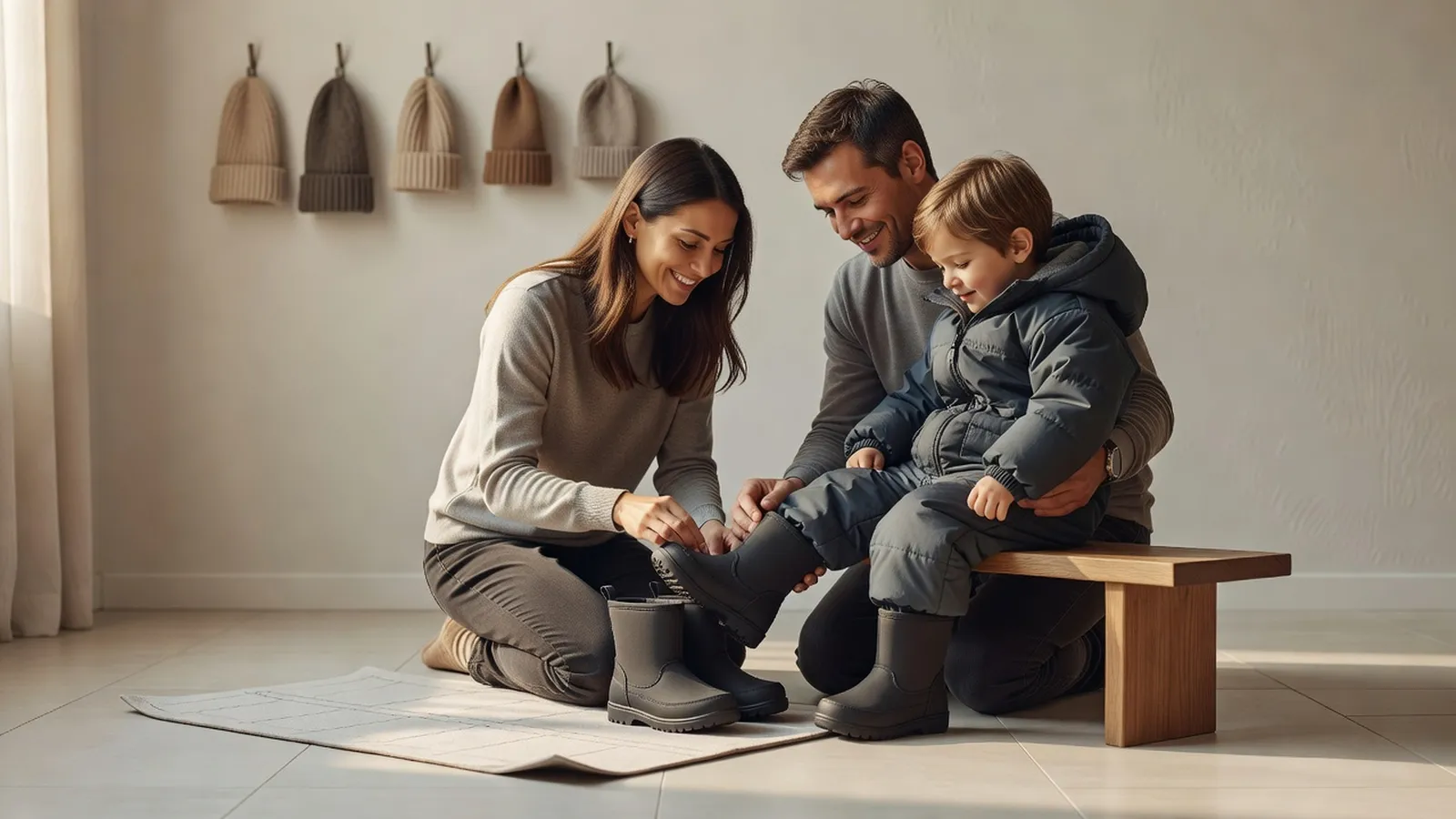
Choose warm, waterproof winter boots that hold the heel comfortably and leave space for the toes to move. Have the child stand and walk in them with the liner and socks they will actually wear. Growing room belongs in front of the longest toe, not in a loose heel. Revisit the fit over the winter, take wet boots off after play, and use the temperature and wind chill, rather than a number on the box, to plan time outside.
Start the fitting with the child on their feet
A child seated on a bench can tell you if a boot is hard to get on. That's a different question from how it fits once they're standing in it. The Canadian Paediatric Society recommends that children try footwear on before purchase. In its 2022 guide to fitting children's shoes, the society describes a fit you can check at the heel, in front of the toes and across them. Those are useful places to look when a lining makes it difficult to see where the foot ends.
Start at the back. With the boot done up for walking, the heel should feel snug. Then, with the child still standing, locate the end of the longest toe. The society's 2022 allowance is about 1.25 cm from that toe to the end of the shoe, roughly the width of a thumb. The thumb is a handy way to picture the distance; there's no need to persuade a child that a boot feels right simply because an adult has pressed the end of it.
Width deserves a separate check. The same guide calls for 5 mm of space beside all the toes. It also describes a small crease in the shoe material when you pinch it with the child standing. If a rubber shell won't let you feel the toes or pinch the material, don't treat the outside of the shell as a measurement of the space inside. Ask a child who can answer where they feel the sides. Can they wiggle their toes? Does the end feel fine but the sides feel close? Those answers can change the decision even when the length looks right.
Finally, let the child walk rather than asking for a verdict while they're looking down at their feet. Can they walk comfortably with the boots fastened as they would be outdoors? The society describes everyday footwear in modest terms: it should protect the foot, provide some grip and allow comfortable walking on different surfaces. It says children's feet usually develop without special footwear. The guide to winter boots for the Canadian climate gives the wider context for choosing a boot, but the fitting is something only the child can do.
Growing room is not next season's size
It can be tempting to look at the space in a new pair and ask how many months it will buy. The Canadian Paediatric Society's growth estimates explain why it's worth watching the fit. They don't give a reliable way to answer that question for the child on the bench.
In its 2022 footwear guide, the society says that before 18 months of age, feet probably gain more than half a shoe size in two months. For a toddler, the average it gives is roughly half a size over three months. From age three onward, its estimate is around a size per year. The qualifications matter as much as the numbers: probable growth, average growth and the actual room in today's boot are not interchangeable. Nor does a yearly estimate tell you at what point in the winter a particular pair will stop fitting.
Consider a pair put away while it still had space at the front. The useful question when it comes out again isn't what size the child wore at the end of last winter. Put the liner back in, find the socks intended for this winter and repeat the standing check. The old size label hasn't changed. How the heel sits, where the longest toe ends and what the child says when walking are fresh information.
A short note can make that next fitting easier. Record the date, which socks the child wore and what you noticed, such as “heel sits comfortably; room to move toes in the lined boot.” That's more useful to another caregiver than “plenty big.” If the child later asks to take the boots off or says the front feels different, you have a specific comparison to make. There's no need to wait for a predicted change in size to check a complaint about today's fit.
What goes inside: the sock and the liner
Lay the usual winter socks beside the boots before the try-on. A fitting in thin socks with the liner out won't answer the question a family is likely to ask on a snowy morning: how much space does the child have when everything is in? If you're choosing between pairs, keep the socks the same and fit each boot with its own liner. Otherwise it's hard to tell what made one feel less crowded.
There are two distinct pieces of Canadian advice about socks. In its winter safety guidance, the Canadian Paediatric Society (2023) recommends warm, waterproof boots with room for another pair of socks and enough freedom to move the toes. The wording describes capacity. A boot can have room to spare without that space having to be filled every time the child gets dressed.
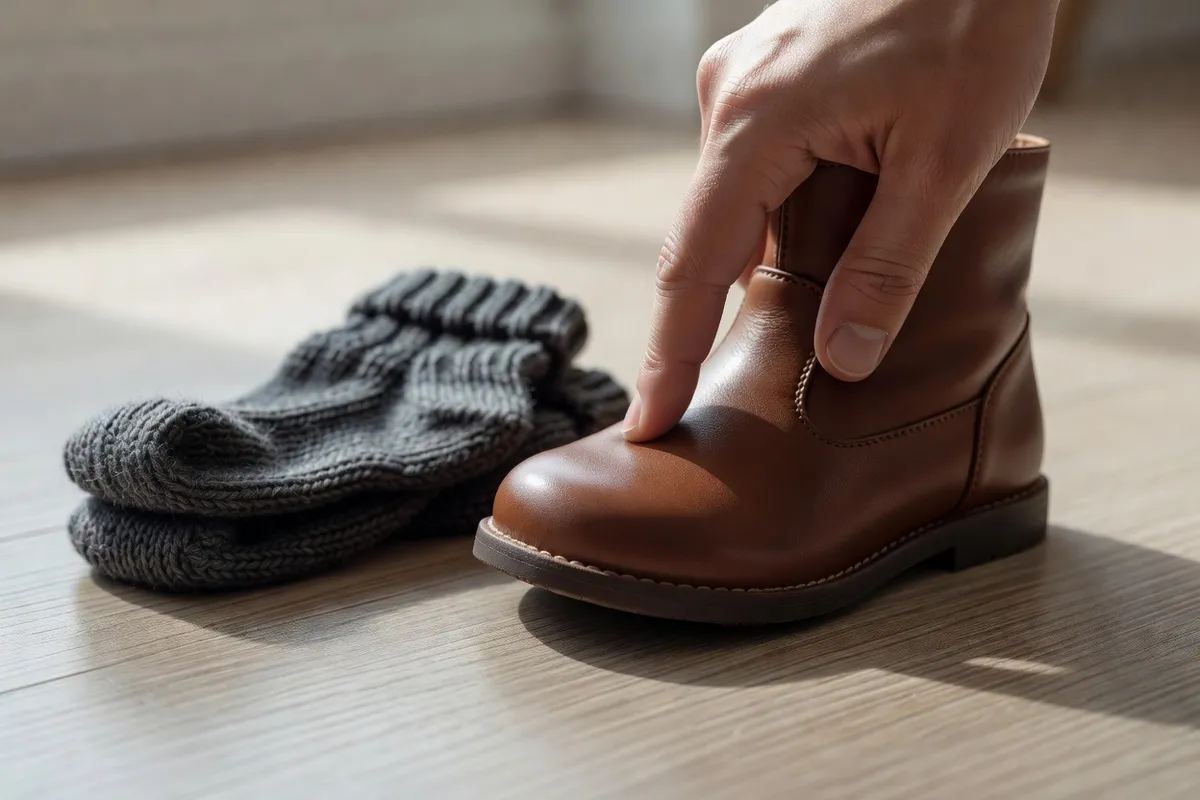
Parachute's winter outdoor safety guidance (2026) addresses what to put on the foot. It favours a single pair of socks, in wool or a wool blend rather than cotton. Parachute cautions that particularly thick socks may leave feet colder: they can limit blood flow as well as the air circulating around the toes. It's worth keeping the two recommendations in their original form. Room for another sock is not an instruction from the society to double up; Parachute's preference for a single pair isn't a reason to choose a tight boot.
A liner also has a claim on that space. In its 2026 FAQ, Kamik directs families to the size chart for the particular style and says to consider the sock and liner when a child falls between sizes. The company says most of its boots fit as sized, with some variation by style. In its account, a liner, especially when worn with thick socks, can make the larger size worth considering. That's guidance about Kamik's footwear, not a conversion rule for every lined boot.
There's a practical way to settle the between-sizes question without guessing at a foot-length chart. Compare how the two sizes fit with the intended liner and sock. If the smaller one crowds the sides and the larger one leaves the heel loose, neither has passed the whole check. Consider a different fit rather than counting on growth to resolve the loose heel or discarding the liner to make the smaller boot work.
Read the shell, sole and cold rating separately
A winter boot description can put a material name, a sole name and a temperature on the same line. They tell you different things. The Canadian Paediatric Society (2022) asks for some grip on smooth surfaces, not a particular outsole design. Its winter guidance (2023) asks for warmth and waterproof protection. When reading a description, look for which part of the boot a claim actually covers. A statement about the shell, for instance, describes the shell.
Kamik's Tundra Jr is a useful example of how to read those details without taking them as a recommendation. The following are the manufacturer's own 2026 specifications, not an independent assessment of the boot.
| Detail Kamik lists for the Tundra Jr (2026) | What to take from it at a fitting |
|---|---|
| Removable liner | Try the boot with the liner in place. A comfortable fit in the empty shell doesn't settle the size. |
| Waterproof Ground-CTRL rubber shell | The waterproof claim identifies a particular part. It doesn't tell you whether the inside of the child's boot is dry after play. |
| Grip XT outsole | This identifies the sole. The name alone doesn't establish how much grip the child will have on a particular surface. |
| Temperature rating of -32 °C | This is a maker's rating for the boot, not a temperature at which a child is advised to stay outdoors. |
Of those details, the removable liner is one a family can use immediately: take it out to look at the inside, then put it back before deciding on fit. The outsole needs a different kind of attention. Let the child take some ordinary steps and turn around. A comfortable walk indoors answers a question about movement; it isn't a test of traction on an icy path. There is no need to stage such a test to choose a size.
The same distinction helps when the attraction is a familiar material rather than a number. The comparison of mukluks and sheepskin boots looks at warmth across boot types. For a child, bring the decision back to the particular pair: what part is described as waterproof, how does it feel with the sock inside, and can the child walk comfortably? A description of the lining leaves each of those questions open.
The wet-boot check belongs at the door
Picture the end of outdoor play, when the child is ready to come in but still has a coat, mittens and boots to get out of. This is the point at which the Canadian Paediatric Society's 2023 winter advice is particularly concrete: remove wet boots as soon as play is over. Parachute (2026) likewise advises getting out of wet shoes and clothing promptly. It identifies wet clothing and footwear as major factors in frostbite and calls for dry boots that aren't tight.
Make the handoff clear if one adult brings the child in and another gets them ready to go back out. “The shell is waterproof” is a description of the boot. “The liner and socks are wet” describes what the next person needs to deal with. Undo the boot and check the inside instead of deciding by the look of the toe or the snow left on the mat. A removable liner gives you access to that part; its presence isn't a promise that the boot is ready for another outing.
For a day of slush rather than dry snow, the Montréal guide to boots, soles and socks considers the whole combination. The useful habit for a child's pair is to check in both directions: dry and comfortable when it goes on, out of wet footwear when play ends. If another outing is planned, base the choice on the condition of the pair now, not the condition it was in when everyone first left home.
A child on a sled needs an adult's attention
On a family walk, an adult pulling a sled and a bundled child riding on it are not doing the same thing. The Canadian Paediatric Society (2023) singles out babies and toddlers because they move less and can't tell an adult when they feel cold. A quiet passenger isn't providing the sort of feedback an older child might give about cold toes. The adult's comfort isn't a substitute for checking the child.
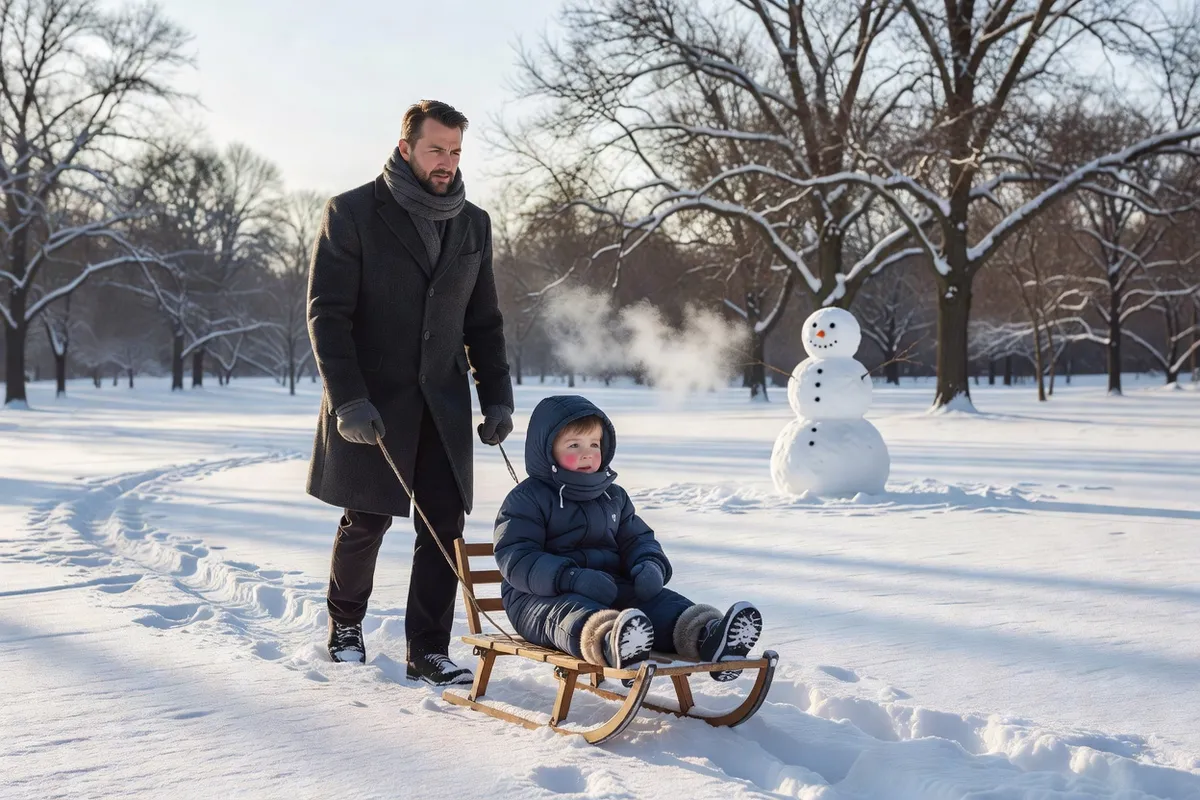
The society's 2023 winter clothing guidance puts boots in the company of layers that are easy to add or remove, a toque that covers the ears and mittens in preference to gloves. It describes warm hands and feet as a general sign that a child is adequately dressed. That is a check on the outfit, not a reason to stretch outdoor time. The winter layering interview explores how to put an outfit together; for decisions about children in the cold, keep the child-specific guidance close at hand.
Don't let a careful boot fitting draw all the attention down to the feet. Parachute (2026) notes that for children under three, the head accounts for a larger share of body size, making heat loss a particular concern. The Canadian Paediatric Society (2023) includes cheeks, ears, nose and fingers along with toes among the places frostbite most often affects. Before the sled leaves the door, there's as much point in seeing where the toque sits over the ears as there is in checking that the liner is in the boot.
Health Canada's 2021 guidance on extreme cold also identifies infants under one year as especially vulnerable to frostbite and hypothermia. Its advice concerns exposure to cold in general; it doesn't prescribe a boot or a sock for an infant. For a family deciding about a sled ride, that distinction matters. The question isn't just what to put on a small passenger. It's also whether to make the outing at all.
When the forecast changes the plan
Read the air temperature and the wind chill before deciding on outdoor play. Then keep the source of each threshold attached to the number. The organizations below aren't rating footwear, and their figures don't all describe the same decision.
The Canadian Paediatric Society's frostbite guidance (2023) suggests shorter outings at -15 °C or colder, taking wind chill into account even if the air temperature by itself would not reach that mark. It suggests staying indoors when either the temperature or the wind chill reaches -27 °C or lower. Shorter play and indoor play are different recommendations; reading only the indoor threshold misses the society's advice for the less severe part of a cold spell.
Parachute (2026) advises indoor play when the air temperature or wind chill is below -25 °C. It warns that exposed skin can freeze within minutes in those conditions. That's not the same cutoff as the society's -27 °C or lower. Reported side by side, the difference is useful: a family looking up a recommendation later can find the wording it actually read. Averaging the figures would produce a new cutoff endorsed by neither source.
Environment and Climate Change Canada's wind chill scale (2025) answers a different question again. It describes general exposure risk. Wind chill values from 0 to -9 fall in its low-risk band. From -10 to -27 it describes moderate risk, including discomfort and the possibility of hypothermia or frostbite with prolonged exposure and inadequate protection. At values from -28 to -39 the risk is high; the department gives a window of 10 to 30 minutes in which exposed skin can freeze. That window is a warning about exposed skin, not an allowance for play.
Health Canada (2021) likewise notes that the general risk of windburn and frostbite rises with wind chill below -27. None of these figures becomes more favourable because a boot carries a colder rating. If the plan calls for staying inside under the child-specific guidance you're consulting, a different liner doesn't change the forecast.
What to keep from the try-on
By the time the boots come off the bench, a family should be able to describe the fit without mentioning the size: where the heel rests, how much room the longest toe has, whether the sides feel close and how the child walks. Keep the socks that went with that assessment in mind. If the pair later feels tight with different socks, there's a useful comparison to make before assuming the child's feet have grown.
Leave a little room in the routine, too. At the door, there's the chance to notice a damp liner before putting the boots back on. Before play, there's time to read the wind chill and change plans. Later in the season, the child can stand in the same boots again and show what's changed. Those small decisions are more useful than asking a size label or a cold rating to speak for the whole winter.
Frequently asked questions
How much space should there be at the front of a child's winter boot?
For children's footwear, the Canadian Paediatric Society (2022) suggests about 1.25 cm beyond the longest toe while the child stands, plus 5 mm of room beside the toes. Check that the heel fits snugly as well.
Should I go up a size to get through the winter?
Choose by the fit now, not by a predicted end-of-season size. The Canadian Paediatric Society (2022) recommends a try-on before purchase; its estimates of foot growth are not a timetable for an individual child.
Does a child need to wear extra socks in winter boots?
The Canadian Paediatric Society (2023) looks for space to accommodate an extra pair and allow toe movement. Parachute (2026) favours one pair in wool or a wool blend and cautions against very thick socks.
How does a removable liner affect sizing?
Fit the boot with the liner inside. Kamik's 2026 FAQ says its liners occupy space and advises taking the planned socks and liner into account when choosing between sizes.
Does a cold rating mean it is safe to play outside at that temperature?
No. For play decisions, consult child-specific guidance. The Canadian Paediatric Society (2023) and Parachute (2026) each give an indoor-play threshold based on temperature or wind chill, not on the rating printed on a boot.
Sources
Verified on
- Société canadienne de pédiatrie, Footwear for children, Société canadienne de pédiatrie, 2022.
- Société canadienne de pédiatrie, Winter safety: Advice for parents and kids, Société canadienne de pédiatrie, 2023.
- Société canadienne de pédiatrie, Frostbite, Société canadienne de pédiatrie, 2023.
- Parachute, Winter outdoor safety, Parachute, 2026.
- Santé Canada, Extreme cold (It's Your Health), Gouvernement du Canada, 2021.
- Environnement et Changement climatique Canada, Wind chill and the Wind Chill Index, Gouvernement du Canada, 2025.
- Kamik, FAQs (Product Care & Use), Kamik, 2026.
- Kamik, TUNDRA JR Winter Boots, Kids, Kamik, 2026.