

Marianne Kowalchuk
winter stylist in Winnipeg
This interview is with an expert imagined for this guide.
For deep cold, start with a base layer that moves moisture away, removable insulation and a wind-resistant shell. Cover your hands, feet, ears and nose, and adjust your outfit before you sweat. Marianne Kowalchuk, a winter stylist in Winnipeg and an expert imagined for this guide, explains how to dress for the walk and the wait that follows. At a wind chill of -30, a reading Environment and Climate Change Canada (2025) classifies as high risk, plan where you can get indoors, too.
Read the forecast before opening the closet
When someone says it's -30 out, what do you want to know first?
Is that the air temperature or the wind chill? An air temperature of -30 °C isn't another way of saying the wind chill is -30. In the wind chill chart from Environment and Climate Change Canada (2025), an air temperature of -20 °C with a wind of 20 km/h gives a wind chill of -30. At the same air temperature, a 40 km/h wind brings that index to -34. The thermometer hasn't changed, but the exposure you need to plan for has.
That distinction matters when the route changes from a sheltered block to an open stretch. Environment and Climate Change Canada (2025) puts wind chills from -28 to -39 in its high-risk band and says exposed skin can freeze within 10 to 30 minutes under those conditions. That's a description of risk, not a countdown to use for an outing. The clothing question is where you can cover up before heading out; the route question is where you can get inside.
Winnipeg's climate normals for the Richardson airport station, published by Environment and Climate Change Canada (2025) for 1991–2020, put the January daily mean at -16.3 °C. The average January had 5.3 days when the daily high was -20 °C or colder. That last figure describes days that stayed cold even at their warmest, not the number of mornings that reached that temperature. Neither figure tells you what you'll encounter on the way home.
Give each layer a job
What belongs against the skin on a day when you'll be moving and stopping?
Start with the garment you're least likely to change along the way. The Canadian Centre for Occupational Health and Safety's cold-weather guidance (2025) calls for an inner layer that insulates and moves moisture away from the skin. It lists wool, polyester and polypropylene as options. It advises against cotton because it gets damp readily and loses its insulating ability. Staying dry is part of the job, not something to think about only after you've chosen a coat.
Put the base layer on and try it under everything else. Reach forward as if holding a bag, bend to fasten a boot, then sit down. The question isn't how trim the shirt looks on its own. It's whether the sleeves sit comfortably inside the next layer and the hem stays where you want it when you move. A shirt that needs to be rearranged every time you reach up is a poor foundation for that particular outfit.
The centre notes that wool and synthetic fibres retain warmth when wet. That doesn't make a damp base layer one you should plan to spend the rest of the outing in. If the day starts with a brisk walk and ends with you standing around outside, make the upper layers easy to adjust rather than expecting the shirt to handle that change on its own.
The winter layering guide lays out the roles of the whole outfit. It helps to read those roles as a list of jobs, not a shopping list. Start with the clothes you already have and see which piece does each job without getting in the way of another.
How do you divide the work between the middle layer and the shell?
The middle layer is where you want room to make a change. The Canadian Centre for Occupational Health and Safety (2025) points to the insulating role of air held between layers and recommends middle layers that can be opened or taken off easily. A mid-layer you can remove without pulling everything else over your head makes for a simpler change when you get to shelter. Ease matters more here than how neatly the pieces match.
The shell has a different assignment. A wind-resistant outer layer belongs on the exposed part of the route. For wet conditions, the centre calls for a waterproof outer layer. Think about the shell with the rest of the outfit underneath: can you close it without catching the middle layer in the fastening? Can you reach the pockets you intend to use? Try both with your hands covered.
| Part of the outfit | Job to give it | What to check before leaving |
|---|---|---|
| Base layer | Insulate and move moisture away from the skin | Sit and bend without having to straighten the hem afterward. |
| Middle layer | Provide insulation you can adjust | Open or remove it without disturbing the rest of the outfit. |
| Outer layer | Resist wind; provide waterproof coverage in wet conditions | Fasten it over the layers you'll actually wear. |
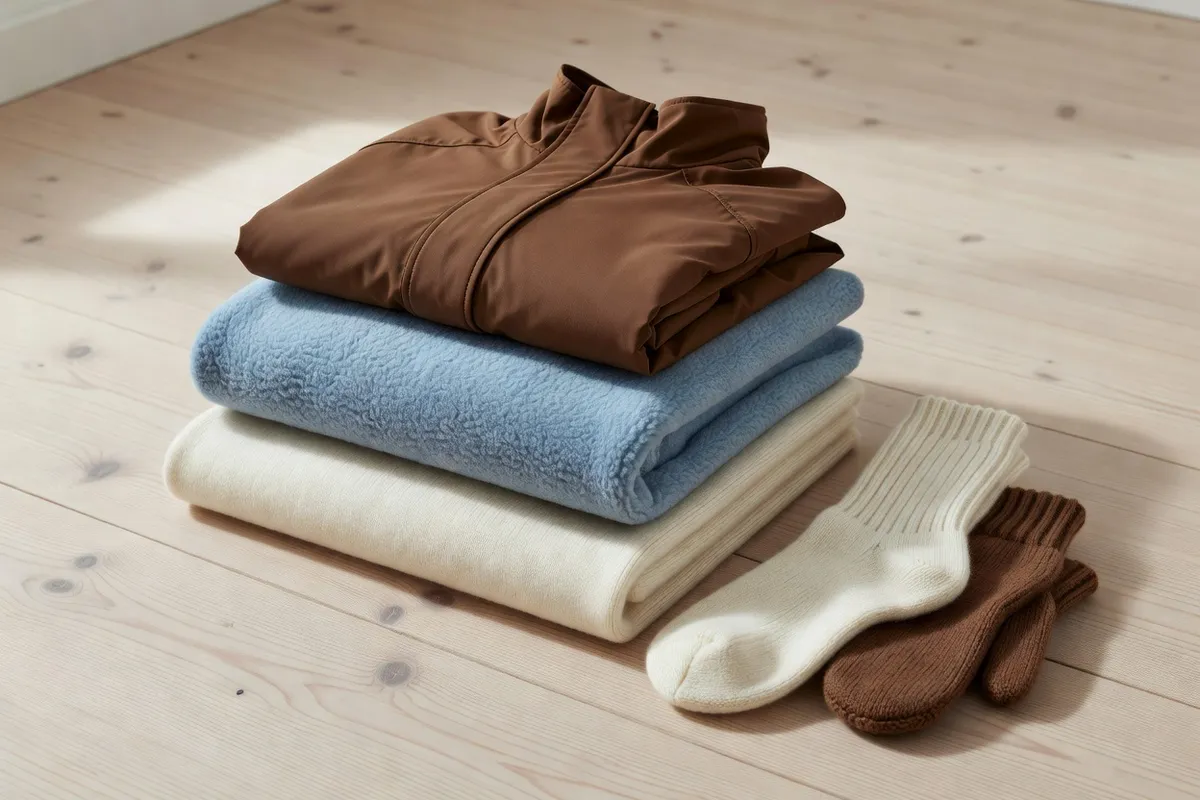
Make room to move from the waist down
What changes when you layer under winter pants instead of under a coat?
The fit check becomes more about bending and sitting. Try the base and outer layers together, then take a seat and reach for your boot fastenings. Stand up again without straightening the clothes first. Check where the fabric gathers behind the knees and at the boot tops. If the outfit needs attention every time you sit or stand, change the combination at home, where you can see which garment is causing the trouble.
Look at the junction between pant cuff and boot. Arrange the sock, base layer and outer pant as you intend to wear them, then check that each stays put when you step up or crouch. A waistband that works on its own also needs to work under the coat when it's closed. These are simple dressing checks, but they're easier to do with the whole outfit on than to diagnose on the way out.
Think about where an outer pant comes off. If you need a place to sit and take off your boots, that's fine when there's a change room at the destination. It's less practical if the only stop between walking and waiting is a standing-room entrance. Use the actual destination to decide how much adjusting you expect to do there.
Wet conditions bring a different clothing problem from dry cold. The guide to boots, soles and socks for Montréal's slush season picks up that side of the wardrobe. Don't treat an outfit chosen for wind on a dry day as a complete plan for a wet route.
Dress for the change of pace
How would you dress for a brisk walk that ends at an exposed transit stop?
Start at the stop and work backward. If you expect to stand still in the wind, you need to arrive with the insulation and coverage for that part of the trip, even if you won't want every piece fastened for the walk. If there is a sheltered spot before the stop, use it to add back anything you took off. Don't make the stop itself the place where you sort through a bag for your mitts.
Environment and Climate Change Canada's winter guidance (2026) recommends taking off a layer before you start to sweat and using a wind-resistant outer layer. Those ideas work together when the insulation is independently adjustable. On a sheltered part of the route, you can open or remove a mid-layer and close the shell again before you go back into the wind. If there's nowhere suitable to adjust, walking less briskly may be more practical than planning a clothing change on the move.
Check the wait, not just the walk. In the high-risk wind chill example, a route that lets you stay inside until nearer departure is a different proposition from one that leaves you outside with no clear end to the wait. An extra layer doesn't fix the uncertainty. Think about where you can turn back or step back in if the timing changes.
At the door, make sure you can manage the trip with your hands covered. Keep what you need for boarding somewhere you can get to it without undoing the entire coat. That's one less reason to stand in the wind with the outfit partly open.
What does the same approach look like at an outdoor rink?
If conditions are suitable for skating, distinguish getting ready, skating and standing at the boards. The clothing you want while moving isn't necessarily what you want while waiting for someone else to finish lacing up. If there is an indoor change area, decide there what you will wear onto the ice and where you'll keep the layer for the pause. If there's nowhere to change, don't build the outing around taking clothes off outdoors.
Do the movement check in the full kit. Bend as you would to lace your skates, turn your head with the neck warmer in place, and see how the mitts work with the fastenings you need to handle. Do those jobs inside if you can. It's better to uncover a collar that catches or a cuff that won't sit under a sleeve before you're out by the boards.
The pause is part of the outing. If you feel yourself getting too warm while skating, head to shelter to adjust rather than waiting until you're damp. If clothing does get wet, Environment and Climate Change Canada's winter guidance (2026) calls for changing out of it. That makes access to a dry change more useful than bringing another piece to put on top of everything.
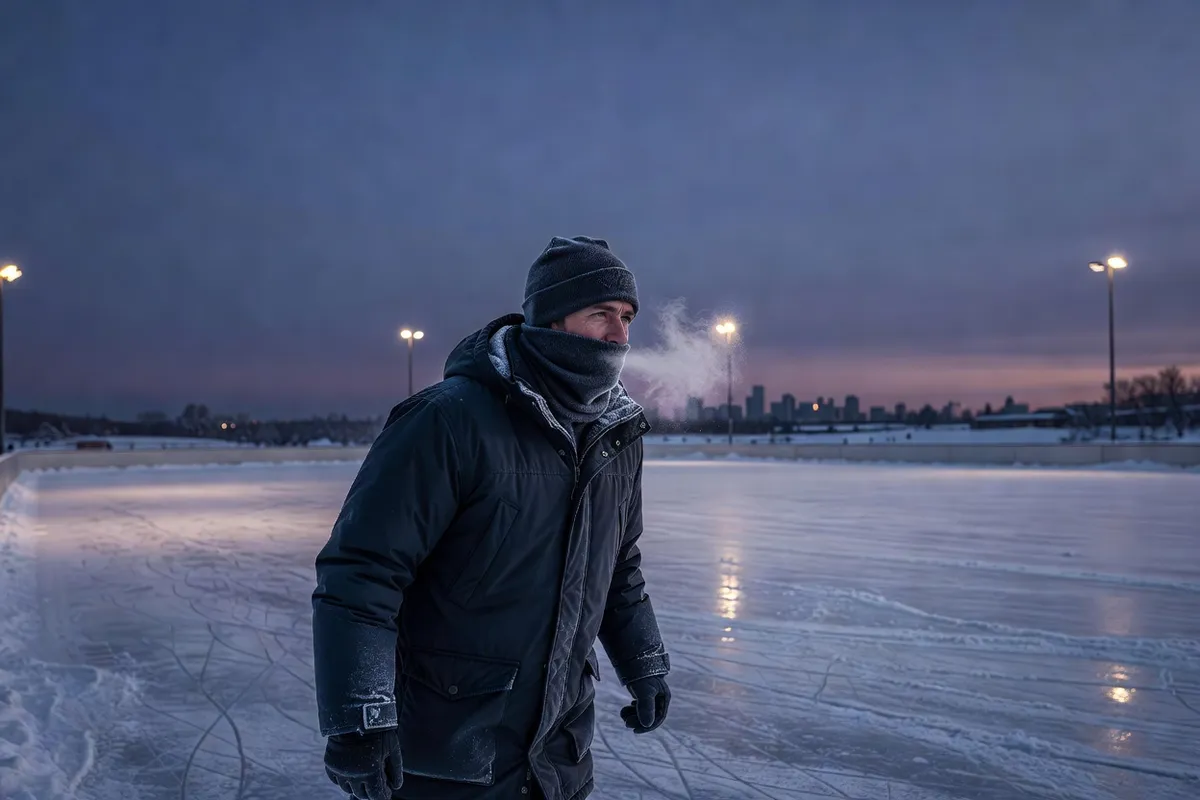
Check the openings around the coat
How do you cover hands, ears and face without making the outfit awkward to wear?
Put on the toque, mitts and face covering before doing up the coat. Then turn your head, look down and reach forward. Check that the toque still covers your ears when you turn and that the sleeve meets the mitt cuff when you extend your arm. Arrange the scarf or neck warmer so it covers the nose without blocking your view. If the pieces shift as soon as you move, try another arrangement indoors instead of counting on keeping them in place by hand.
Health Canada's guidance on extreme cold (2021) identifies hands, feet, nose and ears as areas commonly affected by frostbite. Its prevention advice includes a wind-resistant outer layer, warm socks and gloves, a hat, and a scarf over the nose. Environment and Climate Change Canada (2026) also advises covering exposed skin in extreme cold. The coat's fit is only one part of checking that coverage.
Choose between mitts and insulated gloves by trying the tasks the outing requires and looking at where you can do those tasks under shelter. Can you close the outer layer? Can you reach your keys? If a fastening requires more dexterity, do it before you head out or after you get inside. There's no universal temperature rating here to settle the choice for you.
Read footwear claims in context
What should someone check about socks and boots before trusting a temperature rating?
Put the boots on with the warm socks you intend to wear, close them as you would outdoors and walk around indoors. Check for a fold under the toes, pinching over the foot or a sock that bunches when you take a step. If a thicker pair creates a fit problem, treat that as a reason to reconsider the combination, not as a trade-off you have to accept to dress for deep cold.
Look at the precise claim for the footwear, too. According to Manitobah (2026), its sheepskin-lined mukluks and boots are designed for temperatures as low as -32 °C in cold, dry weather. That's the manufacturer's own claim, not an independent test. It doesn't describe a wet route, give an equivalent wind chill rating or tell you how long to stand outside. The conditions are part of the claim, not a detail to drop when you compare boots.
The comparison of mukluks and sheepskin boots looks more closely at those footwear choices. The guide to what sheepskin does and doesn't do in the cold takes up the insulation question. For this outfit, the check is narrower: can you wear the boot, sock and pant cuff together without having to undo one piece to make another fit?
Give the return leg the same attention as the trip out. If you expect a wet stretch, look at footwear for those conditions rather than relying on a claim for dry cold. If the change of clothes you are counting on includes dry socks, keep them with the things you can reach indoors. They won't be much use if the bag they're in doesn't travel with you. If children are coming along, the guide to kids' winter boots covers fit and growing feet.
Use indoor stops to reset
What do you do with the layers when the trip includes a heated building?
Treat the indoor stop as part of the clothing plan. If you're staying long enough to get too warm in the coat, open or remove layers there rather than walking around fully bundled. Give them a place to go where you can gather them easily for the return. If it's a short errand and there's nowhere to put the coat down, an easy-to-open front is more practical than an outfit that needs a full rearrangement.
When something is damp, work out what you can change. Health Canada (2021) advises changing out of wet clothing promptly. If a dry base layer is available, the heated stop is where it can actually be used. If the only dry item you carried is another mid-layer, that still leaves the wet layer against the skin. The distinction matters when deciding what to pack for a trip with an active stretch.
Put the outside outfit back together before you step through the door. Close the shell, check the face covering and get the mitts on. If you took out a layer indoors, make a deliberate choice about putting it back instead of carrying it out by default. Consider the pace and any wait on the return route. It might not match the trip in.
This is where a pocket you can reach or a coat you can open easily earns its place. The better outfit isn't the one that takes the longest to put on. It's the one you can take apart and reassemble where the trip allows it.
Know when to change the outing
When is the answer to go out for less time rather than put on more clothes?
When the plan depends on things you can't count on: a connection with an uncertain wait, a shelter that might not be open, or a long exposed stretch with nowhere to stop and adjust. If the trip is optional, shorten it or move it to another time. If it's a trip you need to make, consider a route with a known indoor stop or a way to wait inside until nearer departure.
Decide what would make you turn back before leaving. That can be as ordinary as finding that the place you planned to warm up is closed or realizing that the layer you meant to keep dry is already wet. At a high-risk wind chill, the official exposure guidance isn't a promise that a particular coat or pair of boots will buy you enough time to improvise.
The final check is to picture the least convenient part of the trip. Can you close the shell there without taking your mitts off? Do you have a way to get out of the wind before adjusting the middle layer? Is the last stretch a walk straight to a door or a wait outside it? If an answer depends on an assumption about the route, fix the route first.
A workable outfit for deep cold leaves you with choices: insulation you can remove before sweating, coverage you can put back on under shelter and a dry change you can reach if you need it. The option to end the outing belongs in that plan just as much as the shell and mitts do.
Frequently asked questions
Is an air temperature of -30 °C the same as a wind chill of -30?
No. The air temperature is the thermometer reading; the wind chill index reflects the effect of wind on exposed skin.
What should I wear next to my skin in deep cold?
The Canadian Centre for Occupational Health and Safety lists wool, polyester and polypropylene as options for an insulating base layer that moves moisture away from the skin.
Which layer should I adjust if I start getting too warm?
In shelter, open or remove an insulating layer before you sweat, while keeping the wind-resistant outer layer available for the next exposed stretch.
Should I wear thicker socks if my winter boots feel cold?
Check the fit with the socks you plan to wear before adding bulk; the thicker pair is not a good choice if it makes the boot pinch or bunches inside it.
Does a boot temperature rating tell me how long I can stay outside?
No. A manufacturer's claim applies to the footwear and conditions it describes, not to how long a person can safely stay out.
Sources
Verified on
- Environnement et Changement climatique Canada, Wind chill and the Wind Chill Index, Gouvernement du Canada, 2025.
- Centre canadien d'hygiène et de sécurité au travail (CCHST), Cold Environments - Control Measures, Centre canadien d'hygiène et de sécurité au travail (CCHST), 2025.
- Santé Canada, Extreme cold (It's Your Health), Gouvernement du Canada, 2021.
- Environnement et Changement climatique Canada, Be prepared for winter weather, Gouvernement du Canada, 2026.
- Environnement et Changement climatique Canada, Canadian Climate Normals 1991-2020 Data: WINNIPEG RICHARDSON (AIRPORT), Gouvernement du Canada, 2025.
- Manitobah Mukluks, Frequently Asked Questions (FAQ), Manitobah Mukluks, 2026.