
Choose a winter boot treatment by the maker's instructions for the pair, not by the word waterproof on a can. Some untreated suede and sheepskin boots call for a repellent; some boots shouldn't be sprayed at all. For smooth leather, distinguish a conditioner from the protective finish, and use wax or grease only if the maker specifies it. Start with the surface in the condition the directions require, allow the full drying time and follow the product's guidance on renewal.
Read the boot label before the treatment label
At the boot rack, the useful question isn't quite “What keeps water off leather?” It's “What does this pair need that it doesn't already have?” A boot described as waterproof by its maker, a suede boot sold with a repellent treatment and an untreated leather boot present different starting points. If all you know is that the boots are brown leather, you know something about their appearance but not enough to choose a finish.
Manitobah's care FAQ makes the distinction particularly clear. In its 2026 guidance, the company says most of the suede and leather it uses has not been treated and is not waterproof. It identifies its sealed styles with a waterproof label. For its non-waterproof suede and leather, it recommends a silicone-based protector suitable for the material. That's a way to care for the unsealed pair, not a way to give it the same construction as the sealed one.
The decision can look quite different one space over on the same boot rack:
| What you can establish about the pair | What the maker's directions support | What not to assume |
|---|---|---|
| Manitobah identifies the suede or leather as non-waterproof | Use its recommended type of leather or suede protector, avoiding fur | The treated pair is now a sealed style |
| A Bearpaw sheepskin or suede style already has BearCoat | Recognize the exception in Bearpaw's before-first-wear advice | Every new pair needs another coat |
| The boots are Kamik | Leave off aftermarket sprays, chemical treatments and coatings, as Kamik advises | A product labelled for winter footwear is suitable |
| Pajar's smooth-leather directions apply | Condition the dry leather, then use an appropriate waterproofing finish | Any tin of wax will do both jobs |
Keep the care information for the boots beside the directions for the treatment. The former answers whether to treat; the latter tells you how to use that particular product. For a pair that's dirty, wet or marked, the guide to boot care and cleaning is a more useful starting point than the applicator. What the boots need this evening may be cleaning rather than another finish.
Suede: look at the nap and the edge of the fur
On suede, a patch that looks different from the rest of the toe invites attention. Before reaching for a spray, decide what you want it to do. If the job is to clean a mark or put the nap back in order, a protector isn't the step Pajar starts with. Its 2024 care guide puts cleaning first, followed by restoring the nap. Only then does it suggest considering a suede protector, to be applied as its manufacturer directs.
There are two useful details in that sequence. One is the pause after cleaning: you get to look at the suede as suede again, rather than judging the need for a treatment by a dirty patch. The other is Pajar's choice to make the spray an option. The guide doesn't prescribe a coating for every occasion when you clean the boots. If you do use a protector, choose one appropriate to the pair; don't substitute the leather finish from another part of the care kit simply because it's already open.
For Manitobah's non-waterproof suede, the reason for protection is more specific. The company describes the material as soft and porous, able to take up water. It recommends a protective spray but draws a firm boundary at the fur. According to Manitobah, the fur has protective oils of its own. On a pair with a fur edge, identify where the suede ends before beginning the application. A direction to cover the suede doesn't extend to the trim, even where the two meet.
That boundary matters more than making the whole boot look uniformly treated. If the product directions aren't clear enough for you to apply it to the intended area without spraying the fur, leave the can down and check with the maker. Nor is an application a substitute for dealing with a wet pair afterwards. Manitobah calls for thorough drying and local cleaning when its boots get wet. It doesn't say that using a protector takes those chores off the list.
Does smooth leather call for wax?
A tin of wax and a bottle of conditioner offer a choice only if both are relevant to the leather in front of you. In its 2024 guide, Pajar describes two jobs for smooth leather. Once the leather is dry, it advises conditioning it. A waterproofing treatment comes afterwards as protection against future marks and damage. If you're following that guidance, read the names of the jobs separately. Finishing the conditioning step doesn't tell you which finish to apply next.
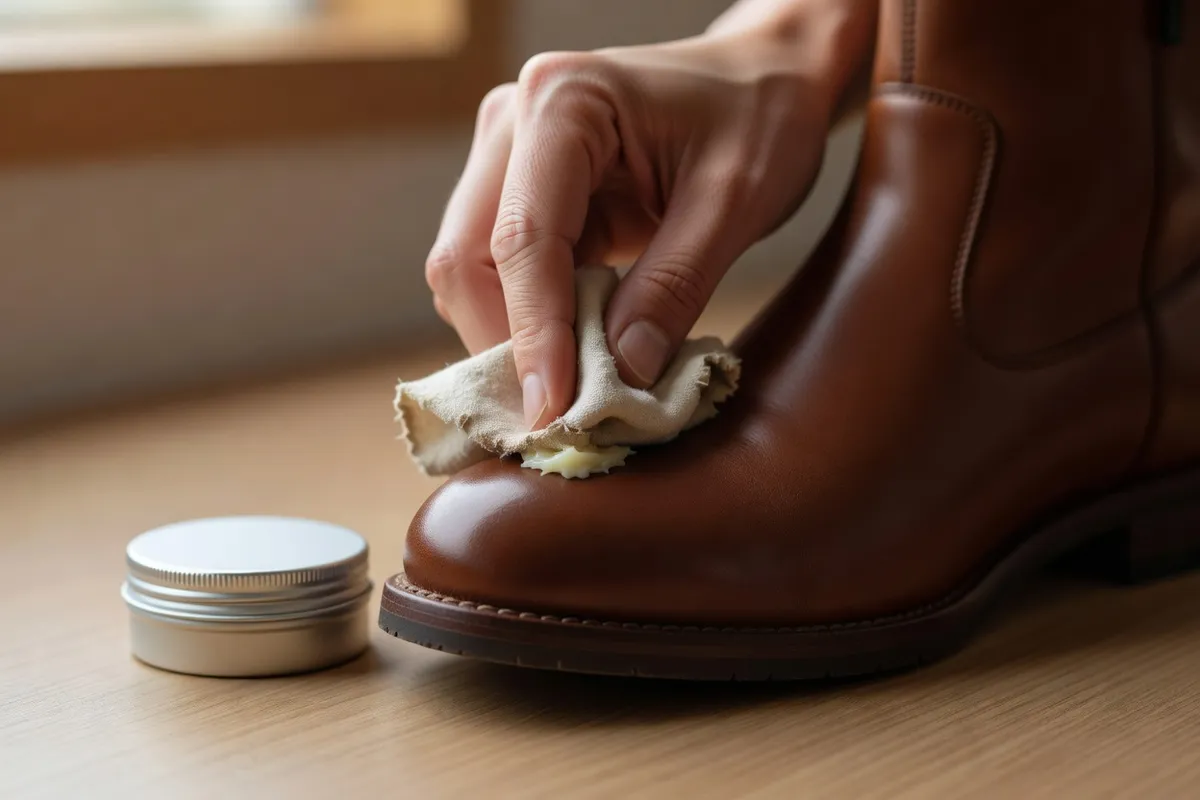
Waxing a leather toe is a recognizable gesture, but it's not an instruction for every leather toe. Look for an explicit match between the boot maker's advice and the treatment you have in hand. Does the advice actually name wax for this leather, or does it say only to use a waterproofing treatment? Does the product describe the surface on your boots? Apply the same questions to grease. Neither the look of smooth leather nor the absence of suede establishes that grease is called for.
A change of applicator doesn't get around a maker's restriction, either. In its product care FAQ, Kamik advises against not just waterproofing sprays but chemical treatments and coatings on its boots. It cites the possibility of material damage and a change in performance. Kamik also says in its 2026 FAQ that using products it doesn't recommend, including waterproofing sprays, may void its one-year warranty. A finish rubbed on with a cloth isn't a sensible workaround for that advice.
For the leather pair whose care note you can no longer find, frame the question to the maker narrowly: identify the style and ask which, if any, finish belongs on its smooth leather. That's more useful than asking which is better, wax or spray, without naming the boot. In the meantime, there's no need to experiment on the visible toe or borrow a routine intended for another pair.
Sheepskin before its first outing
With a new pair, read past the material name to the description of the finish. Bearpaw's 2026 instructions recommend a repellent intended to protect suede against water and stains before the first wear of its sheepskin and suede products. The exception is a style already treated with BearCoat. Two pairs can therefore carry the same material description and call for different decisions before they leave the house.
If you still have the style information, check it for that treatment rather than trying to recognize a factory finish by colour. The practical point of the exception is that you don't have to add something just to complete a new-boot ritual. On the other hand, the fact that one Bearpaw style has the treatment isn't a reason to assume another does. If the description is unclear, resolve that question before opening the repellent.
Cleaning is a separate matter, particularly on a pair that's already been worn. In its 2026 cleaning guidance, EMU Australia advises trying a cleaner on a small, concealed part of the sheepskin before using it more widely. It cautions against vigorous scrubbing because that can remove lanolin and other natural oils. That's advice about a cleaner and how the surface is handled. It isn't an endorsement from EMU Australia of a waterproofing spray, nor does a satisfactory cleaning result establish that a repellent is suitable.
When looking up a pair, distinguish the description of the boot from the name of the area you intend to treat. “Sheepskin boots” is useful for finding the guide to sheepskin footwear; it's less precise as an instruction to coat a whole boot. For care, identify the exterior surface, any trim to be left alone, and any existing finish. That gives a question about a spray a definite object: this surface on this style.
Plan a spray application backwards from the next wear
For a pair that does call for spraying, check the drying directions before setting out the boots. Bearpaw specifies 24 hours to dry in the 2026 directions for its water-resistant spray. If the pair is needed for the next morning and that time isn't available, pick another occasion for the job. The company gives a drying time, not a suggestion to wait just until the surface looks ready.
Preparation also belongs to the particular product. Bearpaw directs users of its spray to begin with footwear that's both clean and dry. A boot fresh from being cleaned hasn't met that description if it's still damp. Choose a well-ventilated place to work, as Bearpaw instructs, and apply the product to cover the intended surface without drenching it. The instruction is about coverage, not saturation. Don't import an application distance or a number of coats from the directions for a different can.
Read the package to see what sort of applicator you're holding. For an aerosol, there's relevant general guidance in Health Canada's chemical safety information for art teachers. The 2026 reference concerns art-class products, not footwear treatments. It explains that compressed gas disperses a coating in fine particles, which can enter the airways and remain there. It also identifies aerosols as highly flammable. Bearpaw's ventilation instruction is product-specific; Health Canada's discussion helps explain why the setting deserves attention when the container is an aerosol.
Health Canada advises following the label, using brief bursts in a well-ventilated area and keeping aerosols away from flames and children. It favours a non-aerosol option when possible. In the boot-care cupboard, that last point still has to be reconciled with the boot maker's instructions. It doesn't make a rub-on coating suitable for a boot whose maker rules out coatings. If you don't have both a suitable product and a suitable place to use it, the application can wait.
A bead on the toe isn't a verdict on the whole boot
After treatment, it's tempting to read the surface like a little weather report. A drop sitting on top of the leather is easy to see; the construction underneath isn't. The drop describes what water is doing at that spot. It doesn't identify a factory treatment, certify the whole pair as waterproof or settle how comfortable its interior will feel on the next outing.
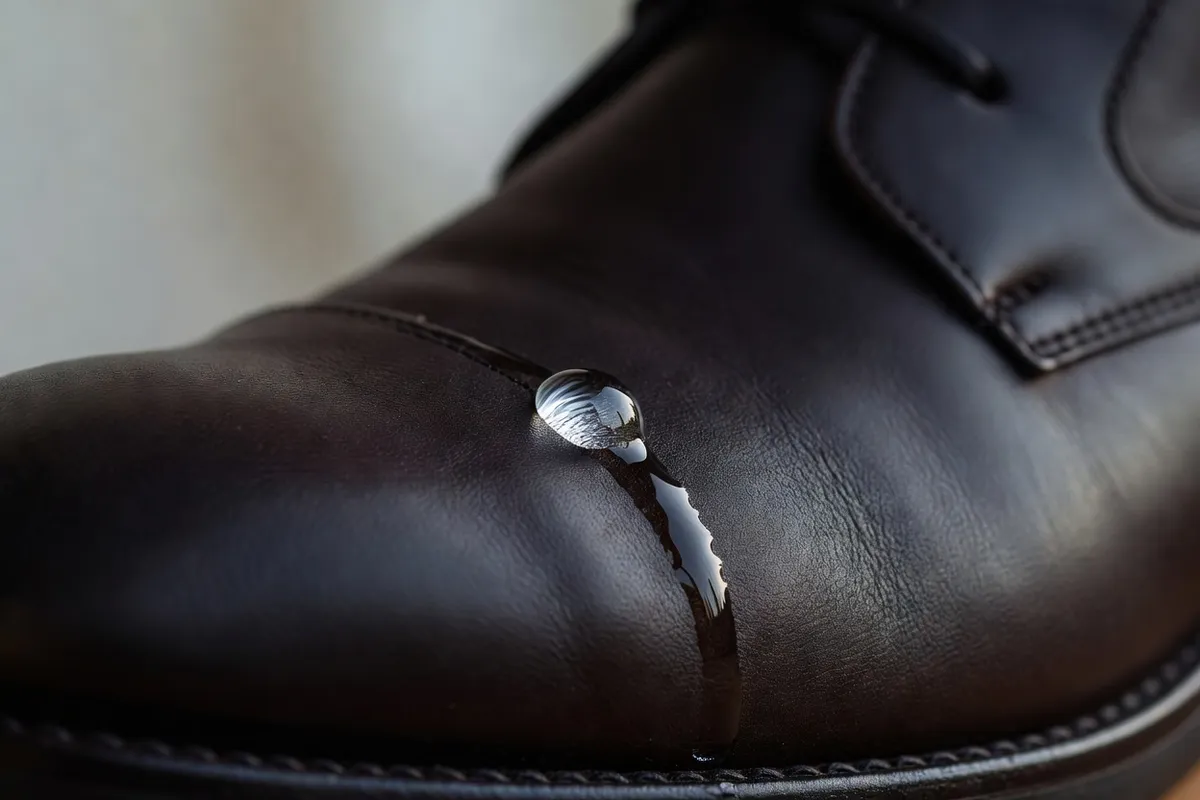
Manitobah's explanation of its own boots illustrates why the inside and outside can tell different stories. The company says its porous, non-waterproof leather and suede need to breathe to perform in extreme cold. Its sealed waterproof styles, by contrast, breathe less. According to Manitobah, perspiration can make the inside of a sealed pair feel damp. A damp interior alone, then, doesn't tell the wearer that a coating has failed or that more needs to be applied.
Suppose the question at the end of an outing is “Should I spray the toes again?” First separate what you know from what you felt. The style description can establish whether Manitobah calls the pair sealed. The care note can establish whether it recommends a protector. Dampness inside cannot establish either of those things. There's no need to diagnose exactly where the moisture came from in order to set the spray aside and give the boots the drying attention they need.
The distinction also helps before a slushy walk. Choosing a pair for wet conditions is a different decision from maintaining the suede on a pair you already own. The guide to boots for Montréal slush looks at the footwear choice. A care product should not have to stand in for a waterproof designation the boot maker didn't give the pair.
Back at the door: dry, clean or seek repair?
Wet boots on the mat present a more immediate task than choosing a finish. For its own pairs that have taken on water, Manitobah advises drying them thoroughly and spot-cleaning. Pajar's 2024 guide describes a drying setup: give the boots shape with newspaper or a boot shaper, and place them out of direct sun, clear of heaters and radiators. Pajar cautions that direct heat can distort the materials or cause cracking. The inviting spot against the radiator is the one to pass over.
Keep the purpose of that drying step in view. Drying a wet boot prepares it for the care that belongs to its material. Drying after a spray application is part of the instructions for the spray. They're not interchangeable waits. If the Bearpaw pair came home wet, the drying time specified for Bearpaw's spray doesn't start on the mat when you take the boots off. Its directions call for a clean, dry surface before the repellent goes on.
A pale salt mark raises yet another question. If it's the mark you want to remove, start with material-specific care for salt-stained boots, not with a protective finish meant for future exposure. Once the cleaning is done, return to the surface you actually have. For suede under Pajar's guidance, that means attending to the nap before considering a protector. For its smooth-leather routine, dryness comes before conditioner.
If what looked like a mark turns out to be a crack in the leather, the original plan no longer fits the problem. Pajar describes its finish as protection against future damage, not as a way to mend existing damage. The boot repair interview on cracked leather and road salt takes up that distinction. It's a good reason to look closely at the toe before spending the evening treating it.
Reapply by the directions, not by the calendar
There is no shared renewal interval in these makers' routines. Bearpaw's before-first-wear advice answers a question about a new pair. Its drying time tells you when a particular application has had time to dry. Neither is a timetable for the next coat. Pajar's suggestion to consider a protector after caring for suede likewise doesn't say that every cleaning must be followed by spraying. And for Kamik boots, scheduling a regular coating would miss the company's advice altogether.
A useful note to keep with the boots is short: the style, any treatment already identified by the maker, the compatible product if one is called for, and its directions for use. When you apply it, note when the pair will be ready to wear. If the product gives a renewal instruction, keep that wording rather than replacing it with a reminder copied from another pair. If it gives none, ask about that product and style rather than guessing at a weekly or seasonal routine.
Next time the boots come off, let the condition in front of you determine the question. A wet pair needs a place to dry. A marked toe needs the right cleaning guidance. A clean, dry pair with an explicit instruction to renew its protector is the one to set out for treatment. That leaves room for a perfectly good outcome that's easy to overlook at the boot rack: the right pair, ready to wear, with nothing more added.
Frequently asked questions
Can I waterproof suede winter boots with a spray?
If the boot maker recommends it, use a protector intended for the suede in question and follow its directions. Manitobah recommends a silicone-based protector for its non-waterproof suede, while Kamik advises against waterproofing sprays on its boots.
Should I use wax or grease on smooth leather?
Use either only if the care directions for the pair identify it as suitable. Pajar distinguishes conditioning dry leather from applying a protective finish; its sequence is not a blanket recommendation for wax or grease.
Do new sheepskin boots need treatment before first wear?
Check the style. Bearpaw recommends a suede water and stain repellent before its sheepskin or suede products are first worn, but makes an exception for styles already treated with BearCoat.
How long should I let sprayed boots dry?
For its own water-resistant spray, Bearpaw's 2026 care directions specify 24 hours. Use the time on the applicable product instructions rather than transferring that figure to another treatment.
How often should winter boots be waterproofed again?
Follow any renewal directions for the particular boot and compatible treatment. A first-wear instruction, a drying time or a damp lining does not establish a reapplication interval.
Sources
Verified on
- Manitobah Mukluks, Frequently Asked Questions (FAQ), Manitobah Mukluks, 2026.
- Bearpaw (site canadien officiel), Bearpaw Technology and Care, Bearpaw (site canadien officiel), 2026.
- Kamik, FAQs (Product Care & Use), Kamik, 2026.
- Pajar, Cleaning Winter Boots: A Pajar Maintenance & Care Guide (5 août 2024), Pajar, 2024.
- EMU Australia, Care & Cleaning (support article), EMU Australia, 2026.
- Santé Canada, Information for Art Class Teachers: Chemical Safety / Information à l'intention des professeurs d'arts : sécurité chimique, Gouvernement du Canada, 2026.